

Admin: Iran War Cost $25B. CNN: Real Cost $50B. Iran War Tracker: $67B.
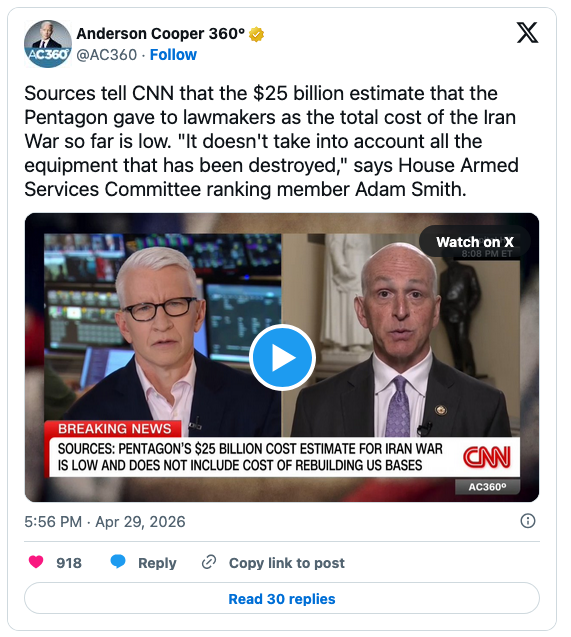
A top Trump administration official told members of the U.S. House Armed Services Committee yesterday that the war in Iran has cost $25 billion, a price tag that does not include repairing the bases in allied countries that Iran wrecked in retaliation, sources told CNN. The real cost, they said, is between $40 and $50 billion.
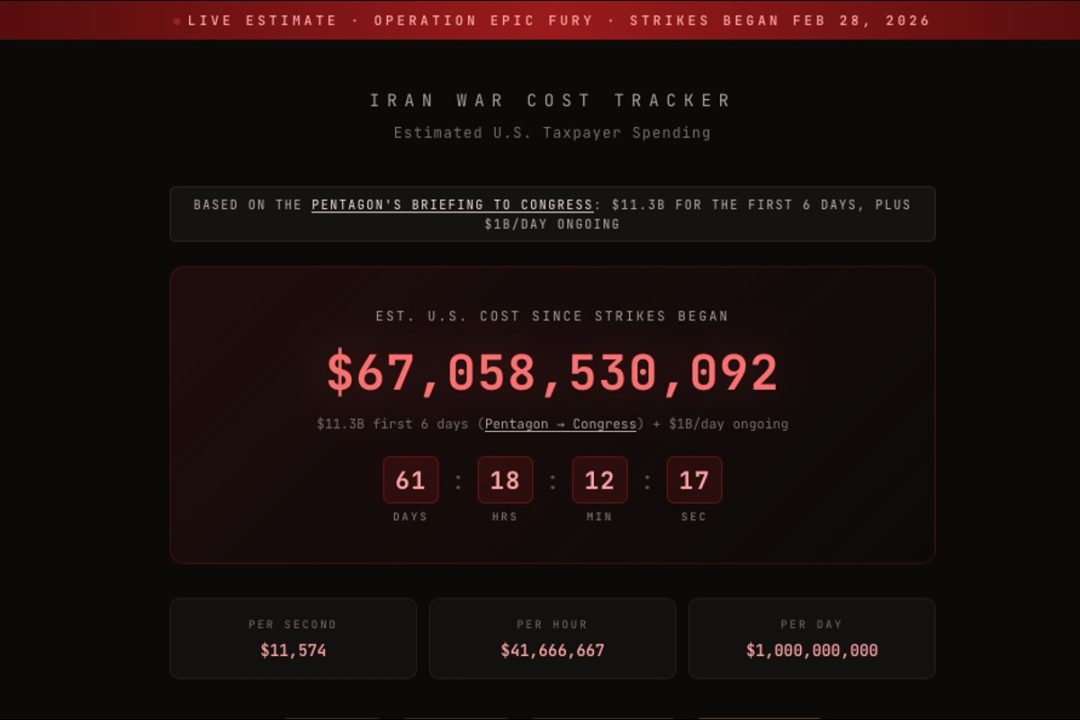
But even the $50 billion estimate lowballs the real cost of the war by almost $17 billion, the Iran War Cost Tracker says.
As well, Defense Secretary Pete Hegseth confirmed in the same hearing that Iran’s nuclear capability was “obliterated” in Operation Midnight Hammer in June. The United States and Israel began bombing Iran, he said, because of its “ambitions.”
The import of Hegseth’s testimony is that the war had no justification beyond attacking on behalf of Israel, which dragged the United States into the war, perhaps with a threat to use nuclear weapons if U.S. President Donald Trump did not order U.S. forces to join its attack.
The Cost of the War
“Approximately, [as] of this day, we’re spending about $25 billion on Operation Epic Fury,” Pentagon Comptroller Jules Hurst III told committee Democrat Adam Smith of Washington.
“He added that most of those costs are from munitions and included operations, maintenance and equipment replacements,” NBC News reported:
During his questioning time, Smith pointed out that the Pentagon hadn’t updated Congress on the cost of the war since it began and asked whether the Defense Department plans to ask Congress for supplemental funding to finance the ongoing conflict.
“We will formulate a supplemental, through the White House, that will come to Congress once we have a full assessment of the cost of the conflict,” Hurst told Smith.
Later, in the afternoon, the comptroller also promised to provide lawmakers with a cost breakdown of what the $25 billion was spent on following questions from Rep. Maggie Goodlander, D-N.H.
That “just reflects the costs of the war,” he said. “So we’ve already spent the dollars on munitions and things like that, so we’re factoring in costs of munitions expended in that total.”
But that total doesn’t include the cost of repairing bases in allied countries, which Iran attacked immediately. In late March, The New York Times disclosed that Iran’s retaliation wrecked 13 bases. The retaliatory bombing campaign forced “many American troops to relocate to hotels and office spaces throughout the region,” U.S. officials told the Times.
Those bases require repair, which will boost the cost of the war by billions of dollars, CNN reported, citing three sources:
One of the sources said the real cost estimate is closer to $40-50 billion when accounting for the costs of rebuilding US military installations and replacing destroyed assets.
Iranian strikes across the Gulf in the early days of the war significantly damaged at least nine US military sites in just 48 hours, hitting facilities in Bahrain, Kuwait, Iraq, the UAE and Qatar, CNN has reported.
Several critical US radar systems and other equipment across the Middle East were also apparently destroyed by Iranian strikes, including the radar system for an American THAAD missile battery in Jordan and buildings housing similar radar systems at two locations in the United Arab Emirates, CNN has reported. A US Air Force E-3 Sentry aircraft was also destroyed in an Iranian strike on a Saudi Arabia air base.
But even the $50 billion estimate is 25 percent too low. The real cost is $67 billion and climbing, the Iran War Cost Tracker says. That’s $1 billion per day.
Hegseth: Iran’s “Ambition” the Problem
Aside from that, Hegseth told Smith that Iran’s nuclear capability had been obliterated in Operation Midnight Hammer, and that the United States attacked because of its “ambitions” to regain a nuclear weapon.
Iran, he said, is “hell-bent on getting a nuclear weapon.” Their “nuclear facilities have been obliterated, underground, they’re buried,” but “we know where any nuclear material might be.”
“We had to start this war, you just said, 60 days ago because the nuclear weapon was an imminent threat,” Smith said. “Now you’re saying that it was completely obliterated?”
Hegseth: They had not given up their nuclear ambitions, and they had a conventional shield of thousands of missiles.…
Smith: So Midnight Hammer accomplished nothing of substance and left us in exactly the same place we were before.
Repeating that the facilities were “obliterated” but that Iran’s “ambitions continued,” Hegseth claimed Iran had adopted the “North Korea strategy” to use “conventional missiles to prevent anybody from challenging them so they can slow-walk their way to a [nuclear] weapon.”
Our “Israeli Partners”
Trump, he said, acted to stop that with our “Israeli partners.”
Director of National Intelligence Tulsi Gabbard admitted the same thing during a U.S. Senate hearing. So did President Trump.
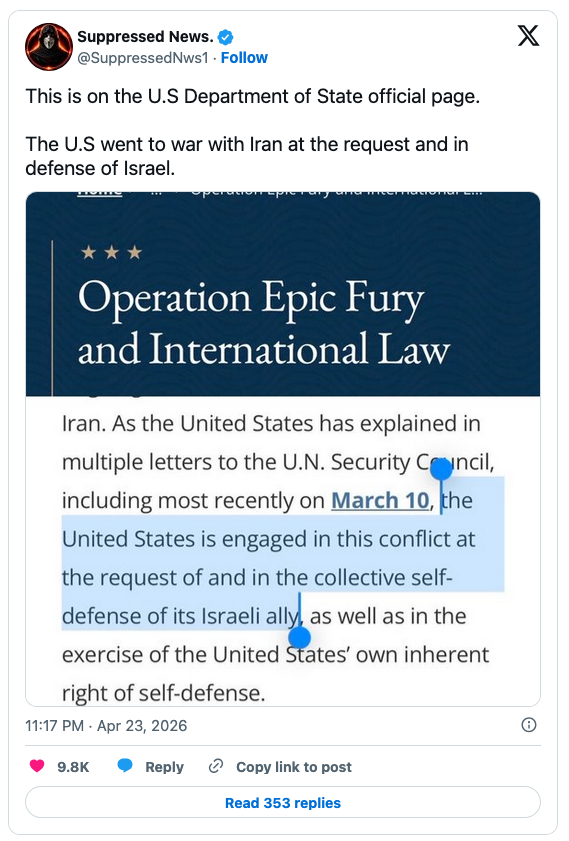
As “our Israeli partners” go, the United States is the junior partner, as Secretary of State Marco Rubio and his department’s legal advisor have confessed. Just after the war started, Rubio admitted that the U.S. “knew that there was going to be an Israeli action, we knew that that would precipitate an attack against American forces, and we knew that if we didn’t preemptively go after them before they launched those attacks, we would suffer higher casualties.”
In its legal justification for the war, the State Department’s legal chief, Reed Rubenstein, explained that the United States attacked Iran “at the request of and in the collective self-defense of its Israeli ally.”
Citing his sources in the White House, former CIA agent John Kiriakou told podcaster Michael Franzese that Israeli Prime Minister Benjamin Netanyahu threatened to attack Iran with a nuclear weapon if Trump did not authorize the U.S. military to attack.
Earlier this month, The New York Times disclosed that Netanyahu lied Trump into the war with what Rubio called “bullsh*t” prognostications about how easily an attack would topple the regime in Iran.
As well, Netanyahu said the Trump administration reports to him “every day.”