

From Ballroom to Drone Empire: Trump’s Fortress for the Elite
A year ago, President Donald Trump promised America a “much-needed” ballroom at the White House. Now, it is becoming a bunker, a drone hub, a military facility, and possibly the safest doomsday party venue in human history.
The project began as an “approximately $200 million dollar structure,” according to the White House’s July 2025 announcement. Trump and “other patriot donors,” the administration said, would pay for it. The Secret Service would handle “necessary security enhancements and modifications.”
That sounded simple enough. The ballroom would be a grand place to host state dinners and other high-profile events. To make room for it, the East Wing of the White House was slated for “modernization,” which in practice meant demolition, so a much larger venue could rise in its place.
Then came the highly suspicious shooting at the White House Correspondents’ Association dinner on April 25. Republican senators seized on the incident and pushed legislation to fund the now $400 million project through Congress, arguing that a presidential ballroom had become a national-security necessity. Trump also defended the ballooning price tag in early May. The ballroom since then has become part of a $1 billion security fight in Congress.
According to the latest update from the president, the ballroom will now double as a militarized command post for what Trump called “the greatest drone empire that you’ve ever seen.”
The Ballroom Goes Underground
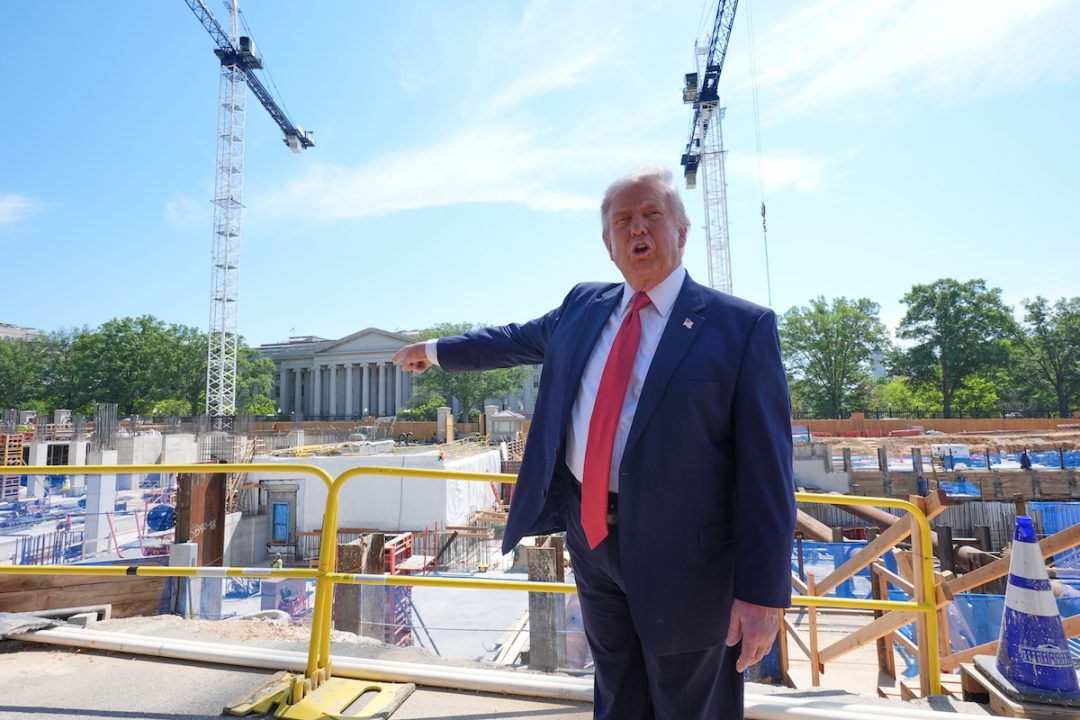
On Tuesday, Trump brought reporters to the construction site and proudly showed off the progress. What he described was not merely a ballroom. It was a hardened military complex, much of it located underground, with a ceremonial hall on top.
Pointing at the busy construction site, Trump said the lower levels would include “very, very important … the most important rooms.” He described the underground section as “far more complex than the upper.”
According to his own explanation, the lower level would house military functions, a military hospital, research spaces, meeting rooms, and defense infrastructure — “all knit together” with “drone-proofing” and “missile-proofing” functions.
But what about the actual ballroom? That, said Trump, is “really, a shield, and protecting all of the things that are built here.”
“This goes down very deep,” the president continued. “These are already down two floors. That is down about six stories deep. That’s big stuff. Normally, when you build a ballroom, you build it flat.”
That is true. Normally, a ballroom does not require an underground military nerve center.
“We are building it in conjunction with the United States military and the Secret Service,” Trump later stressed.
In other words, the ballroom is no longer just a ballroom. It is becoming a fortified presidential facility with a luxury event space attached.
Drone Empire
The underground complex is only half the story. Trump then turned to the roof.
“On top of the roof, we’re gonna have the greatest drone empire that you’ve ever seen,” Trump said. “And it’s gonna protect Washington.”
Trump said the roof would be sealed, “drone-proof,” and built for military use. He described it as a “drone port” that could hold “unlimited drones.” It would be “dead flat,” he added, with “absolutely nothing but strength on it.”
Then came the snipers.
“I hate to use the word snipers,” Trump said, “but we have great sniper capacities built for our snipers. Not the enemy snipers, our snipers.”
It is worth pausing over that description.
The White House ballroom, once sold as a private gift to future presidents, is now being presented as the bastion of a protective “drone empire.” Protect Washington from whom? And why does a president who built much of his brand on a promise of peace now sound as if he is preparing the capital for war?
“Peanuts” at the Pump
The tour came with a useful reminder: Hardship is easier to dismiss from behind reinforced glass and 9,000 pounds of concrete.
One reporter asked whether the president had any initiatives to address rising prices at the pump. As of Tuesday, the national average stood at $4.53 per gallon, up sharply from $3.17 a year earlier.
Trump waved off the burden.
“I had gas down to $1.85 in Iowa,” he told reporters. “I was in Iowa, and the stations had it at $1.85. But I was down to, in many cases, less than two dollars a gallon.”
Everything, he said, was going well. The stock market had reached “a new high.” But Americans, he suggested, would have to endure some pain for what he framed as existential reasons:
I’m sorry, but we have to go a little down and take a little journey. We have to do something with Iran. We cannot let them have nuclear weapons. You want to see the world exploded? You want to see a problem? And this is peanuts.
“I appreciate everybody putting up with it for a little while,” Trump continued, promising that “it won’t be much longer.”
He then tried to reassure Americans that relief was coming because “there is so much oil out there.”
Last week, Trump also said he did not think about Americans’ financial situation, “not even a little bit,” when negotiating with Iran. He later defended the remark as a “perfect statement.”
And so there you have it. Americans get higher prices, ballooning debt, and an increasingly unsafe world caused in large part by America’s interventionist foreign policy. The elites get an impenetrable fortress in the heart of Washington. Somewhere in there is a modern version of “let them eat cake,” only with more concrete and more snipers for the powerful, and more sacrifice demanded from everyone else.
A Fortress for What Future?
The ballroom story is no longer mainly about taste, cost, or Trump’s appetite for spectacle. It is about what power builds when it fears the consequences of its own decisions.
Every government needs security. But there is a difference between protecting public institutions and turning them into hardened sanctuaries for the ruling class.
That difference matters. Leaders who know they have somewhere to hide may think differently about danger than the people who do not. They may become more cavalier about foreign adventurism and war. They may dismiss rising prices as “peanuts.” And they may frame public hardship as a temporary inconvenience while quietly preparing deeper rooms, thicker glass, and stronger roofs.
The question is not whether Washington should be protected. Of course it should.
The question is whether a political class that retreats behind fortresses can still understand the country outside them.