
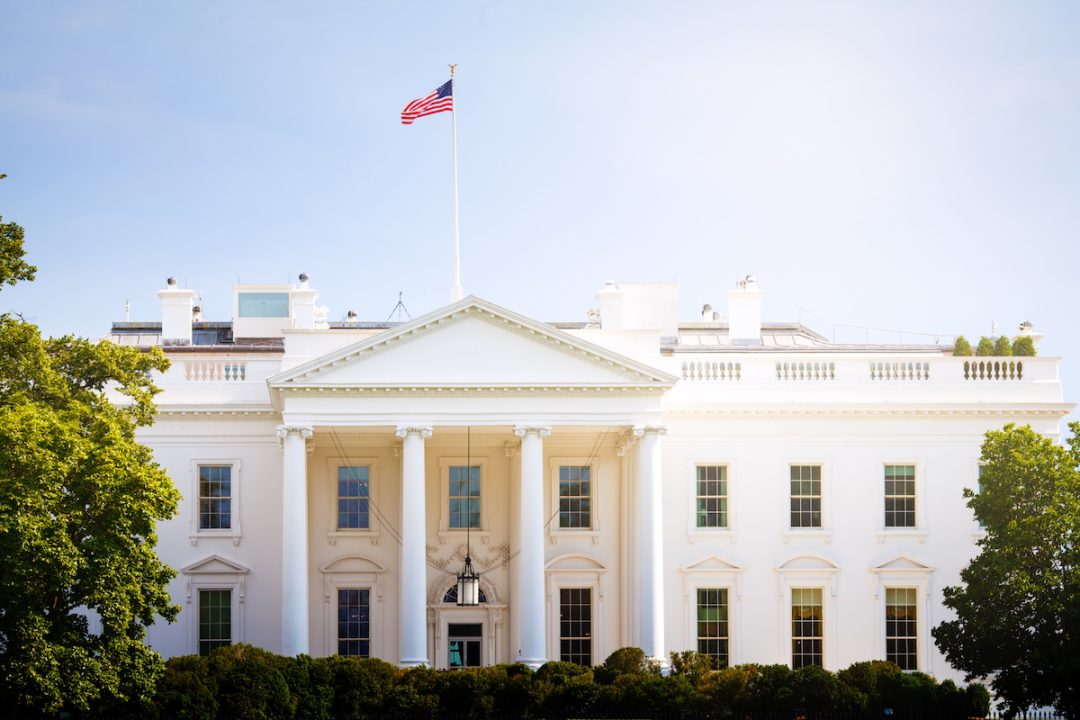
GOP Bill Seeks $400M for White House Ballroom and Security Infrastructure
As the country is engaged in a costly illegal war abroad, and as prices continue to climb at home, a group of Republicans in Congress has turned its attention toward a $400-million White House construction effort. On Monday, Senators Lindsey Graham of South Carolina, Katie Britt of Alabama, and Eric Schmitt of Missouri introduced legislation to authorize and fund the so-called East Wing Modernization Project. That includes a State Ballroom, visitor screening facility, and related “national-security” infrastructure.
The bill arrives in the immediate aftermath of a highly suspicious shooting at the White House Correspondents’ Association dinner on Saturday, and as courts continue to weigh whether the administration had authority to move forward with the ballroom project without congressional approval. Legal challenges temporarily blocked parts of the project, making the legislation not only a funding vehicle, but a political and legal rescue effort for one of President Donald Trump’s most controversial White House priorities. Initially touted as a grand venue for high-profile receptions, the plan took on a different tone in late March, when the president described the ballroom as “essentially a shed” for a hardened underground complex.
The Bill
Dubbed the “White House Safety and Security Act of 2026,” the legislation seeks to authorizes $400 million in federal funding for what is formally described as the “East Wing Modernization Project.” The Trump administration kicked off that “modernization” by tearing down the historic East Wing last October.
The appropriation is direct. It draws from the U.S. Treasury and remains available through January 20, 2029. The funds are intended for “design, construction, and other appropriate expenses.”
The legislation also contains a secondary mechanism to offset costs. It extends customs user fees through March 31, 2032. That extension is framed as a way to balance the federal outlay. Critics argue it simply shifts the burden.
The scope is broad. It includes a secure State Ballroom and a visitor-screening facility. It also allows for “any other related national security facility.” That final phrase appears to be vague by design. It leaves room for expansion beyond the ballroom itself. The president himself left little room for ambiguity, posting on Truth Social on April 16 that “future Presidents and World Leaders” would need
… a safe and secure large scale Meeting Place, or Ballroom, one with Bomb Shelters, a State of the Art Hospital and Medical Facilities, Protective Partitioning, Top Secret Military Installations, Structures, and Equipment, Protective Missile Resistant Steel, Columns, Roofs, and Beams, Drone Proof Ceilings and Roofs, Military Grade Venting, and Bullet, Ballistic, and Blast Proof Glass
That list sounds less like a reception hall and more like a hardened lair. For a proclaimed “Golden Age,” it suggests not confidence, but preparation for doomsday.
Security First
In his press rollout, Graham — recently endorsed for reelection by Trump — cast the bill as a direct response to political violence, tying it squarely to the recent shooting at the correspondents’ dinner. He said,
This weekend’s shooting at the White House Correspondents Dinner is, tragically, just the latest example of an unhinged radical attempting to take the life of President Trump. These repeated instances of political violence underscore the need to adequately bolster the White House security apparatus.
He openly dismissed the idea that the plan is cosmetic. “Our legislation is much bigger than simply renovating a venue,” the senator said. “It represents a necessary measure to keep our Commander in Chief — whoever that may be — safe and protected.”
Other sponsors followed the same script. Britt called it a “clear and present need,” adding, “Given the Department of Homeland Security has been shut down now for 74 days … President Trump was smart to not wait around.” Schmitt described the shooting as “a warning flare in a growing pattern of violent, politically motivated attacks,” insisting that “in this climate, the President and his guests must be able to gather safely on White House grounds.”
The White House reinforced the message. Press secretary Karoline Leavitt said there is no room large enough on site to host such events securely. “It is actually critical for our national security,” she argued, “that a larger secure building … is built.”
The language is not subtle. The supporters no longer frame the plan as optional. They push it as necessary, urgent, and non-negotiable.
Pushback
But the security argument has not ended the debate. Senator Rick Scott (R-Fla.) said he supports construction of a ballroom, but not on the taxpayers’ dime. Per The Hill,
“I don’t know why you would do it” with taxpayer money “if it’s all funded,” Scott told NBC News.
“We have $39 trillion in debt,” he said. “Maybe we ought to stop spending money.”
The administration initially pitched the ballroom as a “gift” from corporate “patriots” such as Amazon, Apple, Google, Meta, Palantir, Lockheed Martin, Booz Allen, and other federal contractors.
Democrats, as expected, moved quickly to seize on the issue for political advantage. Representative Pramila Jayapal (D-Wash.) rejected Graham’s claim that Americans would welcome the expense. She posted,
90% of Americans would love to have affordable healthcare, housing and childcare.… Not a frigging illegally constructed ballroom.
Representative Brad Schneider (D-Ill.) called the project “about what Donald Trump wants,” adding that it is “nothing the American people asked for.”
The Legal Fight
The bill lands in the middle of an unresolved legal fight over presidential authority. At issue is a simple question: Can a president remake part of the White House on his own, or does Congress have to approve it?
A federal court has already answered once. It ruled the project required congressional authorization and halted construction. An appeals court later allowed work to resume on a temporary basis while the case proceeds. The core question remains unsettled.
The challenge comes from the National Trust for Historic Preservation, which argues that demolishing and rebuilding a historic section of the White House without Congress violates federal law. The group has refused to withdraw its case in the wake of the Saturday shooting.
The Department of Justice (DOJ) has pushed in the opposite direction. On Monday, it asked the court to lift the injunction, arguing that delays could endanger the president, effectively recasting a legal dispute as a security risk.