

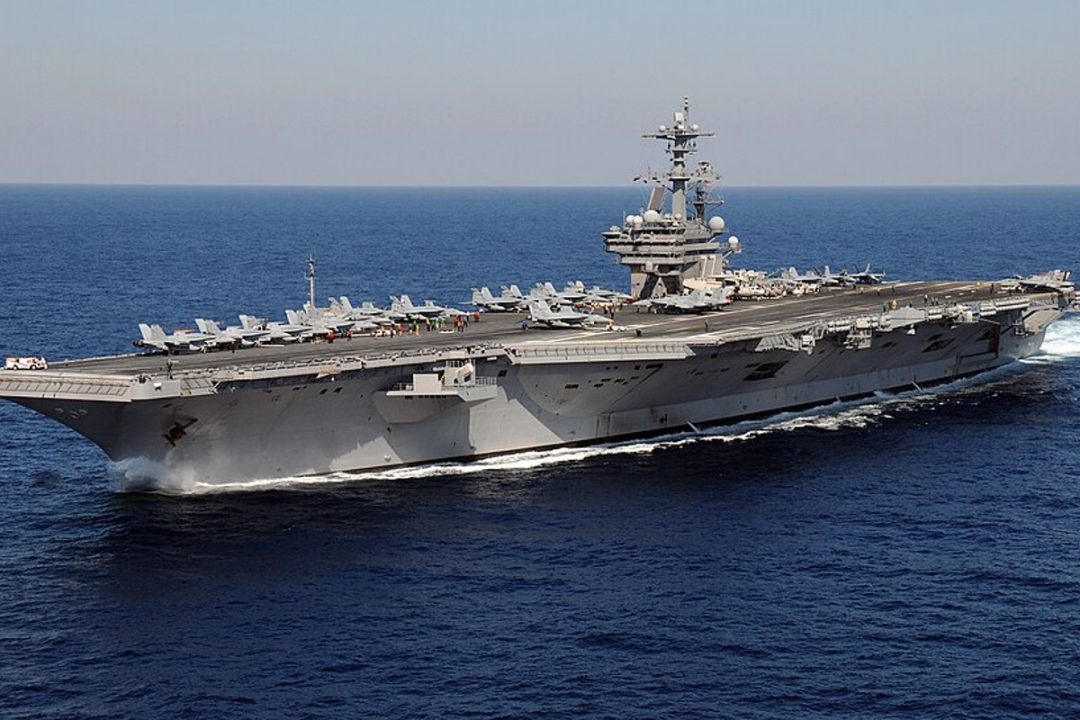
WaPo: More Than 10K Troops Headed for Persian Gulf as U.S. Blockades Strait of Hormuz
Another 10,200 American troops are heading to Iran, apparently to persuade Iran to agree to U.S. terms in peace talks during the two-week ceasefire that ends next week.
But yet another reason, The Washington Post explained in its report on the deployment, is staging more forces there for a ground invasion of Iran.
Already, 50,000 Americans are in the region. Their latest mission: blockading the Strait of Hormuz to squeeze Iran economically.
The deployment coincides with today’s vote in the U.S. Senate not to block Trump from continuing to attack Iran.
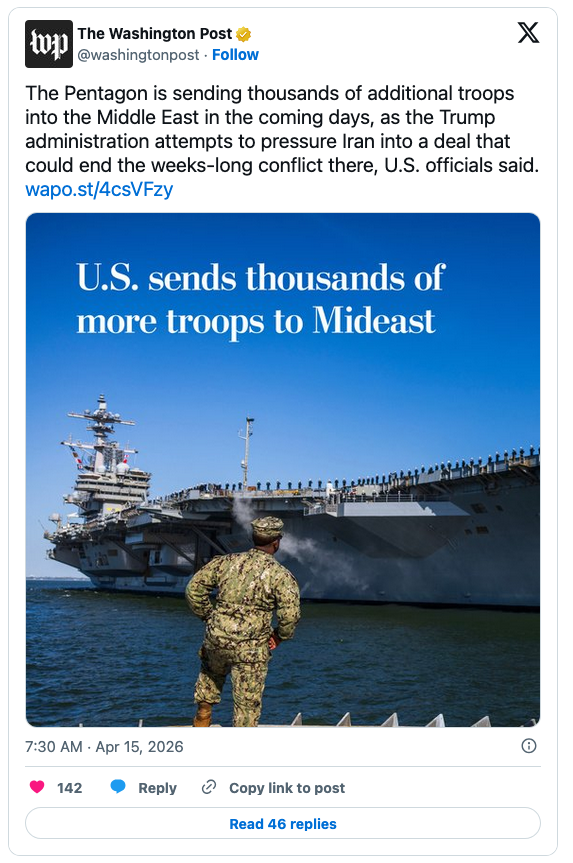
Three Aircraft Carriers in Region
Some 6,000 Americans are headed to the region on the USS George H.W. Bush, officials told the Post, along with “4,200 others with the Boxer Amphibious Ready Group and its embarked Marine Corps task force, the 11th Marine Expeditionary Unit,” which will land there “near the end of the month.”
The newly-arriving forces will mean three aircraft carriers and their contingent of jet fighters and other aircraft are now in the region. The USS Abraham Lincoln and USS Gerald R. Ford are the others.
“The USS George H.W. Bush was close to the Cape of Good Hope, near South Africa, on Tuesday and expected to make an unusual hook around the bottom of the continent on its way to the Middle East, two officials familiar with the matter said,” the Post reported. The Boxer Amphibious Ready Group, which comprises three ships, left Hawaii last week, and included an infantry battalion of more than 800 Marines.
On Sunday, after U.S. negotiators led by Vice President J.D. Vance failed to force Iran to bow to U.S. demands to reopen the Strait of Hormuz and end its nuclear ambitions, President Donald Trump announced a blockade of the strait.
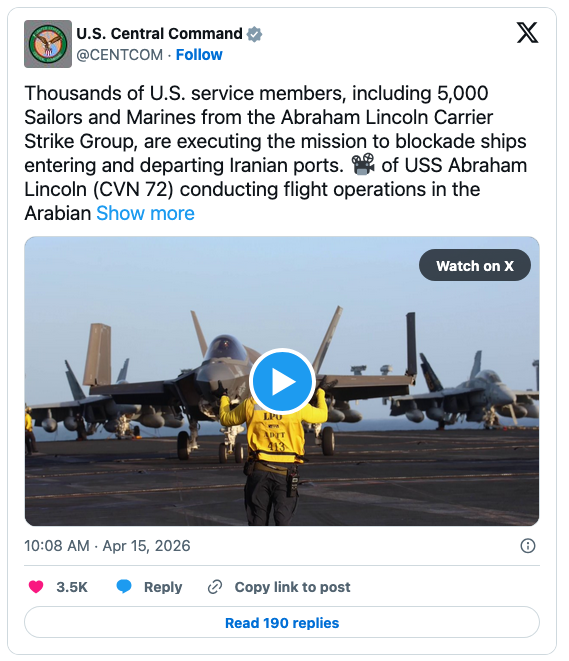
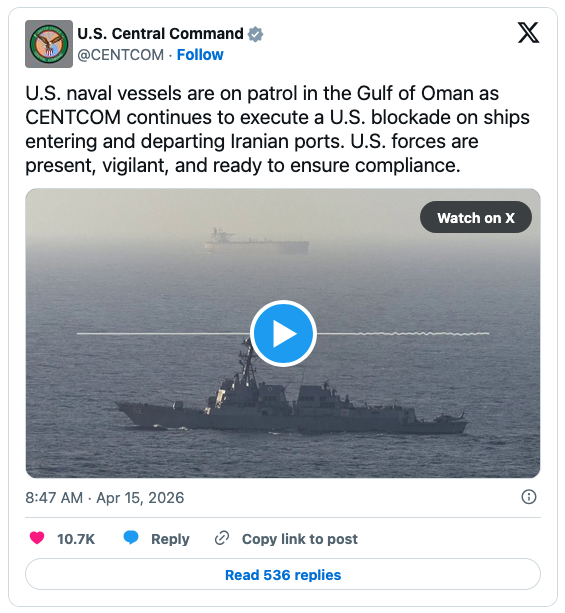
U.S. warships in the Abraham Lincoln’s Strike Group are executing the blockade, U.S. Central Command reported today, and vessels are patrolling the Gulf of Oman.
This morning, Centcom released audio of a seaman’s announcing the formal blockade and ordering vessels attempting to enter the strait to return to Iran if leaving the Persian Gulf and “discontinue transit to Iran if that is your next port of call.”
“Do not attempt to breach the blockade,” the transmission says:
Vessels will be boarded for interdiction and seizure transiting to or from an Iranian port. Turn around, or prepare to be boarded.
Blocking Economic Trade
Centcom commander Admiral Brad Cooper said the blockade “has been fully implemented,” and noted that “90 percent of Iran’s economy is fueled by international trade by sea.”
Since the blockade began on Sunday, “U.S. forces have completely halted economic trade going into and out of Iran by sea.”
“A former senior defense official said that U.S. forces involved in Trump’s blockade are probably on the lookout for ships suspected of supporting Iran,” the Post reported:
Armed boarding teams from the Navy SEALs, Marine Corps or Coast Guard are trained to seize vessels, whether their crews cooperate with U.S. forces or not, the official said.
On Monday, Trump threatened to blow any interfering ships to smithereens. “Warning: If any of these ships come anywhere close to our BLOCKADE, they will be immediately ELIMINATED, using the same system of kill that we use against the drug dealers on boats at Sea,” Trump wrote.
The Post noted that Trump told Fox talker Maria Bartiromo that the war could end “very soon” and that by the midterm elections, which Republicans might well lose, gas prices should fall to prewar levels.
“Iran escalated threats to choke off international trade, with military commander Maj. Gen. Ali Abdollahi saying Iran would block imports and exports from the Persian Gulf, Gulf of Oman and Red Sea in response to the U.S. blockade,” the Post reported:
“Iran will take powerful action to defend its national sovereignty and interests,” he said in comments reported by Iran’s semiofficial Tasnim news agency.
Senate Measure Fails
Today, Senate Republicans killed a measure that would require Trump to stop the war. The 47-52 vote was nearly unanimously party-line. The lone Republican who voted to end the war was Kentucky’s Rand Paul. The lone Democrat who voted for it was John Fetterman, a strong supporter of Trump on the issue.
“The War Powers Resolution of 1973 — the law Democrats are using to force the votes — also requires presidents to remove U.S. forces from any conflict that Congress has not authorized within 60 days,” the Post observed. “Trump can obtain a 30-day extension if he certifies that it is an ‘unavoidable military necessity.’”
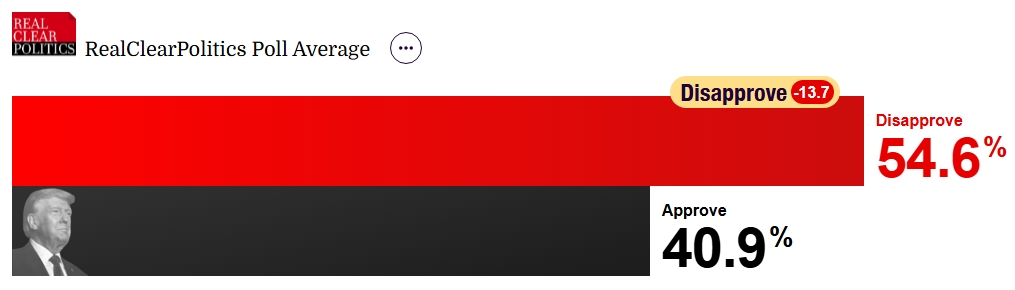
As public support for the war goes, Trump is in trouble.
The RealClearPolitics (RCP) average of polls on the subject shows that 54.6 percent of those polled disapprove of the war. Just 40.9 percent approve.
Every poll but one since mid-March shows negative results for the president.
Three polls since April 8 show disapproval rates of 56, 60 and 60 percent.
Also bad for Trump is overall job approval rating. The RCP average shows that 56.3 percent of those polled disapprove of what he is doing, while just 41.5 percent approve.
But all these numbers, as Trump would say, are likely driven by low-IQ voters who aren’t MAGA.