

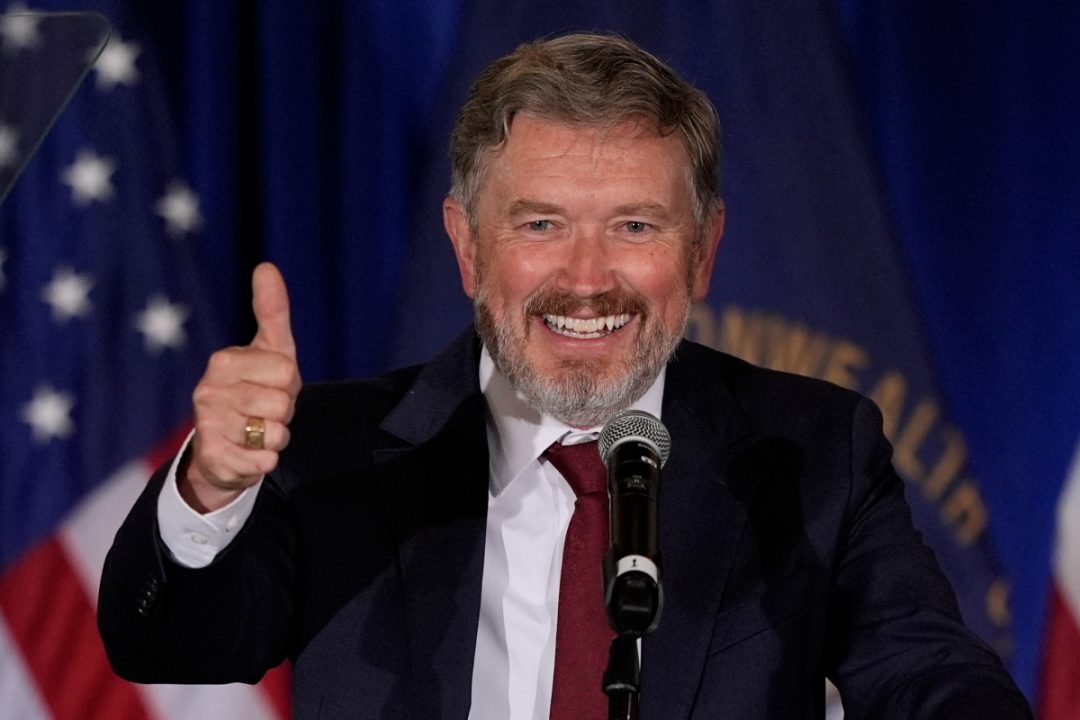
Massie Tells Washington: I’m Not Finished — 2028 Is Already in Play
It didn’t take long for Representative Thomas Massie (R-Ky.) to reinforce hope among his supporters. On Monday, less than a week after he lost his reelection bid, he filed to run for federal office in 2028, signaling that he’s probably not abandoning politics.
“I filed with FEC for the 2028 House race,” he announced early on Memorial Day. “This allows me to raise funds to continue my political operations supporting my position as a current office holder and as a potential candidate for federal office.” Massie finished the announcement with a sentence prompting speculation about what he’ll do next. “I haven’t made a final decision about which office to seek, if I run,” he said.
The news immediately made headlines.
The previous day, the congressman appeared on NBC’s Meet the Press, his first major interview since losing his reelection bid for Kentucky’s fourth congressional district. When asked what he’ll do next, he said he didn’t know, but vowed to stay “engaged” one way or another.
His supporters want him to run for president. Chants of “2028” and “president” broke out several times during his concession speech last Tuesday. They also became regulars at his reelection rallies. In the past, Massie has outright dismissed the idea of a presidential run. He has said he’ll completely abandon politics if he loses in May. That appears to have changed. Last week is the first time he publicly said he was not ruling out the idea.
Lost Primary
Massie lost a race that is being hailed as the most expensive primary in U.S. history. Candidates and reports suggest that up to $35 million between both campaigns was poured into that race. The election was the culmination of a nine-month-long campaign by President Donald Trump and a collection of neoconservative megadonors to dislodge Massie from Congress.
In the past, Trump and Massie had endorsed one another. But in 2025, Massie had bucked the party boss one too many times. He voted against making Representative Mike Johnson (R-La.) speaker again, he voted against a Republican-backed continuing resolution, he then voted against Trump’s signature One Big Beautiful Bill, he called the president’s attacks on Iran’s nuclear sites “unconstitutional,” and he pushed the Justice Department to publish 3 million files on pedophile and suspected intelligence operator Jeffrey Epstein — all to the chagrin of Trump.
No Remorse
But despite losing, Massie appears to have no remorse. Not only is he making moves to stay in politics, but he’s doing so while doubling down on the major positions that got him fired. On Tuesday, he posted on X:
The President’s Big Beautiful Bill, the Iran War, and Republican spending bills will create a $2 trillion budget DEFICIT in 2026. Financing just the new debt costs more than all federal road & bridge projects, and we will be making those new interest payments each year, forever.
Some comments were critical of Massie. “I remember when you voted in favor of the Fiscal Responsibility Act of 2023, which raised the federal budget/debt ceiling under Biden,” wrote an X user named Jennie. “You voted for it in the House Rules Committee and for it in the Final House Vote. You weren’t a ‘fiscal hawk’ under Biden but now all of a sudden you are.” Massie’s response: “That wasn’t a spending bill. It was a Republican bill that raised the debt limit but it included my provision to cut spending 1% if Congress went a full year on a continuing resolution. Congress did in fact go a full year on a CR, but Mike Johnson became speaker and reneged on it.”
This exchange captures the essence of one of the major arguments used to oust Massie. Trump’s neocon brigade painted Massie as a RINO (Republican In Name Only), an obstructionist, and someone who refuses to play ball. This is something Vice President JD Vance articulated during a Turning Points USA event when a student asked why the White House was going after the Kentuckian. Massie is just not there when the party needs him most, Vance replied.
Loyalty to the Constitution
What gets lost in this argument is that at no point whatsoever do lawmakers swear an oath to their party or the president. They vow loyalty the U.S. Constitution. Moreover, lawmakers are elected by constituents who send them to Congress to reflect their interests, not necessarily those of other representatives or the president. Massie is among the few legislators in Congress who appear to take this seriously. And his voting record proves it. He consistently scores high in conservative indexes. He has accrued a lifetime score of 99 percent in The New American’s Freedom Index.
At some point while campaigning in the slugfest for Kentucky’s fourth congressional seat, Massie was unwittingly crowned the leader of a movement. Comparisons to libertarian icon Ron Paul have been thrown about. He ignited in people a zeal for the principles and ideas that got him kicked out of Congress. Judging by the energetic crowds at his rallies and the responses on social media, there’s a political market for small government, fiscal responsibility, constitutional fidelity, and noninterventionist foreign policy. And it appears to be people under 60 who are most approving of such views. Massie said this is what gives him hope. Apparently, it also prompted him to rethink his plans of permanently retiring to the farm life.
What’s Next?
The questions forming in real time are not so much about whether Massie will retire or not. They include: What will he do next? How much of a headache will that cause the Establishment? And if he does indeed pick up where Ron Paul left off, can he lead the movement to unprecedented heights?
Massie is younger by decades than Paul was when he ran for president in 2008. His popularity is rising in the age of social media, which, as Trump showed in 2016, enables candidates to circumvent mainstream media and talk directly to the people. This means the Establishment doesn’t have complete control over the narrative. And he appears be doing all of this at a time when more people identify as independents than either Democratic or Republican; a time when more Americans appear to be disillusioned with both major parties than anytime in recent history.
Are all these factors converging into the most serious threat the Uniparty has faced since its inception?