
U.S. Leaves Iraq More Unstable Than It Found It in 2003
Twenty-three years ago, the United States invaded Iraq under the guise of finding and removing weapons of mass destruction. Less than a year later, the public learned there were no WMDs, despite persuasive dog-and-pony shows by the officials who had convinced Congress that there were. Even though the primary reason for the invasion was no longer in play, the U.S. military stuck around in Iraq until 2011, left, and then returned three years later to fight ISIS, a group that came about because of the 2003 invasion.
ISIS is what is commonly referred to as “blowback” for foreign meddling. Blowback happens more frequently than outright victory when power nations intervene in this volatile and unconquerable part of the world.
Leaving Iraq — Again
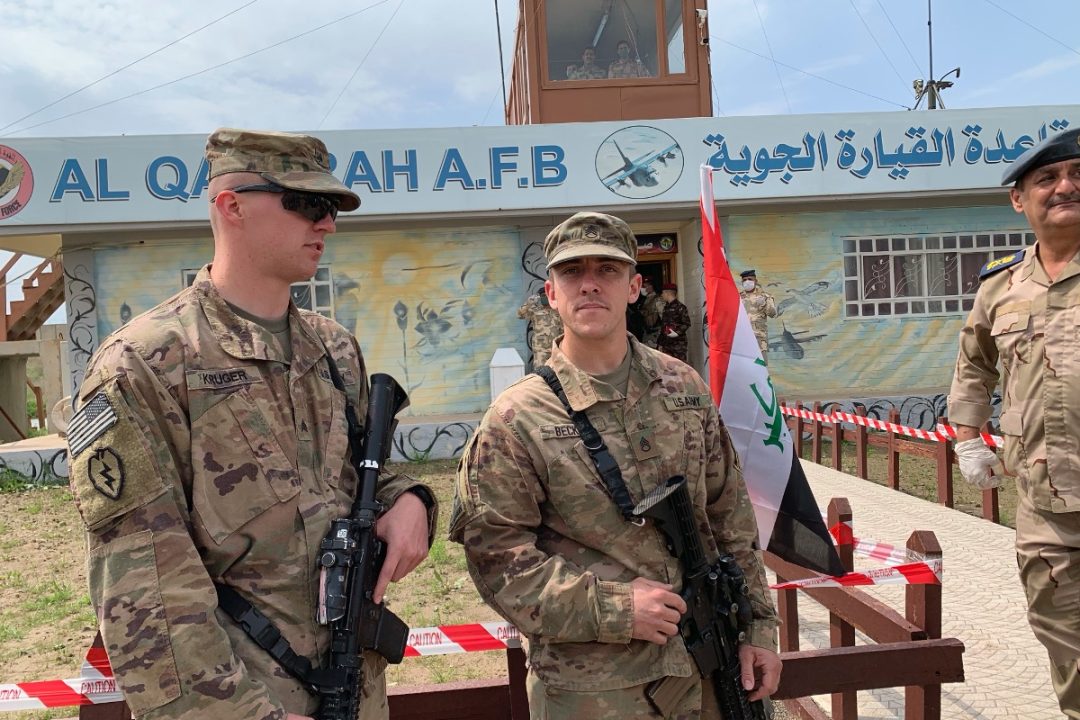
Fortunately, the U.S. military left Iraq this week — again. Unfortunately, instead of returning home, those troops were stationed in a nearby country. Also unfortunately, it appears Iraq is more unstable today then before the U.S. invaded in 2003.
On Wednesday, President Donald Trump announced, with a twist of irony, that “the last American Forces are leaving Iraq!” The president rightly observed that it was “bad decision-making that got us involved in this quagmire in the first place.” Many believe the president plunged the U.S. into his own Iraq-ish quagmire when he started a war with Iran, a larger country that has proven surprisingly resilient and formidable.
Nevertheless, on Wednesday, Trump took credit for the Iraq exit while taking shots at his predecessors. “Launched in 2003 under the presidency of George W. Bush, and continued under the Administration of Barack Hussein Obama in 2014, and Sleepy Joe Biden, Operation Inherent Resolve ends in 2026 under the leadership of President Donald J. Trump,” he said in a Truth Social post.
It was actually the Biden administration that made agreements with the previous Iraqi minister to remove American combat troops by 2026. But kudos to Trump for following through.
Leaving Iraq to Iran
The United States will still have a presence in Iraq, albeit not in combat form (not officially, anyway). A Pentagon official told The Wall Street Journal that America will keep “intelligence, surveillance and other capabilities in the region that could be used in Iraq.” Moreover, thousands of contractors likely remain as well.
The Journal, which supports neoconservative foreign policy, says the Iraq exit leaves behind “a nation in peril” of being taken over by Iranian-backed groups. The Washington Post, another pro-intervention mouthpiece, agrees. “U.S. withdraws forces in Iraq as balance of power shifts to Iran,” reads a Post headline from Wednesday.
Iran-backed militias have more power today in Iraq than they did before the U.S. toppled Saddam Hussein, who spent eight years at war with Iran. Iraq’s current prime minister is Ali al-Zaidi, a 41-year-old businessman who owns a bank, insurance company, and media and construction firms. He’s also “young and handsome,” according to Trump’s list of qualifications.
Disarmament?
Zaidi is tasked with disarming the Iran-backed militias, a mission that his biological perks offer no advantages toward accomplishing. He had set a deadline for the militants to turn in their weapons by Wednesday, September 30. Not surprisingly, that didn’t happen, so Zaidi set a new deadline — June 30, 2027.
But what are the chances that some of these groups will ever turn in their weapons? If you ask Kazem al-Fartousi, a spokesman for Kata’ib Sayyid Al-Shuhada, an Iranian-backed paramilitary group, the probability is zero. He said outright in an interview in Baghdad that “a forced disarmament by the government will not happen,” according to the Journal. “These weapons are for our sovereignty, our freedom,” he clarified with a statement that could just easily be heard in America. Moreover, his outfit helped create the current government, he said. The Journal reported:
His group and other militias hold top positions in ministries, as well as dozens of seats in Iraq’s parliament where they played a role in Zaidi’s selection in the negotiations that followed last year’s election.
But a spokesperson for the commander in chief of Iraq’s armed forces said the government is “advancing its strategy to control weapons and consolidate them under state authority.”
It’s easy to see how things might get dicey soon. “Will we be like Afghanistan or like Yemen and Syria?” asked Mustafa Al-Zaidi, a 22-year-old medical student who plans to leave Iraq because he believes the answer to his question is yes. He echoes the concerns of many Iraqis who see trouble on the horizon.
U.S. Intervention Made Things Worse
American intervention likely made matters worse in Iraq, as we alluded to earlier. The Journal, too, notes how the chaos accompanied by the U.S. invasion “created an opening for Iran to extend its influence in Iraq.” And with Trump’s war of choice on Iran, the American presence has turned Iraq into an Iranian target.
The Department of Defense’s Office of the Inspector General recently issued a report that says the Iranians damaged a lot of U.S. infrastructure in the Middle East. “U.S. Central Command told IG investigators that Iranian strikes damaged and destroyed hundreds of buildings and structures at U.S. bases in Kuwait, Bahrain, Qatar, UAE, Saudi Arabia, Iraq, Oman, and Jordan during the conflict,” according to a summary of the report. Moreover, “U.S. diplomatic sites in Iraq suffered more than 600 attacks.” The estimated cost of the damage totaled over $180 million. That number is likely higher by now, given that the report only covers through June.
A Victory for Iran?
Iran, as expected, framed the exit as a notch on its belt of victories against the U.S., which, if a long-winded letter recently addressed to the American people is to be taken seriously, is a lengthy list. “The victory of the will of the anti-dominion resistance of proud Iraq over the American occupation is a golden leaf in the history of the freedom of the nations of the region,” the Islamic Revolutionary Guard Corps said in a statement, adding:
The expulsion of the American invaders is actually the imposition of the determination of the heroic Iraq which has always spoken with the language of force, is today forced to retreat from the land it occupied for two decades. … Now Iraq, proud and free, is standing on the ruins of the twenty-year occupation and watching the dawn of independence.”
Get America Out of the Middle East
Iraq, like Iran, never had the means to pose a danger to the U.S. homeland. The war was launched under false pretenses. We spent two decades there, added over $2 trillion to the national debt while doing so, and, most importantly, sacrificed the lives of more than 4,500 Americans in the process. And for what? The country is in worse condition today than before the invasion, and Iran could very well take control there.
Short of an incremental yet full withdrawal from the entire Middle East, the United States will continue making the same mistakes — and Americans will keep paying for them in increased costs and lives. Unfortunately, a full withdrawal is not the plan right now. The forces who left Iraq didn’t come home. They were relocated to Jordan, from where they will fight ISIS forces in Syria, per U.S. Central Command.
Continued U.S. presence in the region will result in more American casualties, and will fuel more anti-American resistance groups. It’s long past time the U.S. got out of the Middle East.