

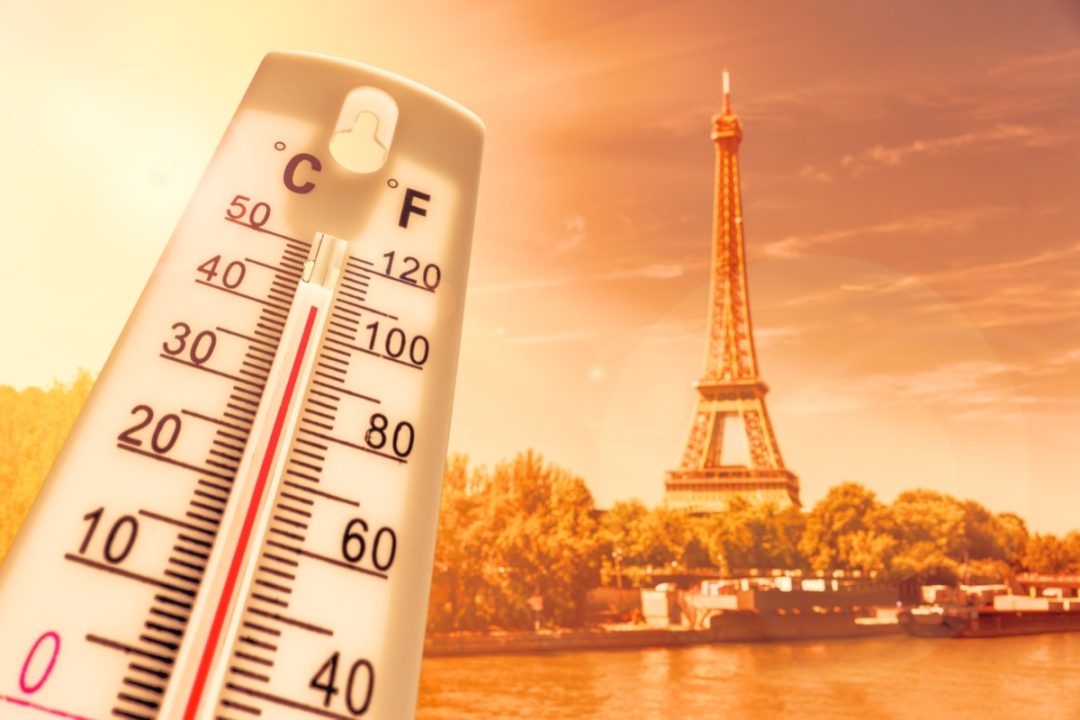
French Leader Blames U.S. for Deadly Heat-wave Deaths. But Should She Really Blame Statism?
Here’s an interesting fact: Yearly, more people die from heat-related causes in Europe than from gunshots in the U.S. (The firearms data include suicides, too.) And this reality is on full display currently, with a recent heat wave having claimed 1,300 lives across Europe. This includes 1,000 excess deaths in France alone. Moreover, something else has heated up as well:
A brouhaha between a statist French politician and Americans over whom to blame.
Many U.S. journalists and social-media figures fingered Europe’s lack of air conditioning.
The politician, Deputy Mayor of Paris Audrey Pulvar, blamed America. Why?
You guessed it: because, the thinking goes, we’re inordinately responsible for “global warming.”
The Daily Mail reported on the story Tuesday:
Only around 25 percent of French homes are equipped with air conditioning, lagging behind even other European countries like Spain and Italy.
The World Health Organization says the heat has caused 1,300 deaths across the continent, with France reporting 1,000 excess deaths between Wednesday and Friday last week as the country shattered records.
One town in southwestern France recorded a temperature of over 111 degrees Fahrenheit on Wednesday.
Pulvar blamed Americans for contributing to the heatwave.
“As the second-largest emitter of greenhouse gases in the world, you bear a significant responsibility for global warming and the consequences we, in France, are experiencing,” she said, adding that America’s AC abundance was “not unrelated.”
But she was brutally mocked by Americans on social media, with many suggesting she should criticize China instead which contributes roughly 12 billion tons of CO2 per year, compared to the United States at about 6 billion tons.
“Let’s all behold the idiot in France blaming the great USA for [France’s] lack of basic needs and infrastructure, while ignoring China, the real world polluter,” one user wrote.
“Great, now do China, you complete moron,” said another.
In the rest of her post, Pulvar touted the Paris government’s efforts to green the city while saying that AC should be used in a limited way, as it “aggravates the problem” of hot weather.
“If every American city made the same ecological transition efforts as Paris and many European cities,” Pulvar said, “the whole world would be better off.”
Another respondent defending America said that Pulvar should just thank us that she’s speaking French and not German. Yet another quipped, “Have you tried surrendering to the heat wave?” Ouch.
Joking aside, there’s much to unpack here. Interestingly, European World Cup tourists in the United States were just in the news for praising Americans’ lifestyles. One luxury that has impressed them, too, is our ubiquitous AC.
This isn’t surprising, given conditions in Europe. In fact, some Parisians are wading into the Trocadero Fountain near the Eiffel Tower to cool off. Others are sleeping outside at night to escape the heat. Now consider that this is what urban Americans did, too (sleeping on fire escapes), on summer nights — 80 years ago.
And there’s an irony to France’s AC-phobia. That is, the country derives 67 percent of its electricity from nuclear energy. In other words, its electricity generation doesn’t create much CO2, relatively speaking. So what’s its problem?
A Regulation Wave
France’s capital city does have unique challenges. For example, as the CBC reported June 26:
The sea of blue-gray roofs in Paris provide a signature look to its canopy, recognized as intangible cultural heritage, and protected by law from change.
But most of them are made of zinc. Add the fact that they’re often un-insulated, with glass windows and the effect for upper-floor residents during a heat wave is like living in an oven, day and night.
Yet despite this, the CBC also relates, city residents usually still must lament, “‘Je n’ai pas de clim.’ (I don’t have air conditioning.)” The reason?
Grok AI summarized it well:
French regulations and policies actively discourage widespread air conditioning (AC) adoption, especially in homes and older buildings, through energy efficiency mandates, historic preservation rules, and broader climate/energy strategies.
In other words, even though France has its low-CO2 electricity generation, its greentopians are going to die with their hot, sweaty, Petri-dish-like boots on.
Still think greentopianism isn’t a jihadist-like religion?
Not Just a Summertime Problem
This goes far beyond AC, too. Consider: “Years ago, America’s economy grew neck and neck with the European Union’s,” investigative journalist John Stossel wrote last year. “Then, about 15 years ago, Europe stopped growing. Today, the USA is 50% richer — even though the EU has 100 million more people.” The reason?
Regulation is a major factor — if not the only one.
Just ponder the Fraser Institute’s “Economic Freedom of the World: 2025 Annual Report.” It found that the U.S. ranks about 5th globally (high score around 8.2/10) in economic freedom. Many EU countries rank lower (e.g., Germany is about 15th, France about 44th). America excels in areas such as regulation and trade freedom relative to much of the EU.
(Note, too, that the gap between Europe and lower-regulation states, such as Texas, is even greater.)
And as Fraser points out:
The standard of living in the most economically free nations is far higher than in the least free.
Late economist Dr. Walter E. Williams emphasized this as well, writing in 2014:
Rank countries according to whether they are closer to being a free market economy or whether they’re closer to having a socialist or planned economy. Then rank countries by per capita income. Doing so, we will find a general, though not perfect, pattern whereby those having a larger measure of economic freedom find their citizens enjoying a higher standard of living.
As for AC, there’s a kicker. Lack of it in hot climates can lead to significant indirect energy/resource waste and productivity losses. (E.g., people take more showers/baths when hot, and fridges must work harder.) These losses can, too, often be more than the direct energy cost of running efficient AC.
So it turns out that sacrificing human lives to the greentopian gods may not “save the environment” after all.