Trump Orders DOJ to Challenge Alaska Senate Election Certification if Republican Loses
President Donald Trump has personally ordered the Department of Justice (DOJ) to challenge the certification of Alaska’s U.S. Senate election if the Republican incumbent loses a close race.
The lawsuit, filed October 22, seeks federal intervention in an election dispute already addressed by Alaska’s courts. Attorney General Todd Blanche insists the government is protecting voters from confusion. Critics see an attempt to prevent the state from certifying an outcome unfavorable to Republicans.
Two Candidates, One Name
Republican Senator Dan S. Sullivan faces Democrat Mary Peltola in the November 3 election. Another candidate, Daniel J. Sullivan, Jr., a retired teacher from Petersburg, has complicated the race.
Republicans accuse the second Sullivan of deliberately exploiting their similar names to divert votes from the incumbent.
The DOJ’s complaint makes that accusation explicit:
The sole purpose of his candidacy is to benefit the Peltola campaign by reducing the number of votes for Senator Sullivan.
The complaint alleges that the challenger requested the ballot name “Dan Sullivan” and switched his political affiliation to Republican shortly before filing. It also cites his work with a Democratic political consultant and previous votes for Democratic presidential candidates.
Alaska Elections Director Carol Beecher initially agreed that the candidacy was deceptive and removed him from the ballot.
But the state’s courts disagreed with her legal authority to do so.
A Superior Court judge ruled that state election laws did not authorize excluding an otherwise qualified candidate based on alleged improper motives. The Alaska Supreme Court upheld that decision in June.
Election officials subsequently distinguished the two candidates on the ballot. The incumbent appears with his Republican affiliation and incumbent status, while his namesake carries neither designation.
According to the sample ballot published by Ballotpedia, the two candidates appear as follows:
Sullivan, Daniel J. Jr.
Sullivan, Dan S. (Registered Republican) Incumbent
Alaska thus addressed the potential confusion through its own election laws and judicial system.
Washington Demands a Certification Block
Nevertheless, the DOJ wants a federal judge to intervene if the election produces a particular result.
Its complaint defines the circumstances:
(1) Senator Sullivan does not win the election; and (2) had all votes cast for Daniel J. Sullivan been cast instead for Senator Sullivan and Alaska’s rank-choice process played out accordingly, Senator Sullivan would have won the election.
If both those conditions are met, the government asks the court to prevent certification “pending an investigation” into whether voters mistakenly selected Daniel J. Sullivan, Jr.
That request presents a practical problem. Secret ballots do not reveal what voters privately intended. Nor does supporting a similarly named candidate establish that the voter made a mistake.
The proposed intervention also depends on who wins. The complaint seeks no comparable remedy if the Republican incumbent prevails.
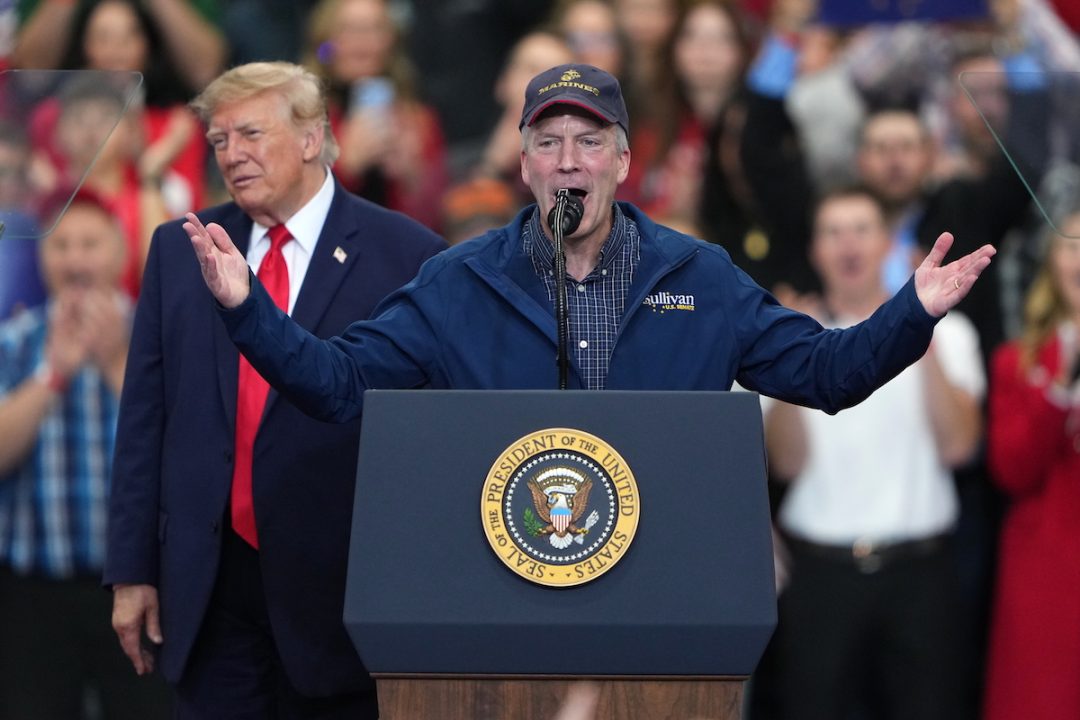
Trump acknowledged directing the legal action. Asked about the lawsuit Friday, he responded:
Well, I’m the one that said, “do it.”
Blanche defended the lawsuit Sunday on CBS’s Face the Nation:
All we are doing is trying to put guardrails in place so that if that happens, there’s a system allowed where the ballots are kept in a way so that we can determine whether there was confusion. It’s not saying don’t certify.
He also insisted:
This is the Department of Justice doing our own research under the law.
Blanche maintains that Trump is not attempting to take over Alaska’s election. Yet the complaint explicitly seeks to prevent certification under specified conditions.
The Constitutional Boundary
The constitutional stakes extend beyond Alaska.
Article I, Section 4 assigns congressional election administration initially to state legislatures:
The Times, Places and Manner of holding Elections for Senators and Representatives, shall be prescribed in each State by the Legislature thereof[.]
Congress may “make or alter such Regulations,” subject to an exception concerning the places of choosing senators.
That distinction matters. Congress possesses enumerated authority over federal elections. The executive branch does not acquire unlimited supervisory power because an election involves a federal office.
The conflict is not new. Earlier this year, Trump openly called for Republicans to “nationalize” elections, describing states as “agents” of the federal government.
In June, a federal judge blocked key provisions of Trump’s election executive order. Judge Indira Talwani stressed:
The Constitution does not grant the President any specific powers over elections.
That ruling concerned executive orders rather than DOJ litigation. Nevertheless, it underscored the constitutional limits on presidential election authority.
In Alaska, the DOJ invokes the National Voter Registration Act, citing,
Congress has tasked state officials with “protect[ing] the integrity of the electoral process.”
But the statute principally governs voter registration. Its general statement of purpose does not expressly authorize suspending certification over alleged confusion between candidates.
The complaint also cites Supreme Court precedents recognizing states’ authority to prevent election abuses.
In Bullock v. Carter (1972), the justices recognized a state’s interest in protecting elections from “frivolous or fraudulent candidacies.”
In Jenness v. Fortson (1971), the Court similarly acknowledged:
There is surely an important state interest in … avoiding confusion, deception, and even frustration of the democratic process at the general election.
Neither ruling establishes that the DOJ may override a state’s judicial resolution of a ballot dispute or halt certification because a particular candidate loses.
Alaska Pushes Back
Opposition has emerged from both parties.
Republican Senator Lisa Murkowski of Alaska declared that the DOJ “should never have filed this lawsuit.”
She added:
Alaskans don’t need any help voting for their preferred candidates, and the State of Alaska has already handled this by clearly distinguishing the candidates on this year’s ballot.
Alaska election officials themselves moved to dismiss the federal lawsuit Monday, arguing that the complaint lacked a legal basis. They requested immediate dismissal with prejudice.
Peltola’s campaign and the Democratic Senatorial Campaign Committee also moved to dismiss.
Their attorneys argued:
DOJ’s complaint is wholly baseless. The fact that DOJ nonetheless chose to file it raises profound constitutional concerns.
The American Civil Liberties Union, Common Cause, and the League of Women Voters of Alaska have also sought to intervene.
On Monday, U.S. District Judge Sharon Gleason expedited proceedings, questioning the DOJ’s decision to sue after voting had already begun and nearly four months after Alaska’s highest court resolved the ballot dispute.
The judge has not yet ruled on the merits.
A Precedent Beyond Alaska
The implications extend well beyond one Senate race.
If the DOJ can halt certification over alleged voter confusion after state courts have resolved the underlying dispute, future administrations — Democratic or Republican — could invoke similar arguments in other closely contested elections.
Federal election laws remain binding, and states cannot disregard constitutional voting protections. But enforcement must rest on actual statutory authority, not expansive interpretations of congressional objectives.
Alaska’s voters, election officials, and courts have established procedures for choosing their senator.
Whether Washington can interrupt that process because the president’s preferred candidate might lose is now the central issue.