

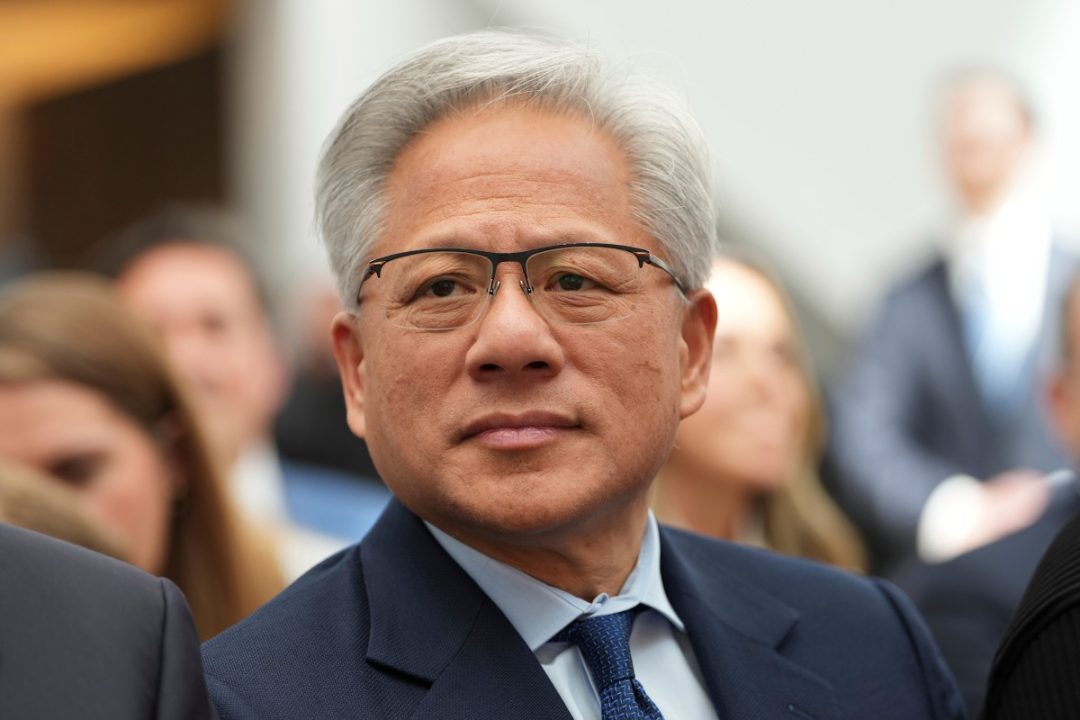
Trump Intervenes to Reinstate Nvidia CEO, Stands to Gain Millions
President Donald Trump personally called into Nvidia’s board meeting to secure the reinstatement of its former CEO, Jensen Huang, despite ongoing federal investigations. Nvidia’s stock soared following the decision, potentially adding $15 million to Trump’s personal fortune in a single day.
It was a remarkable exercise of presidential power, one difficult — if not impossible — to reconcile with the principles of either constitutional government or free-market capitalism.
“I Made the Deal”
On Monday, Nvidia announced the reinstatement of its co-founder, Jensen Huang, as president, chief executive officer, and board member. The board voted unanimously. Just six days earlier, Chairman Harvey Jones had ruled out Huang’s return.
What changed? President Donald Trump readily took credit.
In a Monday morning interview with CNBC, the president declared:
I spoke to them. Let me put it this way: And I convinced them. I made the deal.
Trump acknowledged communicating with directors both directly and indirectly. Semafor reported that the president personally called into Sunday’s board meeting to advocate for Huang’s reinstatement.
The president also acknowledged that Nvidia’s plunging stock price made the directors more receptive to his intervention.
According to The Associated Press, Vice President JD Vance, Treasury Secretary Scott Bessent, and Commerce Secretary Howard Lutnick helped persuade the board.
Nvidia explicitly acknowledged receiving input from senior government officials. On that basis, directors concluded that Huang’s return presented no national security risk.
Trump subsequently proclaimed on Truth Social:
The Country needs Jensen’s leadership at NVIDIA in order to ensure the Success and Prosperity of not only the Company, but the American Economy.
Trump also characterized Huang as a “national treasure” and “patriot.” He said Attorney General Todd Blanche had confirmed that the government possessed no evidence of unlawful conduct by Huang.
The president nevertheless urged Nvidia to continue investigating its compliance with American export controls.
Exoneration Before Investigation?
Huang resigned on November 12 following revelations of multiple extramarital affairs. One involved Alice Huang, an unrelated Chinese businesswoman whom American intelligence officials suspect of working for Beijing.
The woman previously held an executive position at Megaspeed, a Singapore-based Nvidia customer. Federal authorities began investigating Megaspeed in 2024 over suspected diversions of advanced American semiconductors to China. Beijing denies the espionage allegations.
According to The New York Times, Trump received intelligence briefings concerning the relationship in 2025. Nevertheless, Huang retained extraordinary access to the administration, and on October 8, 2026, Trump awarded him the National Medal of Science.
Meanwhile, the investigations have multiplied.
Reuters reported Tuesday that federal authorities are examining Nvidia’s accounting practices, acquisitions, sales practices, and potential export-control violations. California Attorney General Rob Bonta also served Nvidia with an investigative subpoena last Thursday.
On Monday, the administration added Megaspeed to its trade blacklist.
Nvidia itself maintains an independent investigation into the suspected foreign intelligence operation targeting Huang. The company has also established a national security and export-control committee and launched a search for a chief compliance officer.
Huang has not faced criminal charges. However, the company’s own investigation remains unfinished, notwithstanding the president’s assurances.
A Profitable Presidential Intervention
Trump’s involvement carries another complication: his substantial personal investment in Nvidia.
The company’s shares surged 31.5 percent Monday, recovering approximately $950 billion in market capitalization. The broader S&P 500 gained 4.7 percent.
Trump, as a stakeholder, most likely benefited handsomely. An analysis by the Financial Times estimated that the president held between 32,000 and 370,000 Nvidia shares at the end of September. Assuming those holdings remained unchanged, Monday’s rally boosted their value by between $1.3 million and $15 million.
The exact figure remains unknown, as federal financial disclosures report transactions within broad dollar ranges. Reporting delays also obscure more recent transactions.
Nevertheless, Trump’s exposure to Nvidia has grown considerably during his second presidency.
At the end of 2024, Trump disclosed Nvidia holdings worth between $615,000 and $1.3 million. By the end of 2025, that range had ballooned to between $12.5 million and $58 million.
His latest financial disclosure revealed additional Nvidia purchases totaling as much as $265,000 in September.
The White House maintains that independent financial institutions manage Trump’s investments without instructions from the president or his family. That arrangement addresses who executes the trades, it does not eliminate the president’s financial exposure to his own policy decisions.
The Politics of Corporate Governance
Nvidia’s financial relationship with Trump’s presidency extends beyond his investment portfolio.
An October investigation by The Washington Post revealed that Nvidia pledged $25 million toward Trump’s White House militarized ballroom project in October 2025. The company requested anonymity. The contribution followed the administration’s relaxation of restrictions on certain Nvidia chip exports to China.
Senator Chris Van Hollen (D-Md.) highlighted those connections Monday, saying, “This is what a rigged system looks like.”
Criticism also came from Republicans, ABC News reported. Senator Pete Ricketts (R-Neb.) argued that Huang’s conduct did not justify reinstatement. Senator John Curtis (R-Utah) questioned which government officials provided assurances and what evidence supported them.
Huang will testify publicly before the Senate Banking Committee on December 3.
Corporate governance specialists have also questioned whether Nvidia’s directors demonstrated sufficient independence.
Capitalism by Presidential Permission?
Trump’s intervention raises questions that transcend Huang’s personal conduct, Nvidia’s commercial fortunes, and even the president’s financial interests.
Article II of the Constitution entrusts the president with executing federal law. It confers no general authority to manage private corporations, select their executives, or sustain their market valuations.
Nvidia, meanwhile, is incorporated in Delaware, where corporate law entrusts the management of corporations to their boards of directors.
Presidential advocacy may not automatically constitute an unlawful exercise of power. Yet meaningful corporate independence requires directors to exercise their own judgment, particularly when dealing with officials who control consequential regulatory and enforcement decisions.
Trump’s defenders can point to Nvidia’s economic significance, America’s technological competitiveness, and the enormous losses investors suffered following Huang’s departure, but the free-market objection concerns the precedent.
Private enterprise entails risk, and investors assume it voluntarily. Companies succeed or fail through commercial decisions, competition, and accountability.
Government intervention distorts those mechanisms, particularly when politically connected corporations enjoy privileged access to officials with substantial personal financial interests in their success.
Further, if economic significance justifies presidential intervention in corporate management, where does that assumed authority end? And what happens when a future president invokes the same rationale to demand an executive’s removal?
Nvidia’s shareholders, including the president himself, certainly benefited from Monday’s rally. The longer-term question is whether American enterprise can retain its independence when Washington increasingly assumes responsibility for its commercial success.
Related Articles:
Nvidia Spy Scandal Puts Trump’s China Chip Deals Under Scrutiny
Trump’s “State Capitalism”: Washington’s Expanding Corporate Portfolio