

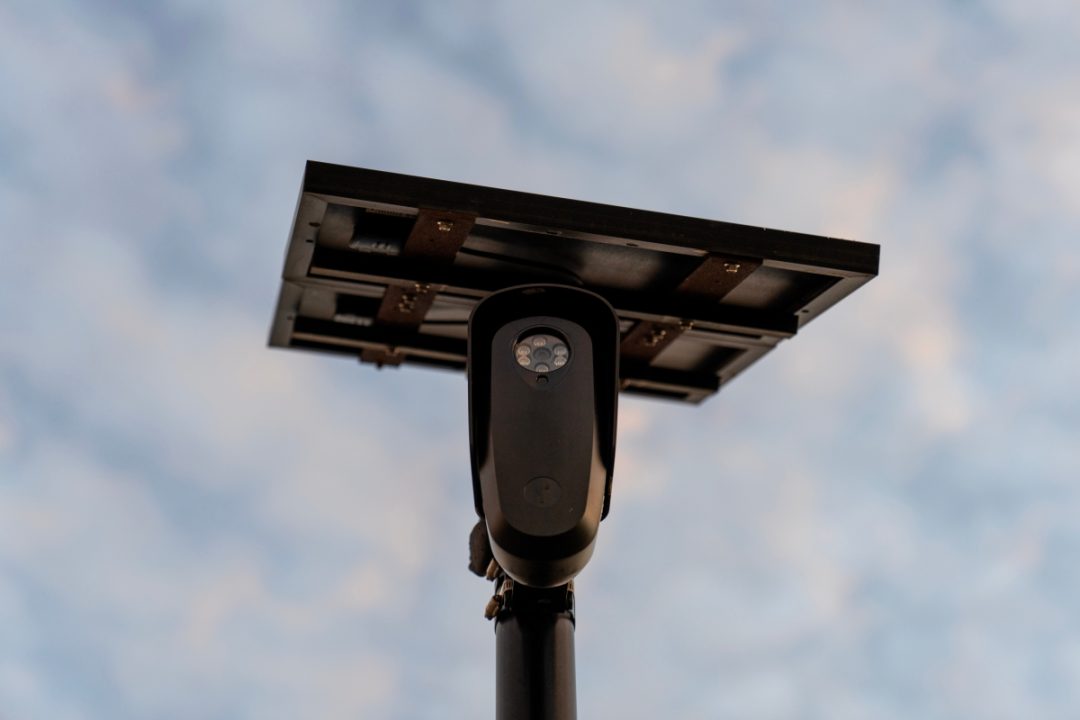
Americans Are Destroying Flock Cameras in Protest
Americans are destroying Flock cameras in illegal acts of protest. As a headline from tech publication Gizmodo eloquently phrased it, “Flock cameras have a people-love-smashing-them problem.”
Resistance to the Flock surveillance camera system has been building up since last year. In Suffolk, Virginia, 13 cameras were destroyed from April to October of 2025. One man was arrested after being caught on cameras that he didn’t smash. In October of 2025, someone took down six cameras in Eugene and Springfield, Oregon. One of the cameras had an expletive-laden note addressed to “ya surveilling f-cks.” In La Mesa, California, someone broke two cameras; one was smashed and left on the median. “This happened weeks after the city’s Flock contract moved ahead despite local opposition,” noted the folks at State of Surveillance. There were other incidents in Greenview, Illinois, and Lisbon, Connecticut, among others.
The Flock revolt appears to be intensifying. Last week a FOX affiliate reported that two cameras exploded in Albany, Georgia. “Intentional criminal activity” is suspected. The Auto Wire rattled off a series of recent anti-Flock vigilante destruction:
The incident list has grown fast since mid-June. In Ashland, Ohio, crews found shattered solar panels and camera poles apparently struck by vehicles, bats, or clubs. In Houston, police are still tallying cameras found cut in half and spray-painted along Washington Avenue. Deputies in Barrow County, Georgia found three poles sawed clean through along a rural road. And in New Bern, North Carolina, two men caught on camera cutting down a freshly installed unit became local celebrities after the police tip line filled up with joke submissions for “Batman and Robin.”
Vigilante Flock destruction is a nationwide trend. It’s happening in “blue” areas, it’s happening in “red” areas, and it’s happening in “swing” areas. Unlike most nationwide acts of protest that include criminal behavior, this one appears to be legitimately organic.
Motivations vary, though they likely fall into three main categories. Those include outrage spurred by reports of officers abusing the technology for personal use, opposition to ICE using Flock footage to round up illegals, the belief that the cameras violate the Fourth Amendment because they constitute “warrantless and unreasonable surveillance,” and a combination of two or all three.
Abuse of Power
In Texas, the Baytown police chief announced in a Facebook video that he authorized an Internal Affairs probe into an officer suspected of “misconduct” related to the Flock system. In Sumter County, Florida, “a sheriff’s detective was fired and taken into custody after she allegedly accessed several systems to gather information on her husband’s ex,” according to reports.
The abuse among law enforcement appears to be endemic. AutoWire reported 18 examples that include hundreds of instances of officers using the Flock system to find or stalk former partners. In Westmoreland County, Pennsylvania, Officer Michael McSherry pleaded guilty to stalking after using the cameras to track his estranged wife and other family members. Lieutenant Victor Heiar of Kechi, Kansas, admitted to doing something similar. Police Chief Lee Nygaard, also of Kansas, resigned after using Flock cameras more than 160 times to find his ex-girlfriend and her new boyfriend. In Riverside, California, “after being arrested for kidnapping his ex-fiancee, Deputy Alexander Vanny allegedly used the system to track one of her friends; he was later convicted of multiple charges.”
Over and over, it’s the same story. People who are supposed to have limited permission to this technology have abused their power in Orange City, Florida; Shelby County, Tennessee; Jerome County, Idaho; Braselton, Georgia; Louisville, Kentucky, and all over Wisconsin. Officers repeatedly use this powerful technology for nefarious and personal means.
Speaking of Louisville, the City Council there voted to keep the location of Flock cameras secret after the city police department refused to comply with an open-records request for the exact locations of its nearly 200 cameras. City officials are afraid that people are going to locate the cameras and destroy them.
The Resistance
The resistance is multi-faceted. It’s not just citizens committing what they view as justified crimes. From local officials to federal ones, pushback is widespread. Knox County, Tennessee, Mayor Glenn Jacobs is urging the commission to ban the Flock system. The sheriff’s office received a grant for the cameras but the current sheriff and Jacobs will not employ them.
Jacobs, who happens to have been the professional WWE wrestler “Kane,” described the problem with the Flock system this way:
These cameras … are motion activated and take a picture of every car which passes by. While License Plate Readers have been around for a while, because of AI and vastly increased networking and data retention capacities, these Flock cameras have capabilities not even imagined in the past. Older cameras only took a photo of your license plate, which was then retained for a short time. Flock cameras take a photo of your place, but also use AI to catalogue distinguishing features of your vehicle: make, color, model, even bumper stickers. That data is stored in a searchable database for sometimes up to a month or more, depending on the policies of that particular agency. When these cameras are deployed in large numbers, they create a network that can be used to track your movements. Currently, there is no federal regulatory framework governing these devices in place, and the Tennessee laws regulating them were written over a decade ago. My fear is that may be inadvertantly creating a warrantless mass surveillance system and undermining the privacy and Liberty of our people.
The surveillance concern is one shared by Representative Tim Burchett (R-Tenn.), who represents the people of Knox County and who’s been coordinating resistance with Jacobs. “These things violate our constitutional rights,” Burchett recently said in a short video recorded on the steps of Congress. Like many, Burchett believes these cameras violate the Fourth Amendment. “Americans should never choose between safety and liberty,” he said. “We gotta ban these dadgum things.”
Burchett also introduced the “Protection Against Mass Surveillance Act.” The point of the proposal is to “prohibit Federal agencies from purchasing or accessing automated surveillance systems that identify, track, or record individuals, and for other purposes.”
In the Bluegrass State, Representative Thomas Massie, who has less than five months left in Congress, announced on Saturday that he planned to sponsor a “a bill to withhold federal money from municipalities and police departments that deploy Flock (and other style) cameras to surveil law abiding citizens.”
SCOTUS Ruling
Flocks are also being tested in court. A Supreme Court ruling from June 29 has the potential to undo the entire system. The Court ruled 6-3 that police conduct a Fourth Amendment search when they pull cellphone location data, because people have a reasonable expectation of privacy when it comes to that information. The judges rejected the argument that pulling only a narrow, time-limited slice from a larger database renders the action constitutional. Once the Fourth Amendment applies, the size of the data “bite” does not matter, the majority judges decided.
That argument undermines the decision of a federal court in the Eastern District of Virginia that sided with the city of Norfolk’s defense of Flock. On the losing end were two citizens who argued that “a city-wide camera dragnet capturing their daily movements amounts to a warrantless search under the Fourth Amendment,” per reports. The lower court said that the Flock system didn’t track enough of a person’s life to be considered a constitutional violation.
The two citizens have now appealed to the Fourth Circuit Court. And, as AutoWire put it, “that appeal drew a genuine murderer’s row of amici.” They have support from the ACLU, ACLU of Virginia, the Electronic Frontier Foundation, and the Cato Institute.
There is obviously no guarantee of a favorable outcome. Lower courts and SCOTUS have become notorious for coming to inane conclusions. But the courts are one of many avenues of remedies. Americans can end Flocks via their city councils, or their county commission, or even through their state legislature. And this seems to be a fight that Americans are willing to put up and endure.