

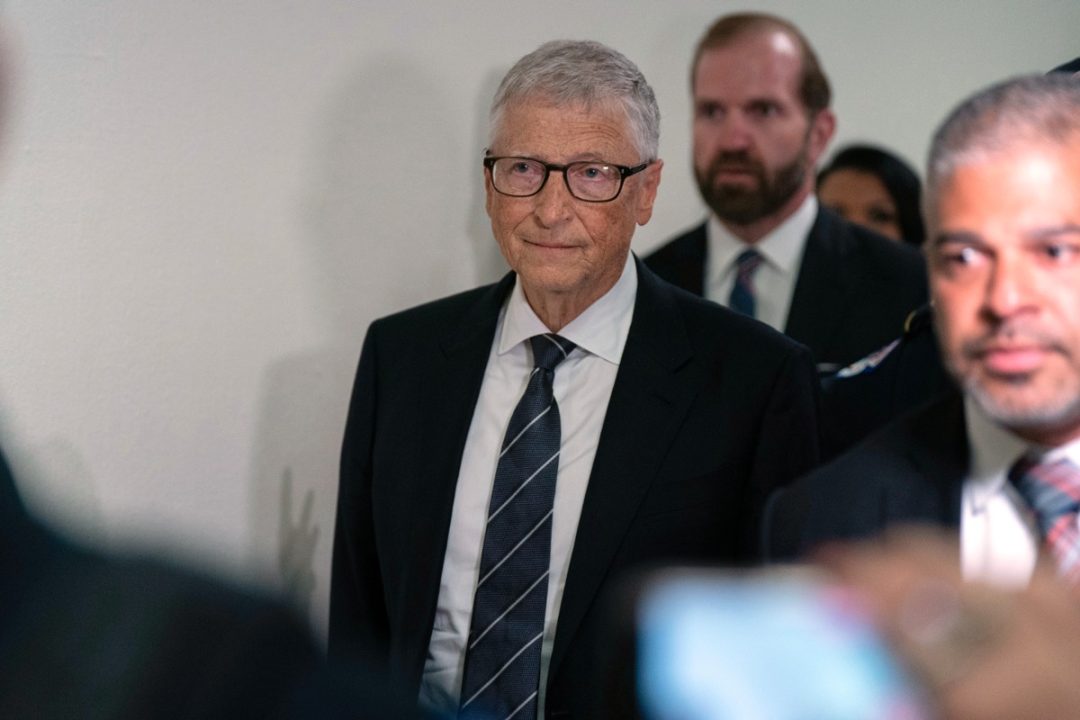
Bill Gates Joins Regulation Chorus Despite Ties to AI Funding
Bill Gates has boarded the artificial intelligence scare train. He’s joined the chorus of high-profile people warning that AI will wipe out humanity if the government doesn’t step in and regulate it. Interestingly, Gates has ties to billions of dollars in AI investments.
“AI is certainly powerful enough to drive events that, you know, cause a billion deaths,” he said during a recent interview with NBC’s Meet the Press. Gates, like the heads of the largest AI companies, is advocating guardrails. “You need law enforcement and the politicians to get into the discussion about what safeguards and monitoring look like,” he said. “And that has to be a required thing. And it will be a little bit of overhead for the industry, but not a dramatic slowing of what they’re doing.”
Alarmist History
Gates has a history of screeching that the sky is falling. The software tycoon moonlit as an alarmist climatologist for decades. He peddled and pumped lots of money into the climate catastrophe narrative. He even wrote a book titled How to Avoid a Climate Disaster. Then suddenly last year he said there was no climate doomsday coming. “Climate change is not the biggest threat to the lives and livelihoods of people in poor countries, and it won’t be in the future,” Gates announced on his personal blog, GatesNotes. He didn’t say that climate change didn’t exist, only that it wasn’t going to bring about the devastation he, the United Nations, and other globalist outfits had been claiming that it would (the UN does not share Gates’ position).
He said he changed his alarmist view on climate change for two reasons. First, because emissions projections had gone down, and second, because it was time to focus on improving people’s lives. Interestingly, the projections he cited as reason to backtrack — the ones that say the Earth’s average temperature will probably be between 2°C and 3°C higher than it was in 1850 — are the same ones the UN is now using to justify its calls to overhaul global society immediately, before the planet turns into a cauldron of perpetual wildfires, floods, droughts, and food-shortage emergencies.
Helping or Hurting Humanity?
As for making people’s lives better, it’s difficult to take this supposed goal seriously, given that Gates has supported policies that have hurt people immensely, among them the ruinous ones leveled during the Covid era. What most likely happened is that Gates’ interests collided. As AI development advanced, he became an investor and advocate. At some point, it became obvious that solar panels and wind turbines weren’t going to cut it when it comes to fueling this energy-hungry technology.
In the same blog he announced that climate change was no longer an existential threat, he praised AI as a technology that can help people:
AI-powered devices make it possible for health workers to provide ultrasound exams for pregnant women in low-income settings — a breakthrough that means many more women will get the treatment they need to survive childbirth and deliver a healthy baby. AI is also helping researchers develop new vaccines and treatments faster, adding to the long list of affordable lifesaving tools that are already available.
Investment in AI
Gates is connected to massive infusions of money into AI. Between 2019 and 2023, Microsoft, the company he started that made him relevant, invested $13 billion in this technology. While Gates stepped down as the chairman of Microsoft in 2014, he was on its board of directors until 2020, is still a major shareholder, and counsels the current head of Microsoft, Satya Nadella.
But it’s through the Gates Foundation that his investment in AI is easiest to prove. Gates is the chair of the foundation’s governing board, and the foundation has pledged over $1 billion in AI investments. Back in May, it partnered with Anthropic on a pledge of “$200 million to back artificial intelligence-related public goods and areas including health and education,” per reports. And just two weeks ago, at the exact time Jacob Coxon’s AI media doomsday tour was beginning, the foundation announced “plans to spend at least US$1 billion over the next two years to expand access to artificial intelligence and … AI-enabled solutions.”
Calls for Government Regulation — Why?
Now Gates joins some of the largest investors in AI who are calling for regulation while, at the same time infusing the industry with a lot of money. How does that work?
After Coxon’s rise to whistleblower stardom, AI chiefs Sam Altman (OpenAI), Dario Amodei (Anthropic), and Elon Musk agreed that government regulation is a good idea. Amodei wrote a manifesto calling for the slowdown and regulation of AI. News reports about it spread like wildfire throughout the legacy media ecosystem.
But just as fast as the issue reached hysterical heights, suspicions arose. Analysts and observers suggested we were watching a theatrical play for regulatory capture — a ploy by these companies to obtain an infusion of taxpayer cash into their expensive projects while cornering the market by raising the hurdle for startups to enter the game. As Dr. Robert Malone succinctly put it, “Big Tech can afford AI regulation. Its competitors cannot.”
The American Prospect noted how the warnings were followed by calls for taxpayer money. “Amodei told Face the Nation that ‘the government and the public need to have a stake’ in artificial intelligence, which is a call to use taxpayer funds on the technology his company’s employees are calling apocalyptic,” the Prospect reported. “Meanwhile, Altman pitched utility companies on using his AI to defend the grid from cyberattacks, which could be generated by the same AI.”
Gates alluded to this as well when he told Meet the Press that regulation would add a “little bit of overhead for the [AI] industry.”
Various reports have also pointed out that these major AI companies have burned through an enormous amount of money.
The AI “Cartel”
The Prospect accused the AI heads of behaving like cartel chiefs and suggested they be held accountable like anyone else who is building something that endangers people:
One way to react to these demands for public money, cartel-like behavior, and something approaching extortion is to haul everyone involved with these companies into police stations for questioning. But rather than stopping tech tycoons taking the law into their own hands, lawmakers have descended into hysteria, demanding that somebody “do something” to save the world.
Good point. If these companies are indeed making something so potentially dangerous, something that has repeatedly escaped and hacked other companies, as they’ve claimed, why are there no calls for accountability? Instead, many politicians are suggesting legislation and kill switches. Even the president, who first said there was no need for additional guardrails, followed up with the announcement of an AI task force.
Perhaps what’s really happening is we’re witnessing a ploy for control over a technology with immense power and potential, a technology that, as Drs. Robert and Jill Malone said, “is rapidly becoming the gatekeeper to the world’s information.” The Malones noted AI’s growing potential for controlling what people know and feel:
Increasingly, people will not search through ten websites and decide for themselves what they believe. They will ask a machine a question and receive an answer. That makes the rules governing those machines enormously important. Who decides which sources the machine trusts? Which claims it labels misinformation? Which questions it refuses to answer? Which information it never shows you at all?
The Malones answer their own question a few paragraphs down: “The people who write the rules for artificial intelligence may ultimately help determine what the machine is allowed to tell you.”
Advocating Censorship
Gates has never been shy about his appreciation for censorship. In 2021, he told CNN that the government should force social-media companies to censor certain views about election “misinformation.” He has also advocated censorship of people who don’t subscribe to his views on vaccines.
As an investor in AI and advocate of censorship, it appears Bill Gates has much to gain from regulating this technology. It seems that, for him, control — control over what people say, control over what people put in their bodies, control over what people think, control over what energy is available — has always been his main agenda. Perhaps it is again in this case.