So Help Me God: The Oath, the Blasphemer, and Your Ballot
On Tuesday, November 3, Americans will file into school gymnasiums and church fellowship halls and choose the men and women who will next stand before a flag, raise a right hand, and swear before Almighty God that they will support the Constitution of the United States.
Many of them will be lying. Some of them already know it.
That is not hyperbole. It is the record. Congress has not declared war since June 1942, when it declared war on Bulgaria, Hungary, and Romania. Since then American sons have bled in Korea, Vietnam, Iraq, and Afghanistan under “resolutions” and “authorizations” the Constitution nowhere mentions. The power to declare war belongs to Congress alone. Every member who surrendered that power to the executive had sworn to support the document that vested it in him. The oath was taken. The oath was broken. Then, two years later, the same man raised the same hand and called on the same God to witness the same promise.
The Founders would not have recognized such a man as a statesman. They would have recognized him as a perjurer.
The first act signed into law by President George Washington, on June 1, 1789, was not a tariff, a tax, or an army bill. It was “An Act to regulate the Time and Manner of administering certain Oaths.” Before the new government collected a penny or raised a regiment, it bound its officers to the Constitution by oath.
A constitution without a conscience behind it is parchment. The oath is the conscience.
What an Oath Is
In February 1775, a young Alexander Hamilton told a Tory pamphleteer to “apply yourself, without delay, to the study of the law of nature,” and named the authorities he should read. Grotius was first. Pufendorf was second. The founding generation learned the meaning of an oath from men such as Samuel Pufendorf, who wrote in The Whole Duty of Man According to the Law of Nature:
Now when an All-wise and an Almighty Witness and Guaranty is invoked, it causes a strong presumption of the truth, because no man can easily be thought so wicked, as to dare rashly to call down upon himself the grievous indignation of the Deity. Hence it is the duty of those that take an oath, to take the same with awful reverence, and religiously to observe what they have sworn.
The presumption of truth rests entirely on the presumption of fear.
Why is such a thing necessary? Pufendorf answered that too:
Now the end and use of an oath is chiefly this, to oblige men the more firmly to speak the truth, or to make good their promises and contracts out of an awe of the Divine Being, who is infinitely wise and powerful; whose vengeance they imprecate to themselves when they swear, if they wittingly are guilty of deceit; whereas otherwise the fear of what men can do may not be sufficient; because possibly they may have hope to oppose or escape their power, or to beguile their understandings.
There is the doctrine. Now here is its shadow. The modern officeholder has every reason to believe he can escape the power of men. He has the gerrymander, the war chest, the friendly press, and the short memory of the voter. He can beguile our understandings with a 2,000-page bill no one has read. The only power he cannot escape is the one he invoked with his hand raised.
And the penalty, Pufendorf insisted, is greater for the oath-breaker than for the ordinary liar:
But the taking of an oath has this effect among men, for the sake of that invocation of God which is therein made use of, whose wisdom no man’s cunning can elude, and who suffers not the man that mocks Him to escape unpunished; that not only a heavier punishment is assigned to him who forswears himself, than to him who barely breaks his word, but it puts them in mind to avoid all deceit and prevarication in the matters which it is added to confirm.
The man who breaks his word is a liar. The man who breaks his oath is a perjurer. Every generation of Christians before ours knew the difference.
Vattel and the Word Alone
In December 1775, Benjamin Franklin reported that Emer de Vattel’s The Law of Nations was constantly in the hands of the members of the Continental Congress. Vattel was not a footnote to the founding. He was on the desk.
Vattel wrote of an age when popes claimed the power to absolve princes of their sworn treaties, and he dismissed the pretense with contempt:
But, in the present day, even children know that an oath does not constitute the obligation to keep a promise or a treaty: it only gives an additional strength to that obligation by calling God to bear witness. A man of sense, a man of honor, does not think himself less bound by his word alone, by his faith once pledged, than if he had added the sanction of an oath.
Vattel’s man of honor would be bound by his bare promise, with no Bible, no raised hand, and no witness but his own conscience. The oath adds nothing to his obligation except the weight of Heaven. What, then, are we to make of men who are bound by neither? Men who campaign on the Constitution in October and legislate against it in January? Men whose word means nothing and whose oath means less?
Vattel said even children understood this. Our officeholders are not children. They have simply decided the rule does not apply to them.
Sidney, Cato, and the Men No Oath Can Bind
Algernon Sidney went to the block on Tower Hill in December 1683, convicted in part on the strength of his unpublished manuscript. That manuscript became the Discourses Concerning Government, and the generation that wrote the Declaration of Independence read it as scripture of liberty. One section bears a title every member of Congress should have engraved on his desk: “Kings cannot be the Interpreters of the Oaths they take.”
Sidney exposed the courtier’s trick. Those who serve power at the expense of their country, he wrote, cannot persuade mankind that rulers may govern as they please while everyone knows there are laws to restrain them. Nor can they persuade mankind
that princes can attempt to dissolve the obligations laid upon them by the laws, which they so solemnly swear to observe, without rendering themselves detestable to God and man, and subject to the revenging hands of both, unless they can invalidate those oaths.
Unless they can invalidate those oaths. There, in one clause, is the entire history of American constitutional decay. No one in Washington openly repeals the Constitution. They reinterpret it; they call it “living”; they declare that “general welfare” means unlimited welfare and that “commerce” means everything. Madison promised in The Federalist, No. 45, that the powers delegated to the federal government were “few and defined.” The oath-breaker’s art is to swear to that Constitution and then interpret it into a different one. The servant of power does not break the oath. He empties it.
Forty years after Sidney’s death, Thomas Gordon, writing as “Cato,” confronted the men behind the Jacobite plot of 1723. Many of them had sworn allegiance to the very government they conspired to overthrow. Gordon asked in Letter No. 125:
Or how should the love of liberty and peace bind these men, whom neither the laws of humanity, and of their country, nor the religion of an oath, nor the awful gospel of Jesus Christ, can in the least bind?
In the next letter he turned to the clergymen who had joined or cheered the conspiracy, and his words fall with special force on any official who professes faith while trampling his oath:
Your little regard to conscience, and your wanton contempt of oaths, are sad proofs how small power the Christian religion, or any religion, has over you. What can bind the man whom oaths cannot bind?
That is the question of this election. Put it to every candidate on your ballot. What can bind the man whom oaths cannot bind? Not a campaign promise; not a party platform; not a pledge on a website. If the name of God will not hold him, nothing you or I can say will.
The Words They Say
Article VI of the U.S. Constitution requires that senators, representatives, state legislators, and all executive and judicial officers, federal and state, “shall be bound by Oath or Affirmation, to support this Constitution.”
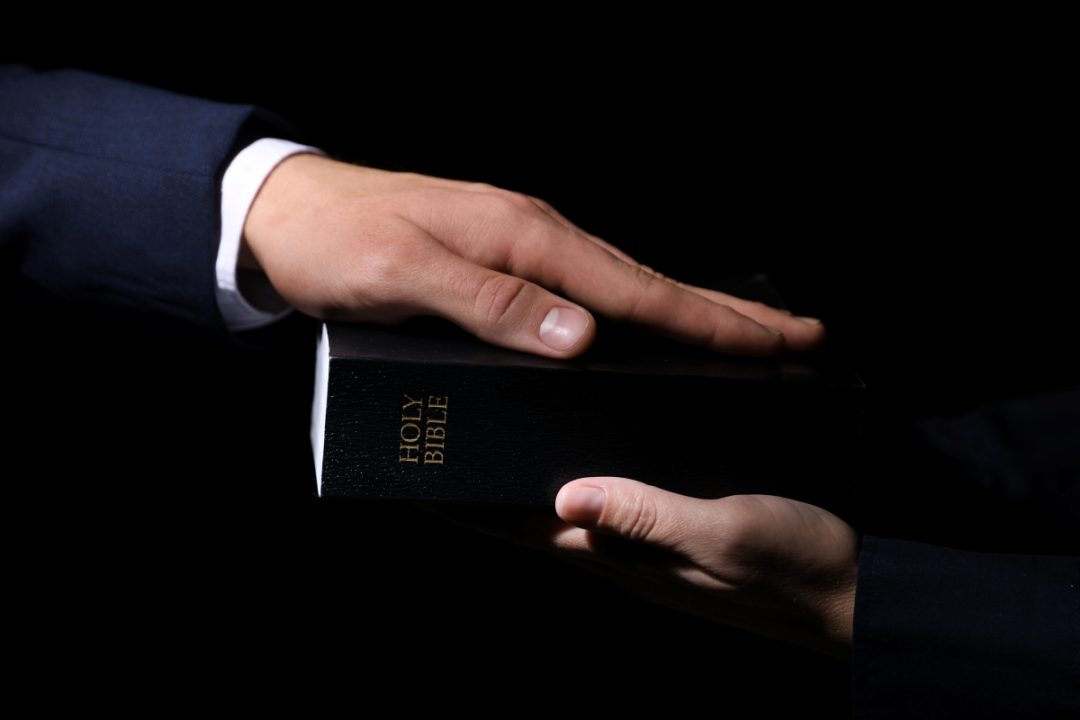
The oath sworn today by members of Congress, set out in federal law, goes further. Each member swears to “support and defend the Constitution of the United States against all enemies, foreign and domestic,” to “bear true faith and allegiance to the same,” and that he takes the obligation “freely, without any mental reservation or purpose of evasion.” Then he closes with four words: “So help me God.”
Read the middle clause again. Without any mental reservation or purpose of evasion. The law anticipates the liar. It names his method and forbids it in advance. The man who swears those words while privately intending to vote for whatever his leadership, his donors, or his ambition demands has not merely broken his oath. He perjured himself in the act of taking it.
Notice, too, what the Constitution does not require. It allows an affirmation in place of an oath, a courtesy the Framers extended to Quakers and others whose consciences forbade swearing. Franklin Pierce affirmed in 1853. No officeholder is compelled to invoke God. Tradition holds that Washington added “So help me God” on the balcony of Federal Hall in 1789, though that account first appeared in print decades later. Whatever Washington said, the modern officeholder chooses those words for himself. He volunteers to call the Almighty as his witness.
The ancients understood what that volunteering meant. Polybius observed that a Greek official could not be trusted with a single talent though watched by 10 clerks and 20 witnesses, while Roman magistrates handled vast sums honestly because they had sworn an oath. Rome kept faith because Rome feared the gods. Cicero preserved the example of Marcus Atilius Regulus, who, released by Carthage on his oath to return, went back to torture and death rather than break his word to an enemy.
Regulus kept his oath to Carthage at the cost of his life. Our representatives will not keep theirs to their own countrymen at the cost of a committee assignment.
Perjury in the Name of God
We call ourselves a Christian nation. We say our liberties come from our Creator. Very well. Then let us take seriously what our Creator says about men who use His name to vouch for a lie.
Thou shalt not take the name of the LORD thy God in vain; for the LORD will not hold him guiltless that taketh his name in vain. (Exodus 20:7)
And ye shall not swear by my name falsely, neither shalt thou profane the name of thy God: I am the LORD. (Leviticus 19:12)
The commandment against taking His name in vain is not chiefly about a curse muttered on a golf course. Its first and gravest application is the false oath: invoking the name of God to guarantee a promise one has no intention of keeping. Leviticus makes the connection explicit. To swear falsely by His name is to profane it.
Now picture the scene repeated every January in the Capitol. A man places his hand on a Bible. He calls on God to witness his fidelity to a constitution of few and defined powers. He has already promised his donors and his party that he will vote for programs that the Constitution does not authorize. Then he finishes with “So help me God,” smiles for the cameras, and goes to work dismantling the very document he just swore to defend.
That is not a political misstep. It is blasphemy, committed in public, in our name, and paid for by our taxes.
The Preacher warned, “When thou vowest a vow unto God, defer not to pay it; for he hath no pleasure in fools: pay that which thou hast vowed. Better is it that thou shouldest not vow, than that thou shouldest vow and not pay.” Better that a candidate refuse the oath altogether than take it in God’s name and break it in Caesar’s service.
Washington understood the stakes. In his Farewell Address he asked, “Where is the security for property, for reputation, for life, if the sense of religious obligation desert the oaths which are the instruments of investigation in courts of justice?” Substitute the halls of Congress for the courts of justice and the question answers itself. When the sense of religious obligation deserts the oath of office, there is no security for anything.
Here is the shame of it. A congregation that would be scandalized by profanity from the pulpit will cheerfully reelect a man who profanes God’s name on the Capitol steps. Pufendorf warned that God “suffers not the man that mocks Him to escape unpunished.” The apostle put it more plainly: “Be not deceived; God is not mocked.”
God is not mocked. But He may well ask why His people kept rehiring those who mocked Him.
Before You Mark the Ballot
Sidney said the oath-breaking ruler makes himself “subject to the revenging hands of both” God and man. The hand of God is His to raise. The hand of man, in a constitutional republic, is yours, and it holds a pen on Election Day.
The ballot is the only remedy for perjury the Founders left in the hands of ordinary citizens. Impeachment requires the cooperation of the very class of men who share the guilt. You alone can remove the oath-breaker without asking his permission.
So, before you vote, ask the questions that matter. Has this incumbent voted to send Americans to war without a declaration from Congress? Has he funded programs found nowhere among the enumerated powers of Article I, Section 8? Ask the challenger which enumerated power authorizes his favorite promise. If he cannot answer, he does not intend to keep the oath he is asking you to let him take.
Do not reward a man for swearing to God what he has already decided to betray. Do not tell yourself that he is the lesser evil, as though a smaller perjury were a virtue. Every vote cast for an oath-breaker is a vote to make the name of God a stage prop in the theater of power.
Gordon asked what can bind the man whom oaths cannot bind. The answer, on November 3, is you.
He will swear to God. Hold him to it or answer for him.