
Neocons Deny War Played a Role in GOP Disaster; Blame Vance, Other Issues
The warmongering neoconservatives who pushed President Donald Trump to attack Iran and blow the midterm elections for the GOP are flat-out lying to their listeners and readers.
No, the chicken-hawk podcasters and columnists say, the war is not to blame for the beating the GOP took on Tuesday. It was those who opposed the war, and other issues, that handed Congress to a Democratic Party on the verge of becoming openly communist.
Fox bloviator Mark Levin and Washington Post columnist Marc Thiessen say those who wanted a ceasefire and eventual peace are to blame. Thiessen avers that Vice President JD Vance has been “disloyal” to Trump for admitting the war is to blame.
Ben Shapiro fabricated more nonsense: “unaffordability, chaos, and corruption.” And the survey data, he claimed, show that “unaffordability” was the election’s top issue.
Levin’s Deranged Rant
Levin took to his radio microphone to blame the awful people who didn’t want the war and thought Trump should sue for peace.
“Why is it still going on?” Levin asked:
Because the VP came up with an MOU [memorandum of understanding] that was utterly defective. They thought they’d get a deal. We paid hundreds of billions or tens of billions of dollars. They rejected it. And we have this constant back-and-forth, back-and-forth, negotiation, no negotiation, talks, no talks.
Levin claimed that “we should have taken care of it,” “armed the Iranian people,” and “removed the regime.” It’s “the the only way to ensure the safety of the United States of America.”
“Now, these very same people want you to believe that we had an electoral blowout because the president of the United States took military steps to prevent the Iranian Nazi regime from getting nuclear weapons and using them against us,” Levin fumed:
They want you to believe that we had a blowout because this went on for too long, when, in fact, it’s their heroes that caused it to go on too long, constantly looking for off-ramps and off-ramps and off-ramps, constantly coming up with ideas to negotiate and talking terms and so forth and so on. They’re the reason it’s been prolonged. But even now, today, are we at war? … Our military sits there. …
Was I running the war? I wasn’t running the war. Who was advising the president? The vice president, some of the other people in there, advising him not to finish them off militarily? You start a war, you finish a war.
“These halfwits have a lot to answer for,” British podcaster Piers Morgan wrote of Levin and Shapiro.
Levin replied with his customary ad hominem invective.
“Piers Morgan is a washed-up scumbag, he will always be a washed-up scumbag, and has always been a washed-up scumbag,” Levin wrote:
And in two countries. His own country has gone to hell thanks to people who share his pathetic imbecility, but he spends his days trashing our country and platforming terror-loving Jihadis, while undermining our military and commander-in-chief. He’s another buffoon who has no problem with Iran having a nuclear weapon.
Thiessen: Vance Must Go
Thiessen attacked Vance today in the Post, just as he did on television. He ordered Trump not to endorse Vance for president, for Vance fled the reservation and admitted the truth.
“A source familiar with post-election happenings told Fox News Digital that there was a White House meeting Wednesday morning aimed at aligning the entire administration officials on post-midterm messaging,” the website reported:
A second source … described the meeting as a regular senior staff meeting.
Vance ignored the “messaging” and told the truth on X.
“The reason we lost is the war,” Vance wrote:
The president himself said so last night. …
[E]everyone knows why we lost. And any honest conversation about where we go from here must start there.
“Of course, this is ridiculous,” Thiessen wrote:
While Iran was an important factor, the exit polls showed it was one of many issues that contributed to Tuesday’s results. Though Vance tried to suggest he was merely echoing the president’s own view, he was clearly criticizing Trump’s decision to go to war, which the president has repeatedly defended since Tuesday. As he told the Wall Street Journal, “I did the right thing. I would have done it again.” Vance conspicuously did not say the same. Indeed, his statement contained not a single word of support for Trump’s decision to act to prevent Iran from ever getting a nuclear weapon.
And the “irony is,” the neoconservative warmonger wrote, Vance should “take a good hard look in the mirror” if he wants to ascribe blame.
It was a “failure to win” the war that caused the electoral loss “due to the Iran ceasefire and the disastrous memorandum of understanding with Iran that was negotiated by Vance,” Thiessen wrote, parroting Levin:
The Trump Doctrine is all about winning — going in with defined objectives and overwhelming force and then getting out quickly. And in April, America was just weeks away from achieving its military objectives in Iran. Operation Epic Fury was an overwhelming success, destroying more than 85 percent of Iran’s defense industrial base, sinking its navy, grounding its air force, decimating its ballistic missile capability and crushing its conventional military forces.
But it ended short of completion, because Trump was incorrectly advised by Vance and others that the Iranian regime desperately wanted a deal to end the war. Soon Vance signed an MOU that was supposed to lay the groundwork for that deal, which the Iranians clearly had no intention of ever pursuing. A successful military blockade crippled Iran economically, but also created false hope that Iran would soon cry uncle and sign a deal to give up its nuclear ambitions — which it never did. Each time Trump lost his patience and prepared to resume major combat operations, he was assured that this time the Iranians were finally ready — only to be set up for failure yet again.
Those “botched negotiations” kept the war going, “and with it the high prices Americans are paying at the pump,” he continued:
If we had finished the job in April, major combat would have been over six months ago, and gas prices could have come back down to below $3 a gallon long before Americans went to the polls.
But instead of a clear and decisive end to the military campaign, Americans were treated to months of fruitless talks, repeated Iranian violations and U.S. retaliatory strikes, followed by still more negotiations — which created the impression of a standoff with no end in sight. Americans spent the past six months in petroleum purgatory, repeatedly promised a deal to end the war and bring down gas prices that never materialized.
That failure of resolve engineered by Vance — not Trump’s decision to go to war — is what ultimately shivved the GOP on Tuesday night.
As the architect of the failed negotiations that extended the war, Vance should man up and take responsibility for leading the president into a strategic cul-de-sac — instead of publicly blaming his commander in chief. And if he cannot bring himself to say that he agrees that President Trump made the right decision to disarm Iran, he has no business seeking the GOP nomination to succeed him. If Vance can’t endorse Trump’s national security policy, Trump should not endorse him.
Thiessen didn’t remind everyone that Trump authorized Vance’s negotiations. And at any time Trump could have done what Levin and Thiessen wanted: to “obliterate” a “whole civilization,” as he famously promised.
Nor did Thiessen admit that Trump followed Vance’s advice.
Davis Exposes Thiessen
The Federalist founder Sean Davis leveled the flailing pundit.
“Thiessen spent the last nine months peddling nonsense about the Iran war, claiming it would be fast and cheap and have no downsides and everyone would love it, and now that the GOP has been destroyed because of Marc’s war, he’s trying to blame J.D. Vance for the whole thing,” Davis wrote.
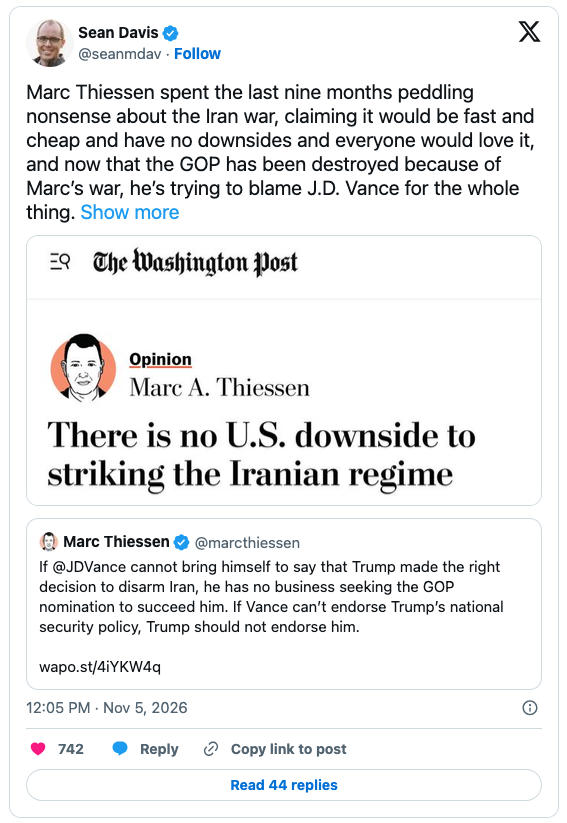
Davis pointed to a Wall Street Journal article that explains Thiessen’s role in the run-up to the war.
“To make the case, [late GOP U.S. Senator Lindsey Graham] said he worked closely with two other men — retired Army Gen. Jack Keane, a Fox News contributor, and Marc Thiessen, onetime chief speechwriter for former President George W. Bush,” the newspaper reported:
The trio took turns calling the president, he said, and compared notes. Graham said “there were not a lot of other voices” advancing the argument for action.
Thiessen and Keane wrote opinion pieces and went on television to secure Trump’s attention. Trump has posted Thiessen articles online, including one where he argued Iranians could be the “boots on the ground.” Neither men responded to requests for comment.
Shapiro: Other Issues
For his part, warmonger Shapiro — at 42, still young enough to enlist in the Army or Marine Corps to fight in the wars he advocates — thinks other issues mattered more to voters.
Three “big things have happened” since Trump took office, he said on his podcast, that crushed the GOP: “unaffordability, chaos, corruption,” he said:
Now, by every metric, unaffordability was the top issue … by a long shot. There was no close second. If people believe that their lives are unaffordable, you’re going to lose, your party is going to perform poorly. And by the way, again, this is sort of the generic way that things work in a midterm election. People believe that all the problems will be solved by an election. They don’t get solved, then they’re mad about it, and then they revert to the other party during a midterm. That’s normal.
Yet “mere unaffordability” doesn’t account for the “wipeout.”
“And here are the other ingredients: chaos, and corruption,” Shapiro said:
So if you have a generalized sense things are not going well, and then on top of that you layer in a feeling of chaos, a feeling the person just doesn’t care about your issues and is distracted, and then layer on top of that corruption, you’re looking at electoral doom, and that’s what happened.
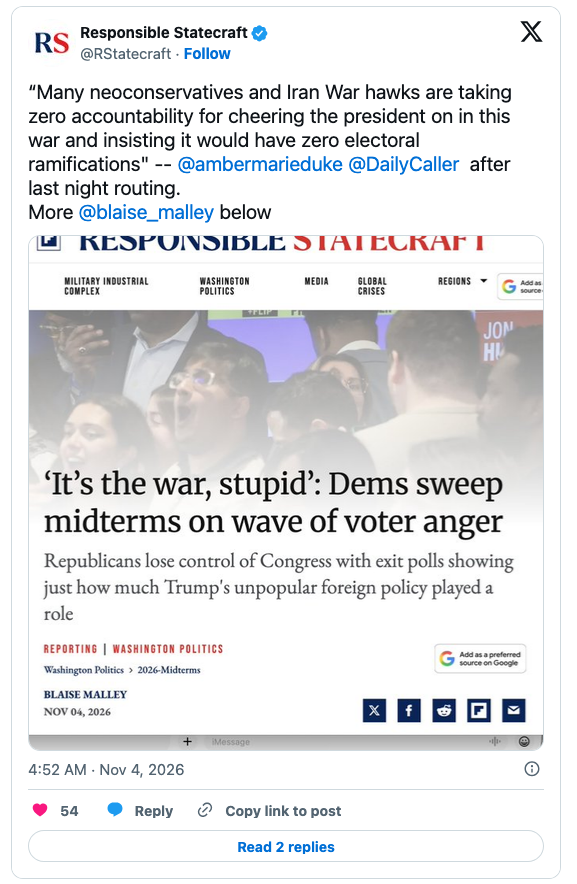
Shapiro didn’t add that consumer goods are unaffordable because the war against Iran has sent oil and gas prices through the roof, which Trump has admitted, or cite the exit polling data that showed what voters cared about.
“Exit polling showed 74% of voters said the Iran War was a ‘crucial’ or ‘major’ factor in their vote,” wrote Blaise Malley of Responsible Statecraft:
Exit polling also found that 62% of voters believed using military force against Iran was the “wrong decision.”
This all jibed with polls leading up to the midterms. Gallup reported last week that 77% of registered voters considered the situation in Iran “extremely” or “very important” to their vote, placing it among the top issues surveyed, alongside the economy and healthcare. A late-October NetChoice/Echelon Insights poll of six swing states found that “ending the war with Iran” was voters’ third most commonly-cited priority, behind only the cost of living and jobs.