
GOP Midterm Surge? Polls Inflate the Democrats, but Underplayed Republican Support May Deflate Them
Back in 2016, late Democratic consultant Pat Caddell accused Reuters of rigging polls to turn a Donald Trump lead over Hillary Clinton into the reverse. “I suppose you can get away with it in polling because there are no laws,” an incredulous Caddell remarked. “But, if this was accounting, they would put them in jail.”
And little has changed since then. So says another political consultant, ex-Democrat Dick Morris. Referencing an analysis of hundreds of polls taken over many years, Morris states that they routinely inflate Democrats’ numbers.
That is, they do this over summer months. But then, to avoid embarrassment, they become more accurate in September and October, the politics wonk asserts.
And now, get this: Morris made his comments a week ago, during August’s closing days. True to form, too, pollsters had been telling us all summer that the Republicans were poised for a midterm shellacking. But what do we witness now?
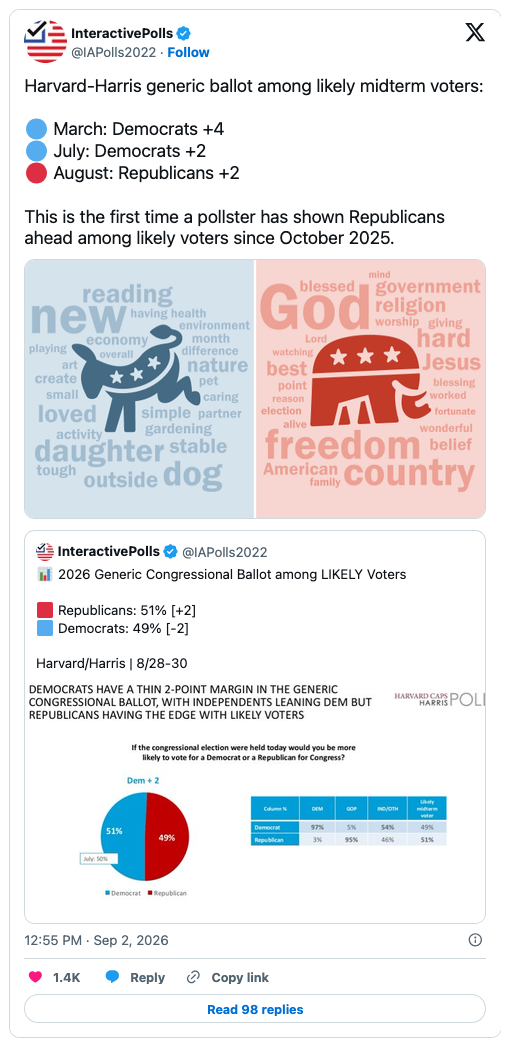
On Wednesday, September 2, a poll was released showing the GOP with a likely-voter lead in the generic congressional ballot. Well, well, Morris, who hasn’t always made stellar predictions, can perhaps take a bow here.
Pollster Prevarication?
This season has already seen, in fact, some major polling “anomalies.” As American Thinker editor J.R. Dunn wrote Monday, the claim of pollster inaccuracy was
reinforced this summer by the scandals involving primary poll results involving Abdul Mohammed El-Sayed, who was given double-digit leads in the Michigan Democrat senatorial primary but barely eked out a 1% victory, and the Florida Democrat senatorial primary, in which ex-military hustler Alexander Vindman held a [healthy] polling lead … but lost to socialist Angie Nixon by 12 points.
Now, to be fair, the above doesn’t prove corruption. After all, as I reported August 14, “primary elections are notoriously difficult to poll accurately. This is due to low and unpredictable turnout, late candidate dropouts/consolidations, shifting voter preferences, and high undecided shares.” This said, primaries’ mercurial nature doesn’t explain what Morris related. Per Dunn again:
Morris … reports on a study by Patrick Ruffini at Echelon Insights. Ruffini analyzed the results of … [more than 3,000] polls taken during … [senatorial] election campaigns over the years. He discovered that pollsters have been regularly overstating the numbers for Democrat candidates in the months leading up to the election, with emphasis on the summer months. Then, during the final weeks of the campaign, the pollsters carefully “ratchet back” their results, bringing them into sync with the actual voter sentiment going into election day. “They’re wrong in July and August,” Dick tells us, “then they get more and more correct as September and October roll around, so as not to be embarrassed in November.”
As for details, Ruffini found that pollsters overestimated Democrats by 3.7 percentage points on average. This error increased, though, to approximately 5.9 points during summer months and then exhibited that autumn correction.
Speaking of which, this brings us to this cycle’s first “correction.” As PJ Media informed yesterday:
A new Harvard-Harris poll [tweet below] shows Republicans now leading Democrats in the generic congressional ballot among likely voters.
Among likely voters, Republicans hold a two-point edge over Democrats. Among registered voters, Democrats still lead by two points, but even that is good news for the GOP, as experts say Democrats need a 3-4-point lead to retake the majority.
There’s still more good news for the GOP, too. As PJ Media also tells us:
Seven in 10 respondents said they are likely to vote, with Republicans reporting slightly higher turnout enthusiasm than Democrats. That is definitely not the enthusiasm gap Democrats were counting on this cycle.
This may be contrary to the conventional narrative, too, which held that many rank-and-file Republicans were disenchanted with their party.
Can We Make It Make Sense?
This all raises a question, however. What’s the point of all these polling machinations if you’re just going to “fess up” as an election approaches? Dunn provides his theory, stating that those
inflated numbers aren’t aimed at the voters (who pay no attention to the elections until after Labor Day), or even the Democrats. They’re aimed at the Republicans, particularly all those fellows of the Russell Kirk Institute for Defeatism Studies, ever ready to look at the week’s results, fall on their knees, and go into the time-honored cries of, “It’s over… Nothing can be done… Let’s all go home now…”
Perhaps, but there may be another explanation — or at least an additional factor. People have a different mentality during peak summer months. They’re enjoying barbecues, fun in the sun, and vacations. They’re simply not as likely to be focusing on elections. (This reality may elude professional commentators and other politics wonks who live, eat, and breathe politics.)
Yet come late August-early September, it’s back to school and to “reality.” Elections may be approaching and brains resetting. You can bet, too, that more people are more focused on politics, at least to a degree. And what will many discover when tuning in?
They’ll learn that the Democrats have gone, and still are, bat crazy. They’re still the party that doesn’t know the difference between boys and girls. And such a realization can certainly shift the polls a handful of points.
This would align with Ruffini’s findings, too, as he studied polls from the last four election cycles. So he began with 2018 — which is well after the point the Democrats went full cuckoo’s nest.
Conclusion
The tuning-in explanation is just a theory itself, but there’s some evidence for it. Republican pollster John McLaughlin, surveying likely voters August 18-24, found just what other pollsters did: the Democrats being ahead. His congressional-ballot poll gave them the typical five-point lead, 48 to 43 percent. (And with 9 percent undecided, there was plenty of room for a shift.)
Commentator Bill O’Reilly has McLaughlin on his show and trusts him, and I also consider him a straight shooter. The point is that he, again, was getting typical summertime polling results — and wasn’t likely cooking the books for Democrats.
So what’s the verdict? People gravitate toward simple, one-dimensional explanations. It may be “Everything’s basically OK” or “Everything’s a conspiracy.” But I suspect the Truth is more nuanced, as it usually is.
To wit: While some polling is no doubt corrupt, there also likely are pollsters who try to do their job. Unlike most people reading me right now, many voters are very fickle, too. Operating on taste and not Truth, a little news can mean a whole new political fling. And at the intersection of this corruption and confusion, of sublimity and simple-mindedness, lies the fate of our nation.