Trump Questions Iran Strategy As War Hurts GOP Midterm Prospects
President Donald Trump is not so sure we should have killed Iran’s top leadership tier. He’s still pretending the war is about preventing the Persians from having a nuclear weapon U.S. intel said they weren’t close to having, but he’s openly questioning some strategic elements.
The president is back in campaign mode, throwing rallies to gin up support for Republicans running in close congressional races. The consensus is that Republican voter enthusiasm is low, though House Speaker Mike Johnson (R-La.) attributes this to erroneous polling and claims it’s not true. Whatever the reality, the president has gone into full campaign mode and the vice president is begging voters to “give us another chance.”
The GOP is projected to lose the House of Representatives, and possibly the Senate. A primary reason for this ominous forecast is the war on Iran. The war has made life exponentially harder on regular Americans back home, many of whom never fully recovered from the financial consequences that began during the disastrous Biden years. And many voters blame Trump and the GOP-controlled Congress for today’s high gas and grocery prices.
The news has only gotten worse on this front. According to a Bureau of Labor Statistics report released Wednesday, the Consumer Price Index rose in September by 3.7 percent from a year earlier, and 3.4 percent from August. Most of that is because of increased gas prices, which spiked by nine percent.
Have We Gone Too Far?
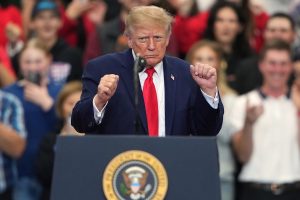
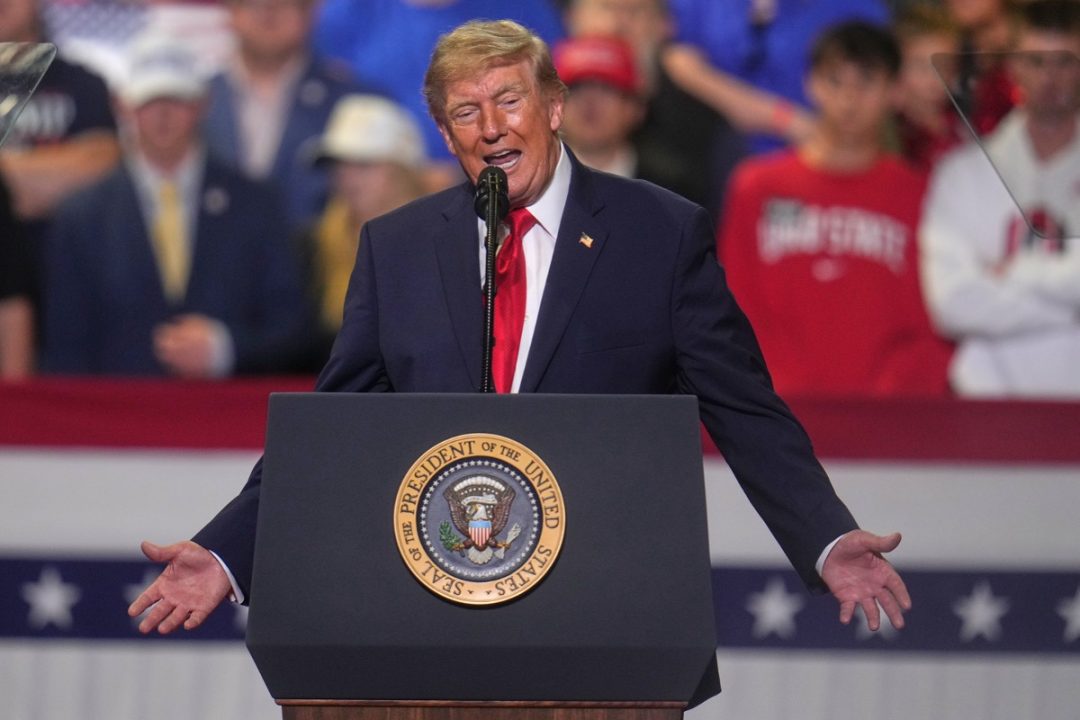
Trump made a curious comment during a rally in Ohio on Monday, suggesting the administration made a mistake in the way it has carried out the war on Iran. His statement indicates that he regrets the decision to kill Iran’s top leaders. To be fair, that strategy may not have been an American one. Nevertheless, Trump said this week:
We might have gone too far with the leaders because we don’t know who the hell we’re dealing with anymore. … We’re having a hard time figuring out who the hell to deal with. To be honest with you, I think we went too far. … We should have stopped at level one. Level two and level two-and-a-half was probably going too far.
The president, didn’t however, acknowledge or admit that launching the war against Iran was a mistake.
Among those who immediately jumped on this comment was Joe Kent, the former director of the National Counterterrorism Center who resigned in protest of the war just a few weeks after it began. In a social media post, Kent said Trump is right:
Trump is correct: killing the ayatollah & most of the moderates was a mistake. The Israelis assured Trump that doing so would annihilate the regime. Instead, it cleared the way for IRGC [Islamic Revolutionary Guard Corps] hardliners to take control and galvanized the Iranian people against America. The Israelis sold Trump a lie to ensure we’d end up ensnared in a conflict that serves their interests, despite bringing nothing but harm to the American people. Trump can break out of this trap by walking away now. No more escalation, or waiting for a deal that the Iranians can’t give him.
Israel Made Us Do It
That America attacked Iran on behalf of a foreign nation is almost a foregone conclusion now. Kent, like many others, believes Trump launched the war because Israeli leaders convinced him to do it. Numerous legacy media reports based on purported sources within the administration have said Israel sold to Trump rosy scenarios such as the one Kent described.
Even Israeli Prime Minister Benjamin Netanyahu admitted to a version of this story. Back in August, while on his own campaign trail, Netanyahu said during a Hebrew-language TV interview that he had been working on U.S. leaders for many years. “It took a long time to bring the United States to its senses,” he said. But he finally got us to attack Iran due to “close to 1,000 hours on American television with the ability to influence the United States [and an] intimate knowledge of all its leaders.”
Not Endorsing Netanyahu
Speaking of Bibi, Trump has not endorsed him for reelection, something the longest-serving Israeli PM is reportedly seeking. Netanyahu is in a tight race ahead of Israel’s October 27 election, and there is no clear path to a governing majority for his Likud party as of now. Trump endorsed him in 2019, but hasn’t done so as of now. Reporters asked him about it as recently as this week, and he said he hadn’t thought about it. When he was reminded that he’d endorsed Netanyahu before, he said, “Well, we may be. I may be doing something.”
This is a curious move on Trump’s part, especially since the president has not only endorsed Netanyahu before, but even called earlier this month for him to be pardoned of corruption charges in Israel.
It’s possible Trump is irked with the Israeli PM for selling him a bill of goods. Iran has proven surprisingly resilient and effective at leveraging the few cards it holds. Its Navy may have been sunk and first layers of leaders killed, but Iran is not down for the count.
Republicans Souring on Israel
It’s also possible a Netanyahu promotion doesn’t fit into Trump’s calculations for GOP victories in November. While lagging behind the Democratic coalition, even Republican voters, especially those under 40, are beginning to sour on their views of Israel, as the country’s disproportional influence on U.S. policy is becoming harder to deny. Endorsing a foreign leader who bragged about dragging America into a war that has made everything more expensive for regular Americans is not exactly a winning strategy. And the more power the Democrats accumulate next year, the more problems Trump and members of his Cabinet are likely to face in the form of investigations and subpoenas.
Blowback
Together with its regional proxies, Iran is disrupting the global energy equilibrium and threatening to torpedo Republicans’ hold on Congress. Moreover, it sounds like killing all their leaders not only failed to topple the regime, but is putting Washington in a place where it has to try and negotiate with fragmented leadership blocs, including people who may be more extreme and crazy than the ones the U.S.-Israeli decapitation strikes took out earlier this year.
This appears to be a classic example of blowback. When it comes to toppling leaders and regimes it doesn’t like, the U.S. has a consistent track record of making matters worse. For instance, in Iraq, Libya, and Afghanistan, our intervention rendered those nations more unstable than before. In some cases, that intervention came back to bite us hard. For example, toppling Saddam Hussein over weapons of mass destruction Iraq never had inspired the creation of ISIS, which then prompted America’s return there three years after it left. Afterward, we and regional paramilitary groups spent another five years fighting militant terrorists who didn’t exist until we intervened. We lost more than 100 troops fighting ISIS. (ISIS still exists, although it doesn’t have nearly the same power it did at its peak.)
But perhaps the most obvious blowback is in Iran. Our meddling there started with a CIA-orchestrated overthrow of Iranian Prime Minister Mohammad Mossadegh in 1953. That was followed by the Deep State-coordinated toppling of the Shah in 1979, which led to the extremist regime the U.S. is trying to get rid of now. This pattern of going from bad to worse is on track to continue.
Vindication of Critics
Trump’s recent comment is partial vindication of everyone who said from the beginning that it was foolish to attack Iran. The New American’s opposition to the war rested primarily on the unconstitutional grounds the war took off from. The U.S. Constitution forbids American presidents from unilaterally launching wars of aggression. That’s a decision for the people to make through their elected representatives in Congress. Yet Trump acted like a king instead of the president of a Republic. It’s not the first time, and probably won’t be the last. And now, because of the way the war has been carried out, Iran no longer appears to have unified, coherent leaders to negotiate with.
The Trump administration has signaled for months that it wants out of this war. June’s Memorandum of Understanding (MOU) was a clear sign the administration is desperate to strike a deal, but, as Iran has shown, it is not entirely up to us when the war ends.
America is once again mired in Middle Eastern quagmire — thanks to another war it didn’t need to start, prompted by another false alarm of weapons of mass destruction.