Comptroller Report: Banks Debanked Both Leftist and Conservative Customers for Political Beliefs
Nine major banks refused service to Americans because of their political or religious beliefs or because the banks did not approve of their legal business activities.
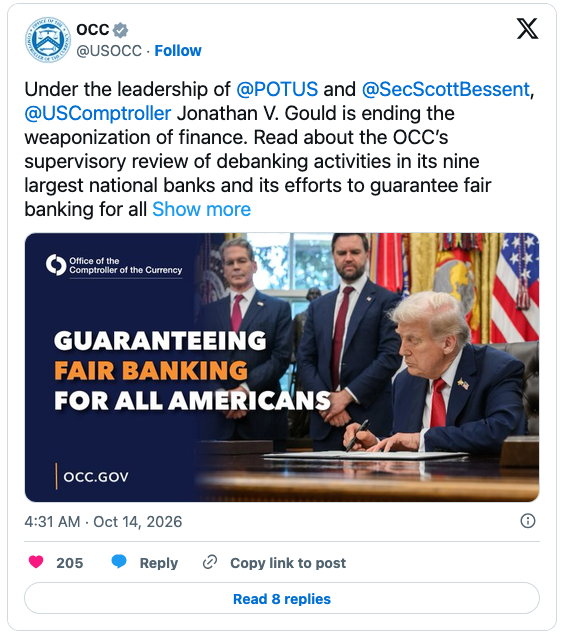
The debanking, as it is called, is revealed in a report released today from the Office of the Comptroller of the Currency (OCC).
The office found that Citibank, JPMorgan Chase, and others debanked not only conservatives but also leftists due to “reputational risk.” In some cases, the banks refused to provide lending because of their favored political causes — meaning the banks’ typically far-left corporate governance.
Of particular note is how a JPMorgan Chase subsidiary zeroed in on conservatives.
Complaints
OCC prepared the report pursuant to President Donald Trump’s executive order of August 7, 2025, Guaranteeing Fair Banking for All Americans.
“Financial institutions have engaged in unacceptable practices to restrict law-abiding individuals’ and businesses’ access to financial services on the basis of political or religious beliefs or lawful business activities,” the order observed.
Indeed, some banks joined “government-directed surveillance” of conservatives, and “suggested that such institutions flag individuals who made transactions related to companies like ‘Cabela’s’ and ‘Bass Pro Shop’ or who made peer-to-peer payments that involved terms like ‘Trump’ or ‘MAGA,’ even though there was no specific evidence tying those individuals to criminal conduct.”
“Individuals, their businesses, and their families have been subjected to debanking on the basis of their political affiliations, religious beliefs or lawful business activities, and have suffered frozen payrolls, debt and crushing interest, and other significant harms to their livelihoods, reputations, and financial well-being,” the order continued:
Such practices are incompatible with a free society and the principle that the provision of banking services should be based on material, measurable, and justifiable risks. Such practices, when wielded to discriminate against customers and businesses in credit transactions due to their religion, are also unlawful under the Equal Credit Opportunity Act (15 U.S.C. 1691 et seq.). They further undermine public trust in banking institutions and their regulators, discriminate against political beliefs and free expression of those beliefs, and weaponize a politicized regulatory state.
Thus the OCC report, which involved the agency’s reviewing almost 100,000 complaints and about 50,000 documents comprising some 420,000 pages.
WePay
Of particular note is JPMorgan, which “decided on multiple occasions between 2021 and 2023 not to provide commercial financial services to a politically conservative leaning retailer,” the report discloses:
Each time a potential new opportunity arose, reputation risk employees flagged reputation risk concerns, including the company’s attraction of “negative attention from people with differing/opposing values.”
JPMorgan’s WePay subsidiary “terminated accounts for several political or religious leaning merchants,” the report continues. WePay “screened a list of terms against the merchants’ customer profiles, websites, and transaction-level information to identify merchants who might be engaged in prohibited activities.”
Terms that violated WePay’s terms of service were “related to political or religious issues or groups, including certain terms added following the events of January 6, 2021.” Those terms included MAGA, America First, and Make America Great. Of course, the list included the names of “hate groups” identified by the disgraced and discredited Southern Poverty Law Center (SPLC). (Federal prosecutors recently charged the outfit and a former top executive with myriad crimes for subsidizing the hate groups it supposedly was fighting.)
“In June 2021, WePay closed the account of a customer that employees characterized in the bank’s internal tracking system as a “[r]ight wing religious conservative non profit with strong anti LGBTQ rhetoric,” the report reveals.
In February 2021, WePay shut down a merchant that sold Trump gear because it “promote[d] hate, violence, or racial intolerance,” the report says:
Following the account closure, one employee reported [that] “we closed their account due to violating our WePay’s Terms of Services (MAGA and Trump-related items are part of it).”
And in December 2020, WePay closed the account of a conservative legal organization because the SPLC had falsely labeled it a hate group.
Other Issues
Leftists got the same treatment from Capital One. In 2023, it decided its “risk appetite” couldn’t tolerate a pro-abortion outfit. A risk-reputation employee observed that the outfit’s candidate donations “are about 95% Democrat.”
“Capital One also declined to provide financial services to … a second organization promoting reproductive rights (‘it’s become so synonymous with abortion and the Dems’) though the bank approved a card relationship with the organization several years later,” the report says. It also declined services for
a public education organization (“This opportunity is likely outside of our appetite primarily due to its partisan leanings. For example, the [organization’s] political arm endorses candidates and all of them are Democrats.”); and … a gun rights organization (“[W]e passed on a relationship with [the organization] due to optics that we endorsed its position on gun rights.”).
Indeed, “several banks restricted financing to firearms manufacturers or retailers, including those offering assault- or military-style weapons for civilian use,” the report discloses:
Others included certain firearms accessories. At least two banks highlighted “polarizing” or “polarized” public opinion surrounding individual gun ownership rights and gun control as part of the basis for their firearms restrictions.
One bank fretted about “civilian gun violence,” and JPMorgan “repeatedly refused” to deal with small firearms companies.
And “most banks restricted access to financing oil and gas exploration, development or production in the Arctic,” the report explains:
These restrictions in general were part of larger “ambitious” climate campaigns intended to advance the banks’ “environmental commitments.” …
Most banks restricted access to financing for new, or expansions of existing, coal mining or plant operations. Some banks went as far as to state that they would not provide financial services to companies deriving a percentage of their revenue from coal extraction, mining, or coal products. As one bank’s business line stated, “[T]here is a high level of protest, headline and mission-related reputation risk.” Another bank’s line of business placed these restrictions under a category for “social risk” considerations.
Remedies
The OCC, the report says, will now take into account debanking when it considers a financial institution’s license application. As well, the report noted, comptroller had removed and forbidden considering reputation risk in supervising banks even before Trump’s order.
“Removing reputation risk from the OCC’s examination program eliminated a potential justification for failing to provide financial services to politically disfavored businesses and individuals,” the report says:
The OCC’s rule also removed a prior regulatory requirement that certain large insured national banks affirmatively consider reputation risk in their risk governance frameworks. The final rule also prohibited the OCC from requiring, instructing, or encouraging an institution to close an account, to refrain from providing an account, product, or service, or to modify or terminate any product or service on the basis of a person’s or entity’s political, social, cultural, or religious views or beliefs, constitutionally protected speech, or solely on the basis of politically disfavored but lawful business activities perceived to present reputation risk.