
Kent: 18 U.S. Intel Agencies Said Iran Wasn’t Building a Nuke; CIA Concluded Iran Could Hold Out for Months
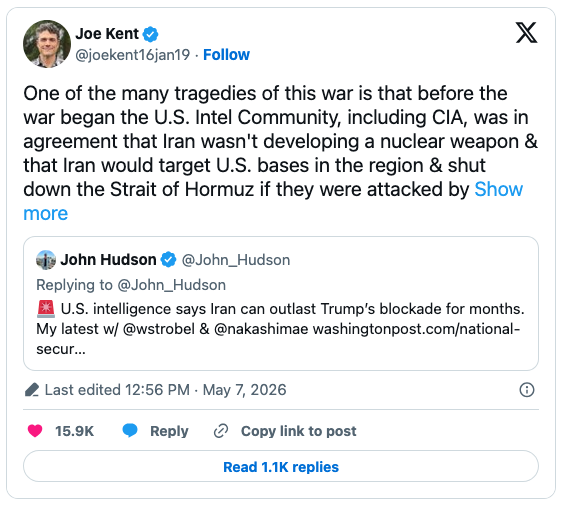
All 18 U.S. intelligence agencies had concluded that Iran was not building a nuclear weapon and would retaliate against U.S. bases across the Middle East if the U.S. attacked the country, former U.S. counterterrorism chief Joe Kent reported today.
The agencies also knew that Iran would close the Strait of Hormuz, Kent reported on X.
The report from Kent — who quit his post due to the war on behalf of Israel — included a story from The Washington Post about a CIA analysis explaining that Iran could withstand American-Israeli attacks for months without suffering severe economic hardship.
Kent also challenged Post columnist Marc Thiessen, who thinks Trump should continue the war.
All Intel Agencies Agreed
A former Green Beret and combat veteran, Kent has opposed the war from the beginning. He has said the U.S. must end aid to Israel and stop fighting its wars. One reason: The stated purpose of the war, that Iran would soon build a nuclear weapon, was bogus.
“One of the many tragedies of this war is that before the war began the U.S. Intel Community [IC], including CIA, was in agreement that Iran wasn’t developing a nuclear weapon & that Iran would target U.S. bases in the region & shut down the Strait of Hormuz if they were attacked by Israel & the U.S.,” Kent wrote:
The IC also properly assessed that targeting the Iranian leadership would strengthen the regime and embolden the hardliners.
Despite the professionalism & accuracy of the IC, the narrative & agenda spun by a foreign government — Israel, won the argument & forced us into this war.
We need to understand exactly how this happened to ensure we are never put in this position again.
Kent’s post affirms the report in The New York Times that Trump unwisely listened to Israeli Prime Minister Benjamin Netanyahu’s claims that defeating Iran would be a cinch. Indeed, Secretary of State Marco Rubio called Netanyahu’s presentation to Trump in the White House Situation Room in February “bullsh*t” after CIA chief John Ratcliffe — citing an intelligence analysis of Netanyahu’s claims — called them “farcical” and “detached from reality.”
Nonetheless, Trump went ahead.
The Post’s revelation about the CIA analysis also knocked a hole in Netanyahu’s “farcical” claims, including that Iran’s regime would collapse and therefore could not close the Strait of Hormuz:
A confidential CIA analysis delivered to administration policymakers this week concludes that Iran can survive the U.S. naval blockade for at least three to four months before facing more severe economic hardship, four people familiar with the document said, a finding that appears to raise new questions about President Donald Trump’s optimism on ending the war.
The analysis by the U.S. intelligence community, whose secret assessments on Iran have often been more sober than the administration’s public statements, also found that Tehran retains significant ballistic missile capabilities despite weeks of intense U.S. and Israeli bombardment, three of the people familiar with it said.
Iran retains about 75 percent of its prewar inventories of mobile launchers and about 70 percent of its prewar stockpiles of missiles, a U.S. official said. The official said there is evidence that the regime has been able to recover and reopen almost all of its underground storage facilities, repair some damaged missiles and even assemble some new missiles that were nearly complete when the war began.
That estimate of Iran’s remaining firepower flies in the face of what Trump said just two days ago.
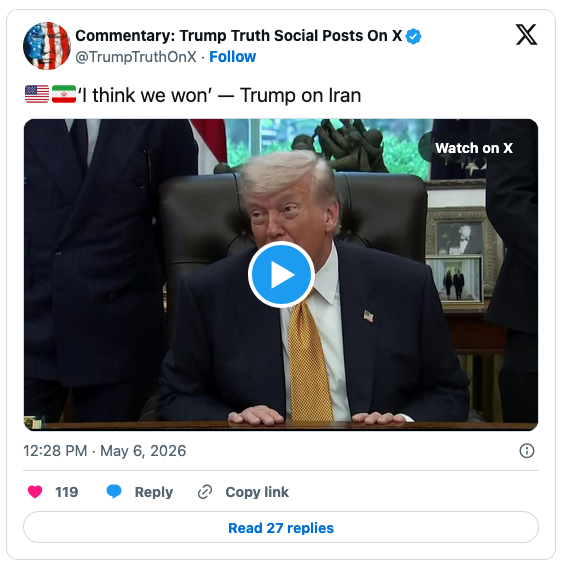
“They don’t have any planes, they don’t have any antiaircraft, and they don’t have any radar left,” Trump said, declaring that “we won” the war:
Their missiles are mostly decimated, they have some, they have probably 18-19 percent, but not a lot by comparison to what they had. And their leaders are all dead.
So I think we won.
Trump’s Options
On Wednesday, the Post revealed that damage to U.S. military assets in the region is much worse than the Pentagon has confessed.
In a longer X post yesterday, Kent wrote that Trump “is left with few good options,” because he must reopen the strait to restart the flow of oil. Aside from rising gas prices that are draining the American worker’s bank account, “looming just over the horizon is a fertilizer crisis that threatens global food supply and could trigger famine in multiple regions,” Kent wrote.
Iran believes it will win the war by not losing, and despite heavy losses of military assets, it “remains durable and capable.”
Trump is left with three options, Kent explained. First, reopen the Strait of Hormuz by force, and deploy the Navy to escort vessels, which risk attacks by Iran. “The threat of an attack will deter most shipping companies, effectively shutting the SOH,” Kent wrote.
Trump understands this, Kent believes, in view of the attack on a U.S. ship that was protecting commercial vessels as part of Operation Freedom.
Second, Trump can again attack Iran, which “seems inevitable but has one major issue,” Kent wrote:
This administration has never clearly articulated our desired end state. President Trump has made differing statements about his main goal: Iran cannot have a nuclear weapon or Iran cannot have the ability to enrich uranium at all, while also claiming that Iran has already been defeated because we destroyed their military equipment and killed their leaders. A war with no clear objective is a surefire invitation for a long and bloody quagmire.
If the goal is eliminating Iran’s enrichment capability, U.S. boots on the ground is a near-certain eventuality: the airstrikes conducted during Operation Midnight Hammer in June 2025 buried Iran’s enriched uranium deposits deep underground below the rubble; to physically secure and remove it would require U.S. troops to conduct a dangerous and complex operation in Iran that would take days or more.
Other ideas, such as arming the Iranian resistance, would be disastrous, Kent wrote.
Trump’s third option is simply walking away from the war because “there is no purely military solution to the conflict with Iran; if there was, we would have achieved it by now.”
“The longer U.S. forces stay in the region, the more we increase the likelihood of Iran dragging us into a drawn-out war on their terms,” Kent continued.
Though Trump would “take political flak for withdrawing,” he “is the master of controlling the media narrative — he could declare victory in Iran while quietly negotiating an enduring deal using diplomatic channels”:
Current U.S. polling shows that many Americans believe that we have won the war in Iran already, President Trump should lean into this, declare victory and walk away while the polling is in his favor.
The war is at a critical juncture. I pray that President Trump chooses option three: seize this opportunity to walk us back from yet another disastrous war that does not serve the interests of the American people.
Kent vs. Thiessen
Thiessen wants Trump to “finish what he started” because, with a peace deal, “Trump is in danger of snatching defeat from the jaws of victory with a deal that would give the battered Iranian regime a new lease on life.”
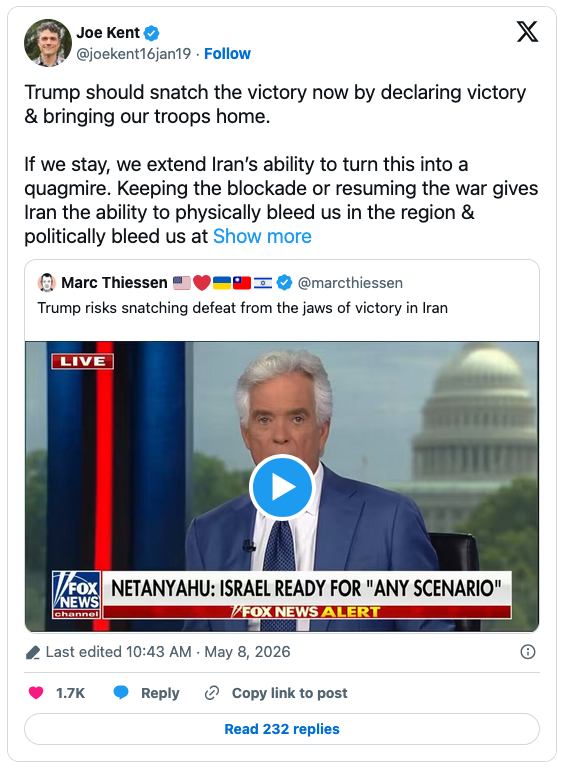
Replied Kent, “Trump should snatch the victory now by declaring victory & bringing our troops home.”
Otherwise, Iran can turn the war into a “quagmire.”
“Iran wins by us staying in this war,” he continued:
If we leave, Iran will be under pressure regionally & globally to open the Strait of Hormuz, we can use sanctions relief as our leverage to get them to do so & make concessions on enrichment.
There are no military solutions, the current diplomatic solutions aren’t working so Trump should reset the game by pulling out, depriving Iran of leverage (the ability to hit our troops) & using unconventional tools to reopen the SOH.