

WaPo Satellite Analysis: Iran Hit More Than 225 U.S. Military Assets Across Region Through Mid-April
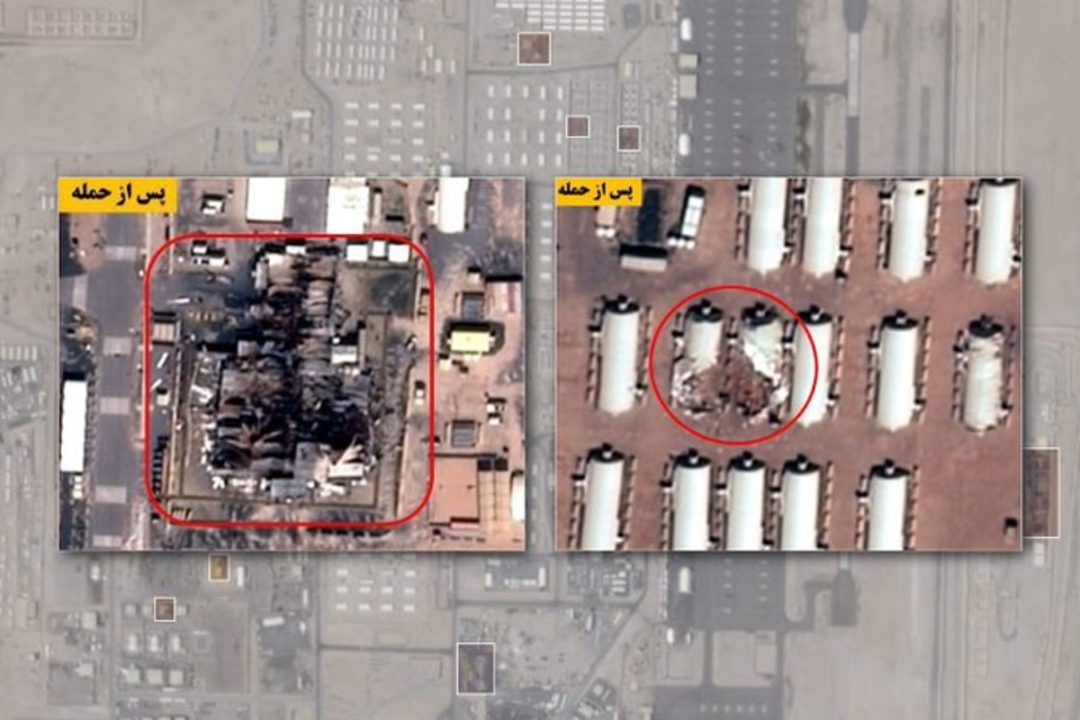
Iranian airstrikes that were launched to retaliate for the unprovoked U.S.-Israeli attack on the country have hit almost 230 U.S. military assets across the region, a review of satellite imagery by The Washington Post shows.
The damage, the Post reported, exceeds that reported by the Defense Department.
The report comes a week after the department’s head bean-counter low-balled the cost of the war during testimony before the U.S. House Armed Services Committee.
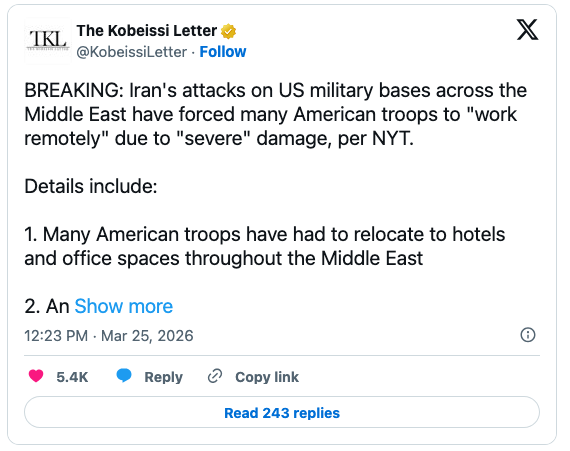
In late March, The New York Times revealed that Iranian strikes had wrecked 13 military bases across the Middle East.
But this latest report suggests that Iran hit back hard. And, it shows, Trump’s war planners underestimated Iran’s ability to defend itself and inflict costly damage.
No Random Craters
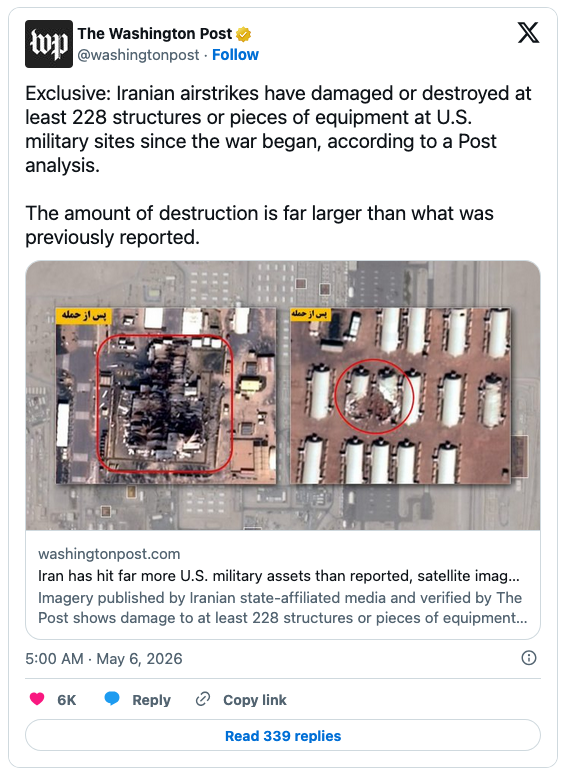
The airstrikes “have damaged or destroyed at least 228 structures or pieces of equipment at U.S. military sites across the Middle East since the war began, hitting hangars, barracks, fuel depots, aircraft and key radar, communications and air defense equipment,” the imagery showed:
The amount of destruction is far larger than what has been publicly acknowledged by the U.S. government or previously reported.
The threat of air attacks rendered some of the U.S. bases in the region too dangerous to staff at normal levels, and commanders moved most of the personnel from these sites out of the range of Iranian fire at the start of the war, officials have said.
While imagery of the region is difficult to obtain, the newspaper scrutinized more than 100 images that Iran released. It validated 109 against the European Union’s low-resolution Copernicus system and the Planet system’s high-resolution imagery. While the Post excluded some images, none was manipulated.
“In a separate search of Planet imagery, Post reporters found 10 damaged or destroyed structures that were not documented in the imagery released by Iran,” the newspaper continued:
In all, The Post found 217 structures and 11 pieces of equipment that were damaged or destroyed at 15 U.S. military sites in the region.
In other words, Iran had no trouble hitting targets:
“The Iranian attacks were precise. There are no random craters indicating misses,” said Mark Cancian, a senior adviser with the Center for Strategic and International Studies and a retired Marine Corps colonel, who reviewed the Iranian images at The Post’s request. The Post previously revealed how Russia provided Iran with intelligence to target U.S. forces.
Some of the damage may have occurred after U.S. troops already left the bases, making protection of the structures less vital. Cancian and other experts said they do not believe the attacks have significantly limited the U.S. military’s ability to conduct its bombing campaign in Iran.
More Damage Than Officially Reported
Reports from early in the war and continuing through last week disclosed damage on anywhere from 13 to 16 installations. But the Post review “reveals that scores of additional targets were struck at the sites.”
William Goodhind, a gumshoe with Contested Ground, which analyzes satellite imagery of war zones, said “the Iranians have deliberately targeted accommodation buildings across multiple sites with the intent to inflict mass casualties.”
“It is not just equipment, fuel storage and air base infrastructure under fire, but also soft targets, such as gyms, food halls and accommodation,” he told the newspaper.
Among Iran’s hits, the Post continued, were satellite communications at al-Udeid Air Base in Qatar, Riffa’s Patriot missile defense system, and air bases in Bahrain and Kuwait. Also hit: a “satellite dish at the Naval Support Activity Bahrain — which serves as the headquarters of the U.S. 5th Fleet — a power plant at Camp Buehring in Kuwait and five fuel storage bladder sites across three bases.”
Iranian images showed “previously reported damage or destruction of radomes at Camp Arifjan and Ali al-Salem Air Base in Kuwait, and at the 5th Fleet headquarters” and elsewhere, including “an E-3 Sentry command and control aircraft and a refueling tanker at Prince Sultan Air Base in Saudi Arabia.”
“More than half of the damage reviewed by The Post occurred at the 5th Fleet headquarters, and the three bases in Kuwait — Ali al-Salem Air Base, Camp Arifjan and Camp Buehring. Camp Arifjan is the U.S. Army’s regional headquarters,” the newspaper reported.
Cancian told the Post that U.S. forces might permit an incoming barrage to strike unimportant targets to save interceptors and “deceive Iranian forces by making emptied base locations appear occupied.”
War Cost
Reports on the damage are important because they are part of the war’s cost.
When the War Department reported a cost of $25 billion on April 29, CNN cited sources who claimed that estimate was low by as much as 100 percent because the damaged military bases must be repaired if U.S. troops are to use them. One source told the network the real cost of the war at that date was “closer to $40 billion to $50 billion when accounting for the costs of rebuilding US military installations and replacing destroyed assets.”
And even that figure was too low, the Iran War Cost Tracker reported. At the time, it reported the cost of the war as $67 billion.
Now, it’s almost $75 billion.