

U.S. Foreign Intervention Is Fueling Global Nuclearization
The latest issue of Foreign Affairs, a globalist publication of the Council on Foreign Relations, includes three articles on North Korea. This suggests that the foreign policy establishment may soon set its sights on Pyongyang. Interestingly, the authors acknowledge, albeit probably unintentionally, that U.S. foreign intervention has incentivized nations to seek nuclear weapons.
North Korea’s Arsenal
North Korea is now armed to the teeth with nuclear weapons and delivery systems. The authors bemoan the failure of U.S. foreign policy to keep that from happening. One of the articles, titled “North Korea as It Is,” was written by a Georgetown professor named Victor Cha. Cha is also president of the Geopolitics and Foreign Policy Department at the Center for Strategic and International Studies, a neocon think tank funded, in part, by defense contractors.
In 2006, Cha was deputy head of the U.S. delegation at the six-party talks in Beijing. Representatives from China, Japan, Russia, South Korea, North Korea, and the United States attended. The goal was to convince North Korean leaders to abandon the path of nuclearization. But there was no chance of that happening. According to Cha, a North Korean interlocutor told him they would never give up nuclear weapons because, they reasoned, the U.S. attacks only countries that don’t have them. As proof, the North Korean pointed to the wars Washington was then waging in Iraq and Afghanistan.
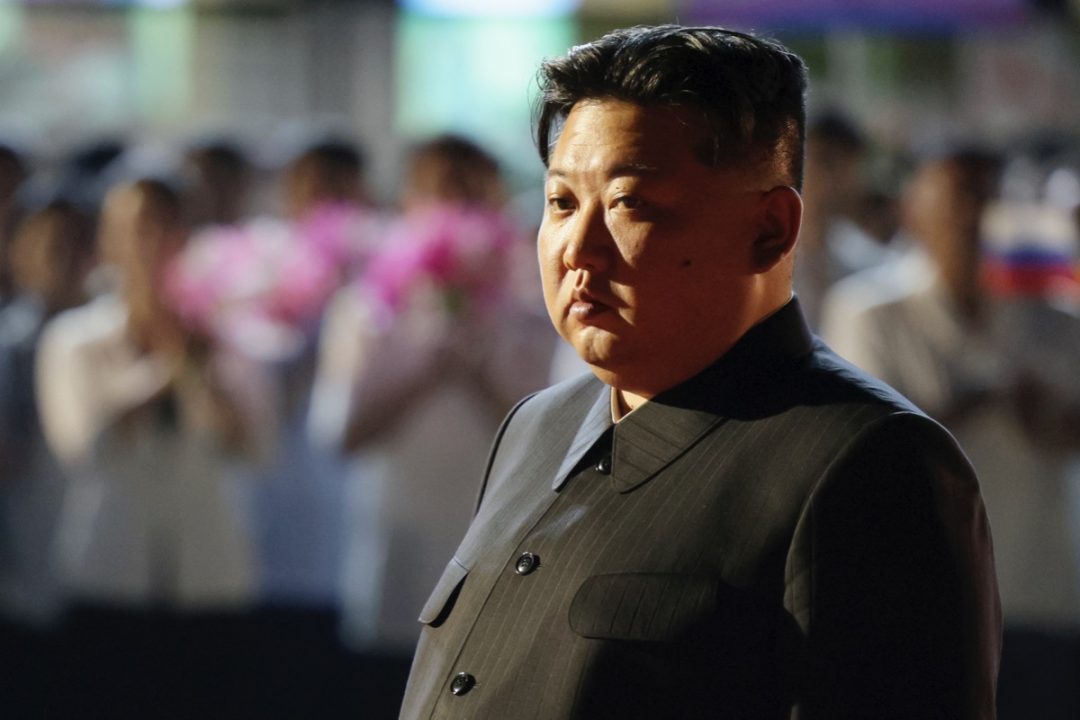
Twenty years later, as the U.S. and Israel were bombing Iran, North Korea’s dictator Kim Jong Un would pat himself on the back for resisting Western pressure and “sweet talk.” In March of this year, Kim said America’s war on Iran proves his country made the right decision to keep its nuclear weapons.
In his article, Cha summarizes how scary North Korea has become, writing:
Over the last 30 years, North Korea’s ability to target the United States has evolved from remote possibility to real danger. The range of some North Korean ICBMs extends to the continental United States. … Pyongyang already has enough launchers and missiles to overwhelm U.S. defenses. As the nuclear expert Ankit Panda has pointed out, North Korea’s 15 to 20 transporter erector mobile launchers, each armed with one ICBM, could deplete the entire U.S. stockpile of 44 ground-based interceptors deployed in Alaska and California that are designed to destroy these missiles midcourse. (Up to four interceptors are needed to defend from each missile.)
Still Growing
Cha makes the case that not only is North Korea dangerous now, but it will grow into an even larger threat. They have 50 nuclear bombs and can build another 50. They have 20 different delivery systems, “including long-range intercontinental ballistic missiles (ICBMs) that can reach targets in the United States.” And they’ve just gotten started. According to Cha:
[North Korea] is actively pursuing ballistic missiles that can be launched from nuclear submarines, whose range and ability to evade detection improve North Korea’s ability to strike back even if the United States attacks first. … North Korean leader Kim Jong Un intends to develop a modern nuclear weapons arsenal the size of that of France or the United Kingdom, each of which has over 200 nuclear weapons, and he is well on his way.
He adds that North Korea is providing “thousands of combat troops, millions of rounds of ammunition, and hundreds of ballistic missiles in support of Russia’s war in Ukraine.” In return, Russia has helped Pyongyang “surmount the technology hurdles that prevent Kim from building the nuclear arsenal of his dreams.”
A New Approach Needed
Despite the use of economic sanctions or incentives such as food aid to prevent nuclearization, the U.S. has failed. Moreover, it “has only hardened resolve in Pyongyang.” This cannot be allowed to go on. The U.S. cannot “stand aside and do nothing because North Korea’s nuclear arsenal is increasingly able to target the U.S. homeland and a stronger North Korea can flex its military power to help U.S. adversaries, as it is doing by supporting Russia in Ukraine.”
Washington needs a new way to deal with the North Korea threat. Cha suggests that
the United States should open conversations with Pyongyang on arms control agreements, limits on nuclear testing and missile production, crisis management mechanisms, and bans on the transfer of nuclear weapons or technology to others. It should also strengthen deterrence and defense with regional allies to gain their support for this new strategy. In other words, the United States needs a cold peace with North Korea — a relationship short of normalization but that prioritizes open dialogue to avoid miscalculation and escalation.
He reiterates that dialogue is crucial to avoiding a nuclear exchange:
The United States must develop direct communication channels to avoid accidental escalation that could trigger a nightmare scenario. Currently, the United States can communicate with North Korea only via phone in the demilitarized zone at the border between North and South Korea (a phone that the North Koreans rarely answer) or by sliding letters under the door of North Korea’s office at the United Nations headquarters in New York, most of which are returned unopened. … These methods are inadequate for staving off potential nuclear war.
America should also pledge not to use nukes first, the idea being that it may keep North Korea from striking first.
Cha also suggests some good old-fashioned saber rattling mixed in with collective preparation:
Washington and its allies could focus on what is known as deterrence by denial: a set of strategies that includes setting up high-density missile defenses, regularly rotating U.S. nuclear weapons-capable fighter jets and submarines to the Korean Peninsula, and threatening precise and advanced conventional military responses to North Korean attacks. By signaling strong allied retaliatory capabilities while downplaying offensive threats that could trigger a “use or lose” mindset in Pyongyang, the United States and its allies could deter North Korea without provoking it.
And we should also make it clear “that any use of North Korean nuclear weapons would prompt the United States to destroy the regime immediately.”
A New Alliance?
Cha further suggests a collective defense alliance among the United States, Japan, and South Korea, with “a collective defense declaration so that an attack on any one of them would constitute an attack on all of them.”
Shifts in North Korean policy are underway. Washington is considering removing about 4,000 troops from South Korea, and is also urging South Korea to boost defense spending, “take over control of wartime operations from Washington, and absorb more of the burden of peninsular defense.”
Cha anticipates pushback for prescribing diplomacy over threats and action. He justifies this prescription by pointing out the obvious. North Korea, he says,
is a proven nuclear weapons state that could retaliate against the United States and its allies. North Korea’s nuclear programs and delivery systems are also far larger than those in Iran and more dispersed across undisclosed locations that are hard to target. These factors minimize the likelihood that a preventive strike would succeed.
Maybe in 1994, “when Clinton considered a military strike,” the U.S. might have been able to destroy Pyongyang’s “fledgling program with minimal consequences.” But those days are long gone. Today, “North Korea’s nuclear arsenal is far too large to eliminate without risking devastation.” He adds that “even the slightest sign of U.S. military action could trigger a dangerous escalation. There is no guarantee that the threat of being obliterated by the United States would deter Kim from acting.”
Defending Against the United States
The big takeaway here is that unhinged leaders of foreign nations believe the best insurance against a U.S. attack is nuclearization. Former CIA officer Jung Pak echoes this in another article in this same issue of Foreign Affairs, titled “How North Korea Won: The Strange Triumph of Kim Jong Un.” Pak writes, “The dawn of a new era of great-power competition has been an unwelcome development for many small countries and middle powers, but North Korea has fared better than most by leveraging its nuclear arsenal to avoid getting trampled by bigger players.”
This aligns with comments Joe Kent, the former director of the National Counterterrorism Center, made after he resigned March 17 in protest of the war on Iran. Kent said the reason the Iranians had enriched uranium to 60 percent was because they wanted the ability to scale up and build nuclear weapons if they deemed it necessary for defense.
If nations are building nuclear weapons to ward off U.S. attacks, that means U.S. aggression is nuclearizing the world. Weaker nations see nuclearization as the safest way to deter American aggression.
Making matters worse, as we’ve seen with the war in Iran, our aggression is also strengthening cohesion among rival nations. If China and Russia are willing to provide Iran with intel on U.S. assets and materials for rebuilding missiles, as appears to be the case, who’s to say the next step may not be to help Iran go nuclear?
Back to the Founding Noninterventionism
For all their faults, hypocrisy, and tyranny, the anti-American Eastern nations are right about at least one thing: U.S. imperialism is a problem. And it’s not only a problem for them, but it’s a problem for the U.S. citizens, who never agreed to become an empire and who haven’t approved a war in many decades. Imperialism is creating enemies abroad, bankrupting us at home, and, as covered here, incentivizing nuclearization worldwide.
It’s long past time to revisit the foreign policy prescriptions urged by America’s Founders and early leaders, who advised against getting caught up in foreign conflicts or going abroad in search of monsters to slay.