


Gavin Newsom Signs Bill to Force Big Companies to Comb Records for Slavery Links
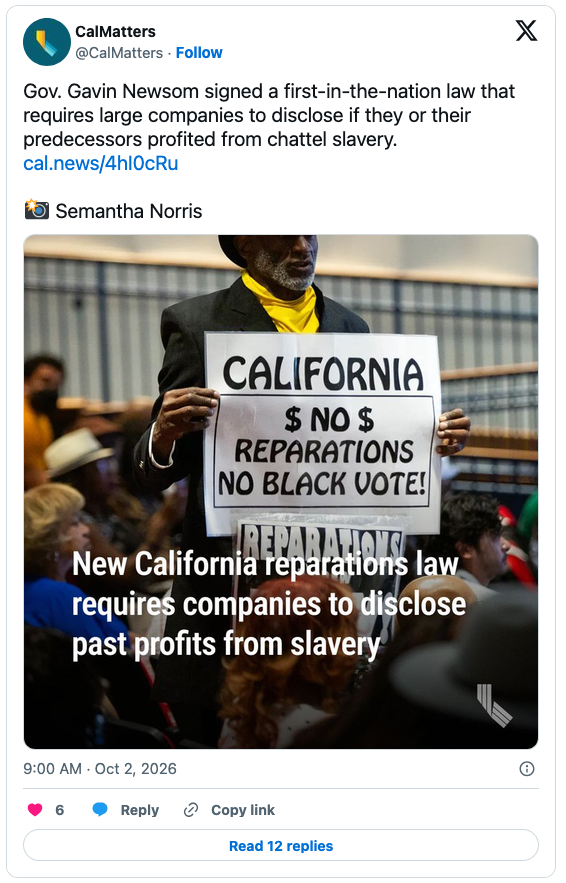
California’s Democratic Governor Gavin Newsom has signed a bill that would force any of the state’s $100 million-plus companies 62 years old or more to examine its records for ties to slavery.
Signed September 30, the bill is supposedly an attempt to get at the “truth” about the companies and their putative connection to the slavery business.
The targeted companies have less than three years to comply with the dopey law. The measure comports with the push to give blacks reparations for slavery despite California’s entering the union as a free state.
Newsom has signed a number of bills he thinks will ameliorate the pain of slavery, which ended in the United States in 1865.
Why the Bill
Newsom and a gang of racialist lawmakers are gunning for big businesses because some might have profited even remotely from slavery. The main concern seems to be insurance companies that insured slave owners against the loss of their human property. The far-left governor signed the bill on his podcast.
“Numerous American businesses across various industries, including, but not limited to, insurance, banking, tobacco, cotton, sugar, railroads, and shipping, reaped substantial profits by exploiting the uncompensated labor of enslaved persons,” the law says:
Consequently, these businesses and the individuals managing them directly profited from the labor of enslaved persons or directly benefited from insurance policies that insured enslaved persons. This intertwining of economic interests highlights the extent to which the exploitation of enslaved persons permeated the foundation of various American industries. However, very few American industries and the underlying businesses and individuals have adequately acknowledged their connection to the enslavement era.
Many California residents are descendants of enslaved persons and their ancestors were defined as property, dehumanized, separated from their families, coerced into performing labor without appropriate compensation or benefits, and were assaulted and abused.
The bill focuses on the insurance business, but includes banking, tobacco, cotton, sugar, railroads, and shipping.
“Insurance policies from the enslavement era, which have been discovered in the archives of several insurance companies, document insurance coverage to slaveholders for damage to or the death of enslaved persons,” the law continues:
In some cases, existing insurance firms or their predecessor firms issued these policies. These insurance policies, loan documents, and other documents and records provide evidence of ill-gotten profits from slavery. Slaveholders and those involved in the slave trade, in turn, profited from the uncompensated labor of enslaved persons, even if such profits have long since been redistributed to shareholders. Industries that profited in this manner may include, but not be limited to, capitalized insurers, financial service providers, textile companies, tobacco companies, railroad companies, shipping companies, the sugar industry, and entities in other industries whose successors in interest remain in existence today.
To rectify this manifest injustice, Californians, including the descendants of slaves, need “complete transparency” about companies that might have profited from what was called the “peculiar institution.”
Punished Companies, Other Bills
Solution: Force “any” company with global receipts of more than $100 million “that was in existence or whose predecessor company was in existence on or before December 31, 1964” to hunt through records for evidence of slavery ties.
Any such company must file a sworn affidavit that it has searched its records with a nit comb. The affidavit must include the names of slaves in the records, along with the transactions that showed a profit from slavery. “Records from 1849 forward” must include insurance policies linked to “slaveholding,” evidence of the sale or leasing of slaves, or the use of them as “collateral for insurance policies, loans, or other transactions.”
The bill covers a company’s subsidiaries and predecessors as well.
Even a company founded in the 1960s, 1950s, or before that couldn’t be linked to slavery must comply with it.
Examples:
- Kaiser Permanente: founded in 1945, gross revenue, $127.7 billion;
- HP Inc.: founded in 1939 as Hewlett Packard / $55.29 billion;
- Teledyne Technologies: 1960 / $6.12 billion;
- Mattel: 1945 / $5.35 billion; and,
- Guitar Center: 1959 / $2.14 billion.
None of these companies could be linked to slavery. But their staffers will waste hours picking through old records to keep Newsom and his far-left lawmakers happy.
Two years ago, Newsom signed bills “aimed at beginning the process of reparations for Black descendants of enslaved people, including a measure that requires the state to apologize for perpetuating slavery,” as CalMatters reported:
The headliner bill … requires officials to sign and display a plaque in the state Capitol that includes the following: “The State of California apologizes for perpetuating the harms African Americans faced by having imbued racial prejudice through segregation, public and private discrimination, and unequal disbursal of state and federal funding and declares that such actions shall not be repeated.”
How any of those putative injustices “perpetuated slavery” is unclear.