


Disabled Toddler Murdered in Netherlands Under Guise of Euthanasia
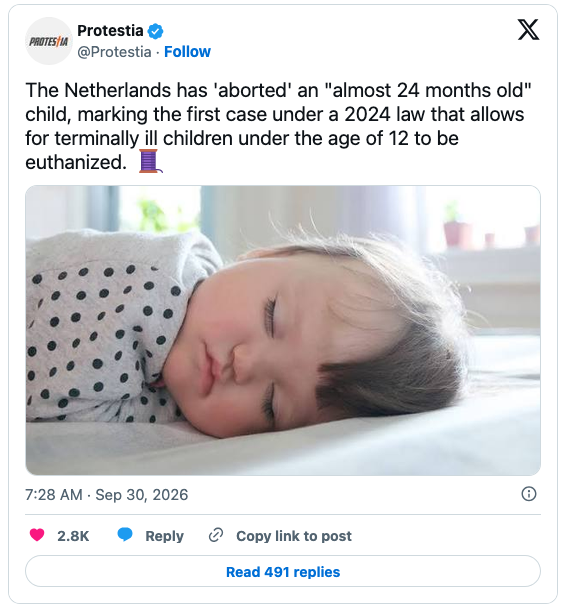
With the permission of parents, a doctor in the Netherlands murdered a toddler almost two years old because the child was disabled and gravely ill.
The official report, which identifies neither the doctor, the child or sex, nor the parents — called it euthanasia, of course. It allowed that the doctor and the parents agreed on the “termination” because of the suffering child’s horrible medical condition.
Though the little one was murdered last year, only now has the odious crime come to light.
The Report
The doctor reported the killing to the “Assessment Committee for Late Termination of Pregnancy and Termination of Life in Newborns and Children Aged 1 to 12 Years,” a panel in the nation that OKs the murders — in this case, after the fact.
Sadly, the child was born prematurely at 26 weeks and three days, during the parents’ vacation abroad. The infant landed in the neonatal intensive care unit, and the “extreme prematurity” led to several “very serious complications,” the report says:
The complications included multiple infections with sepsis, which is an immune response of the body to pathogens causing damage to tissue and/or organs. At the age of four and a half months, the child was transferred to the Netherlands. … MRI of the brain revealed very extensive brain damage. This included periventricular leukomalacia (PVL), which indicates damage to the white matter in the brain, leading to spastic cerebral palsy. In addition, there was damage to the occipital cortex, the posterior part of the cerebral cortex, with an expected visual impairment. A cerebral visual impairment (CVI) was very likely present.
At eight months, the child was diagnosed with infantile epileptic spasm syndrome, which caused “recurrent severe discomfort and developmental delay.” Treatment didn’t stop the seizures, which in turn kept the child from sleeping. A swallowing disorder ensued, and the child suffered seizures while eating.
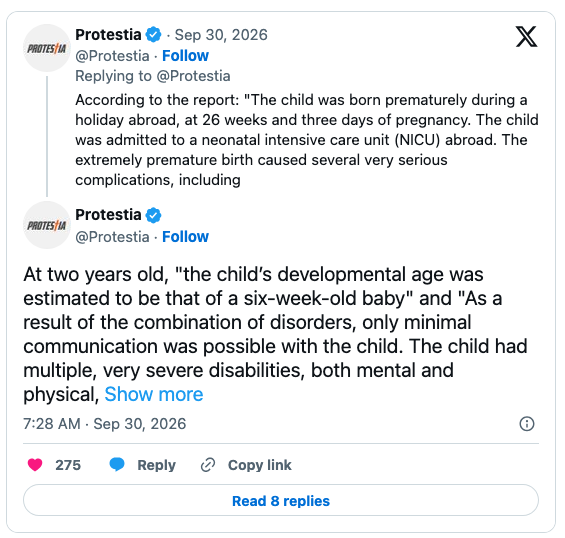
“The extensive brain damage had severe consequences for the child’s functioning,” the report continues:
There was a very severe developmental delay with an estimated developmental age of six weeks, while the child was nearly two years old. There was no verbal development whatsoever, and the cerebral visual impairment further limited the possibilities for any contact. Due to the combination of these conditions, only minimal communication with the child was possible. The child was severely multiply (intellectually and motorically) disabled, and the prognosis was that the child would remain dependent on care for life for all activities of daily living.
The child had sputum clearance issues, meaning that loosening and coughing up mucus from the lungs and airways was difficult, which, in addition to shortness of breath, poses a significantly increased risk of respiratory infections. The child’s rattling breathing was clearly audible, and increasing shortness of breath was visible. Furthermore, the respiratory problems could worsen over time due to scoliosis. The doctor stated that the child exhibited an unsafe swallowing pattern, making it easy for the child to aspirate and for food or stomach contents to enter the airways, posing a risk of aspiration pneumonia (lung infection caused by aspiration). The likelihood of death at a very young age due to complications was considered very high.
In other words, even had the child not been murdered, he or she would have died soon anyway.
The parents wanted to euthanize the child, and the doctor agreed. He consulted other doctors, who agreed the child was suffering an “irreversible situation” but also concluded that “there was no continuous unbearable suffering.” They also concluded that palliative care was an option that would lessen seizures.
“During the oral explanation, the doctor stated that, in his opinion, the child’s suffering did not stem solely from the epilepsy,” the report explains:
The doctor was of the view that the child was experiencing unbearable and hopeless suffering, even if the epilepsy had been under control. The doctor stated that he had followed the medication advice of the consulted doctors. The child subsequently developed more symptoms due to the side effects of the medication, after which it was decided to discontinue it.
Then the doctor consulted another physician, who agreed that the child’s suffering was “unbearable.”
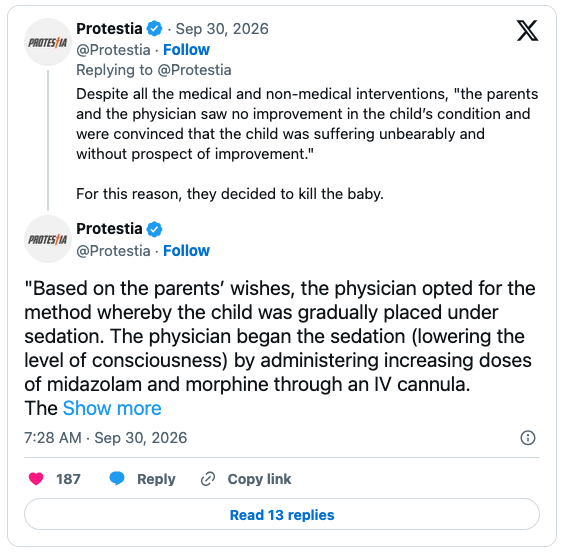
So the doctor put the child to sleep — the same way people put their suffering dogs and cats to sleep:
There are (yet) no guidelines regarding the execution of euthanasia for children under twelve years of age. At the parents’ request, the doctor chose a method in which the child was gently put to sleep. The doctor initiated sedation (lowering of consciousness) via an intravenous infusion of midazolam and morphine in increasing doses. Subsequently, the doctor administered coma-inducing agents (propofol and thiopental), after which the child entered a very deep state of sedation and passed away.

Reaction
The good doctor appeared on television to plead his case, CBS News reported.
“As a doctor, you are in an extremely vulnerable position, because this has never happened before,” he said. “It still feels as if a sword of Damocles has been hanging over your head for almost a year.”
Frighteningly, the doctor hopes more parents will discuss murdering their children. “I think there are parents out there who have never dared to discuss the option of ending their [child’s] lives before,” the doctor continued:
Hopefully, this ruling provides support to these parents to discuss this option with their treating physician.
More frighteningly, he thinks murdering babies with defects is “a kind of emancipation of the child.”
Nazi Extermination Program
In Nazi Germany, such children were declared “life unworthy of life,” or Lebensunwertes Leben.
The campaign to euthanize the “unfit” to live began when two parents asked for permission to murder their child. “In this particular case, the parents submitted a request that their severely disabled child be granted a ‘mercy killing,’ the application being received at an unverifiable time before the middle of 1939 at the Office of the Führer (KDF), also known as Hitler’s Chancellery,” Wikipedia explains:
This office was an agency of the Nazi Party and a private chancellery placed under the direct authority of Hitler which employed about 195 staff in 1939.
There followed the murder of 5,000 children.