
DOJ Says Trump’s $1.776 Billion “Anti-Weaponization Fund” Will Not Proceed, but Offers No Written Rescission
The Department of Justice (DOJ) decided it is not moving forward with President Donald Trump’s $1.776 billion “Anti-Weaponization Fund.” The retreat came after a federal judge blocked the fund, lawmakers revolted, and even Republicans grew nervous about endorsing a taxpayer-funded compensation system for Trump’s political allies.
DOJ posted on X:
The Department of Justice disagrees strongly with the decision on the Anti-Weaponization Fund.… This Fund was open to anybody who was so weaponized, targeted, or persecuted, whether they were Democrat, Republican, Conservative, Independent, or otherwise. The Department will abide by the Court’s ruling.
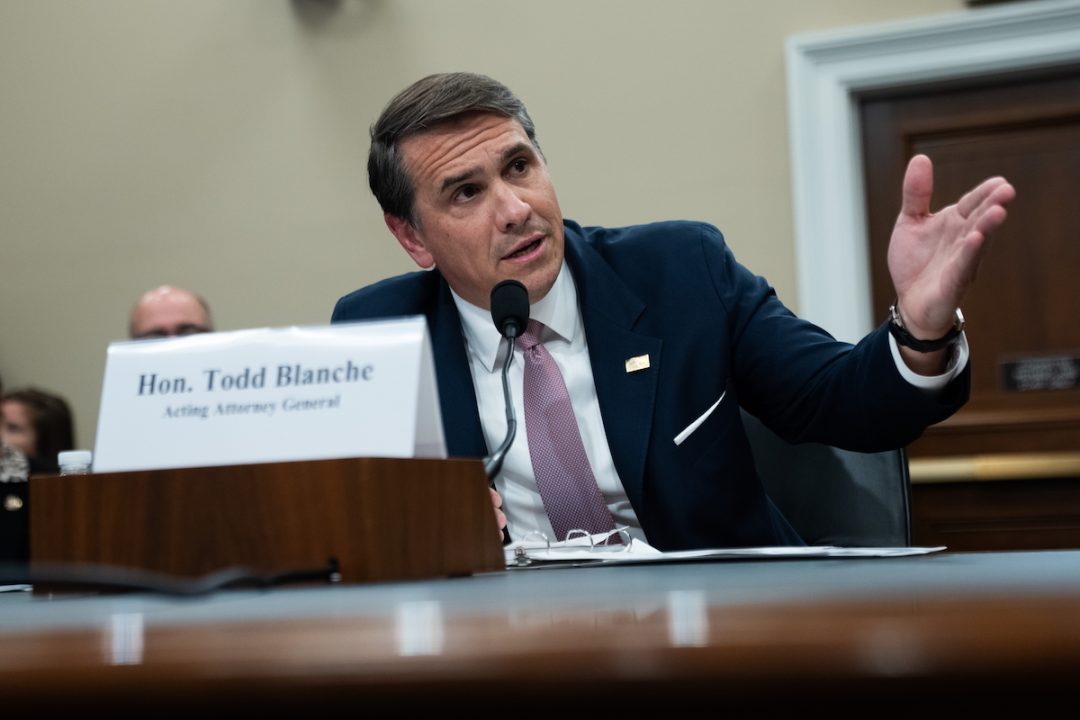
Then Acting Attorney General Todd Blanche went further on Capitol Hill. According to The Hill, he told House appropriators,
We are not moving forward with the fund. Period.
The report continues,
Rep. Grace Meng (D-N.Y.) sought to clarify that DOJ was “not moving forward ever,” and Blanche responded “correct.”
That sounded final. But Blanche would not put it in writing. He also said a related memo remains in place. That memo “FOREVER BAR[S] AND PRECLUDE[S]” federal review of tax returns of Trump, his family, businesses and related entities.
Like the fund in question, it is also a part of the “settlement” between the president and his own Justice Department in a lawsuit against his own Treasury Department and IRS.
A Lawsuit Against Himself
The controversy began with Trump’s lawsuit against the IRS and Treasury Department, filed in January.
Trump sued over the illegal disclosure of his tax returns by IRS contractor Charles Littlejohn. Littlejohn pleaded guilty to leaking tax information and was sentenced to five years in prison in 2024. Trump sought $10 billion in damages. The leaks occurred during Trump’s first term in office.
But the case had a structural absurdity at its center. Trump was suing agencies inside the executive branch he controls. Those agencies were represented by the Justice Department, which also answers to him. As we previously reported,
The institutional optics are unusual, if not bizarre. A sitting president is suing an agency within his own executive branch. The [DOJ] normally defends the IRS in court, yet it is part of the same branch and ultimately answers to the president.
Treasury Secretary Bessent also serves at the president’s pleasure. Both he and Attorney General … can be removed by Trump. At the same time, their departments would be expected to defend the government against his lawsuit. The case therefore places senior officials in the position of defending the United States while their continued tenure depends on the plaintiff himself.
That made the case less like a normal lawsuit and more like a legal performance. Even Trump acknowledged the problem earlier in the case, saying he was expected to “work out a settlement with myself.”
On May 18, the DOJ announced a settlement. Trump would drop his lawsuit. In return, DOJ would create a $1.776 billion fund to compensate people who claimed they were targeted by government “weaponization” or “lawfare.”
The Court Stops the Money
The first serious blow came from federal court in Virginia last Thursday.
Judge Leonie Brinkema temporarily barred DOJ from taking further action to create or operate the fund. Her order blocked the transfer of money. It also blocked DOJ from considering claims or disbursing payments while the litigation proceeds.
The plaintiffs challenging the fund argued that DOJ had no authority to create a payout system of this kind without Congress. They also argued that the fund discriminated on political grounds by favoring Trump’s allies while excluding or disfavoring his opponents.
The court has not issued a final ruling on those claims. But the temporary order was enough to freeze the machinery.
No Official Commitment
While Blanche stated that the fund would not go any further, his statement had a major loophole.
Meng pressed him to put DOJ’s retreat in writing.
“You established it in writing, so it just makes sense to rescind it in writing,” she said.
“I’m not committing to doing anything in writing,” Blanche responded. He added that he would “take it under advisement.”
Blanche then argued that there was nothing to rescind because the fund had not yet become operational. Per The Hill,
“The extent there was a fund, and remember, the fund wasn’t set up yet. There were no commissioners named. There was no, no claimants brought anything in front of that. There was no claims made yet. So, yes, we’re not moving forward with the fund,” Blanche said.
He also pointed to ongoing litigation. DOJ, he said, would continue “defending our rights and making sure our rights are protected,” while still not moving forward with the fund.
When pressed again, he resisted the idea of signing papers that would reverse DOJ’s earlier announcement.
“I’m not sure what that means to sign documents reversing,” he said. “There’s nothing to reverse.”
Then he offered a narrower substitute.
“I think there’ll be a transcript of what I say here,” Blanche said, “so that will be in writing.”
That answer left the retreat suspended between politics and law.
The Florida Judge Wants Answers
A second judicial problem emerged in Florida.
U.S. District Judge Kathleen Williams, who had overseen Trump’s IRS lawsuit, on Friday ordered briefing on whether the settlement was “a product of collusion” and possibly “a fraud on the Court.”
That language did not come out of nowhere. It followed a request from 35 former federal judges appointed by presidents of both parties. They asked Williams to reopen the case and examine the settlement.
Their concern was direct. They said the parties bypassed judicial review by never submitting the settlement to the court. They also questioned whether the lawsuit involved a real dispute between parties.
That issue goes to the heart of federal judicial power. Courts decide real cases and controversies. They do not exist to bless staged disputes between a president and agencies under his control.
Williams has not ruled that the settlement was collusive. But she found the allegations serious enough to demand briefing.
Republicans Blink
The fund also created a political problem for the GOP.
Democrats opposed it as self-dealing. That was expected. The more dangerous resistance came from the president’s own party.
Some GOP lawmakers expressed worries that the fund could compensate people involved in the January 6 protest at the Capitol. Others expected Democrats and dissenting Republicans to use the fund fight to force amendment votes during the push for immigration-enforcement funding.
The backlash grew large enough to disrupt Senate business. On Monday, Senate Majority Leader John Thune (R-S.D.) postponed action on a reconciliation bill tied to immigration enforcement and called on the White House to “shut [the fund] down.”
That pressure appears to have worked.
Blanche’s testimony gave Republicans an exit ramp. They could now say the administration had backed away from the fund. But the retreat looked less like a principled correction than a tactical withdrawal.
That may explain why Blanche refused to put the retreat in writing. A written cancellation would not merely repeat his testimony. It would create a new legal record, one that litigants could use to argue that the fund was unlawful, severable from the settlement, or evidence that the whole arrangement was improvised under political pressure.
Blanche gave Republicans what they needed politically: a statement that the fund was dead. But he avoided giving courts and challengers what they wanted legally: a formal document that could be attached to a brief.