

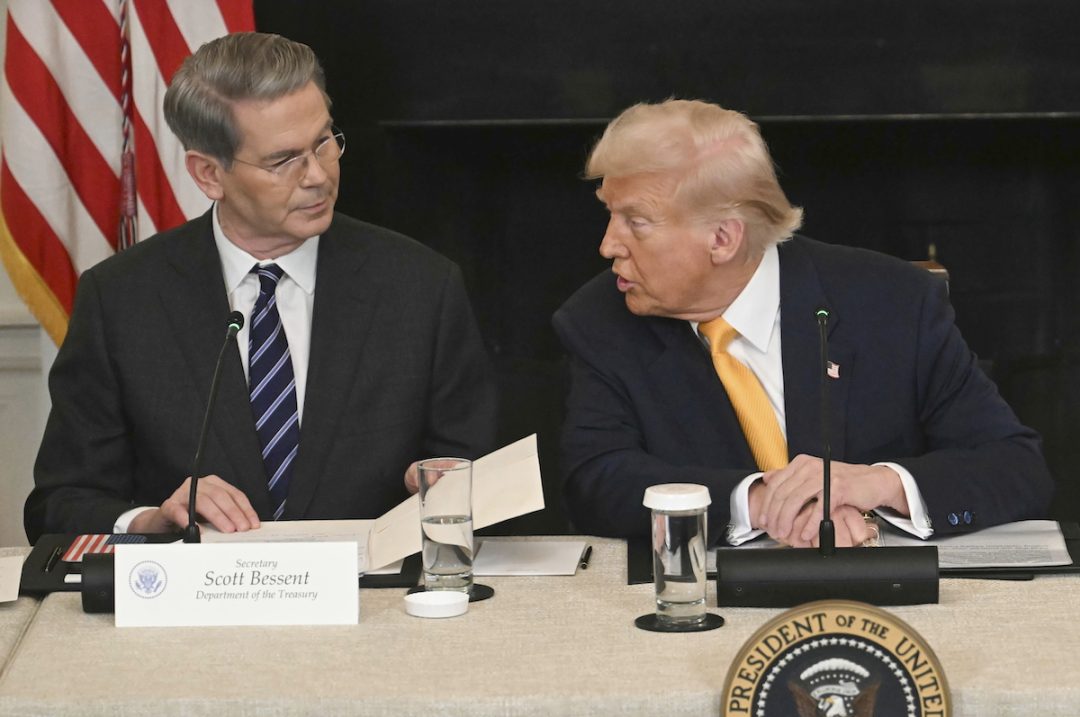
Trump Suing IRS, Treasury for $10 Billion; Bessent Says Payout Would Come From Public Funds
President Donald Trump is suing the Internal Revenue Service (IRS) and the U.S. Department of the Treasury for $10 billion over the leak of his tax returns that occurred during his first term in office.
On Thursday, Treasury Secretary Scott Bessent confirmed at a Senate hearing that if Trump were to prevail, the payout would come from Treasury’s general funds, meaning U.S. taxpayers would ultimately shoulder the cost.
The case carries a layer of irony. Trump has long criticized the IRS as bloated and abusive, and at times floated replacing it with what he called the External Revenue Service. Yet his lawsuit now seeks one of the largest civil payouts in American history from that very agency.
Another twist is political — and in no way excuses the disgraced agency’s failures. As candidate, Trump repeatedly pledged to release his tax return, saying audits were the only barrier. He never did so voluntarily. Now the legal battle centers on returns that became public through a criminal leak rather than a political decision.
The Case
Donald Trump, Donald Trump Jr., Eric Trump, and the Trump Organization filed a complaint in federal court in Miami in late January against the IRS and its parent department, the U.S. Department of the Treasury.
Their core argument is straightforward: The federal government had a legal duty to safeguard their tax returns and related financial data. They say that duty arises under federal tax secrecy law, 26 U.S.C. § 6103, and under the Privacy Act. According to the complaint, those protections broke down in a major way.
The case centers on Charles “Chaz” Littlejohn, an IRS contractor who later pleaded guilty to unlawfully accessing and disclosing confidential tax information. In January 2024, he was sentenced to five years in prison.
Trump and the other plaintiffs argue the IRS is legally responsible because Littlejohn operated within IRS systems and under IRS authority. In their view, this was not an outside hack but a failure of internal controls.
The lawsuit states that Trump family members and hundreds of Trump-related business entities later received formal IRS notices about unauthorized disclosures. The complaint treats each disclosure, and each subsequent spread of the information, as a separate violation, forming the basis for a damages claim of at least $10 billion.
Security Failures
A central theme of the lawsuit is systemic weakness, not just one individual’s crime.
The complaint points to repeated warnings from the Treasury Inspector General for Tax Administration about IRS data security gaps. It argues those warnings were not fully addressed. According to the filing, those weaknesses allowed Littlejohn to move tax data outside IRS systems.
It describes methods that allegedly included uploading files from an IRS computer to a private website, storing information in draft email accounts, and using personal storage devices. The lawsuit also stresses that the breach went undetected for about three years, which, it argues, reflects broader monitoring failures.
The Harm
The complaint presents the damage as both reputational and financial.
It argues the disclosures triggered a wave of high-profile stories that cast Trump and his businesses in a negative light. Littlejohn provided material to The New York Times, ProPublica, and “other leftist media outlets.” The Times relied on the information for its September 27, 2020 investigation, “Long-Concealed Records Show Trump’s Chronic Losses and Years of Tax Avoidance.” ProPublica later published a series, beginning in June 2021, examining how ultrawealthy Americans “[minimize] their personal tax bills — sometimes to nothing.”
The lawsuit describes much of that coverage as false or misleading. It highlights stories that referenced tax avoidance, questionable accounting measures, business losses, or “red flags.” It also points to ProPublica reporting that used language implying fraud or misconduct. The plaintiffs argue these portrayals harmed their public image and business reputation.
Scale is central to their case. The complaint stresses that the material did not fuel just one story. It says the information drove many reports across major outlets and reached vast audiences.
Motivation is another pillar. The complaint cites Littlejohn’s own statements about wanting voters to see a sitting president’s tax returns before an election. It also references prosecutors’ remarks that the disclosures damaged public trust. Together, the plaintiffs say, these factors show the conduct was willful and politically driven, strengthening their claim for punitive damages.
A Precedent
During a hearing, Bessent noted that Trump was one of 44,000 victims whose tax returns were breached at that time. One of them already took the IRS to court. Billionaire Ken Griffin, founder and CEO of the investment firm Citadel, sued after his tax information appeared in ProPublica reporting. Griffin did not pursue a massive damages claim. Instead, he sought acknowledgment of wrongdoing, reforms, and the statutory minimum amount required to proceed with litigation — $1,000 per disclosure.
The case did not result in a large financial award. It ended in a settlement in which the IRS issued an apology and pledged to strengthen its data security practices. No major payout followed.
That outcome shows a court can recognize government failure without triggering a large draw from the federal treasury. Trump’s demand operates on a very different scale.
The Bigger Picture
In 2026, the IRS is set to operate on a budget of about $11.6 billion. A $10 billion judgment would be close to the agency’s entire annual funding. Although the Treasury oversees far larger financial flows, a payout of that size would likely pressure Congress to make up the difference, again using federal funds backed by taxpayers.
The institutional optics are unusual, if not bizarre. A sitting president is suing an agency within his own executive branch. The U.S. Department of Justice (DOJ) normally defends the IRS in court, yet it is part of the same branch and ultimately answers to the president.
Treasury Secretary Bessent also serves at the president’s pleasure. Both he and Attorney General Pam Bondi can be removed by Trump. At the same time, their departments would be expected to defend the government against his lawsuit. The case therefore places senior officials in the position of defending the United States while their continued tenure depends on the plaintiff himself.
Senate Democrats have framed the matter in sharper terms. In a Thursday letter to Bondi and Bessent, Senators Ron Wyden (D-Ore.) and Elizabeth Warren (D-Mass.) called the lawsuit “a shameless and transparent act of corruption” and a “frivolous attempt by President Trump to profit off the failures of his own administration.”
They argued the tax disclosure statute was designed to compensate proven harm, “not to confer $10 billion dollar windfalls to a President seeking to line his own pockets at taxpayer expense.” The Senators noted the leak occurred during Trump’s first term and questioned whether the officials would fully contest the case, especially after Treasury canceled contracts with Booz Allen Hamilton, the contractor employer tied to the breach.
Trump declined to comment on the lawsuit when asked about it at the Oval Office last Friday.