
From Spokane to Palisades: Arson Keeps Coming Up in Some of America’s Most Destructive Fires
Police arrested a man they believe started at least one of three massive fires that have razed hundreds of homes in Spokane, Washington, over the last three days. The arrest falls into a long pattern of arson and destructive fires in this country.
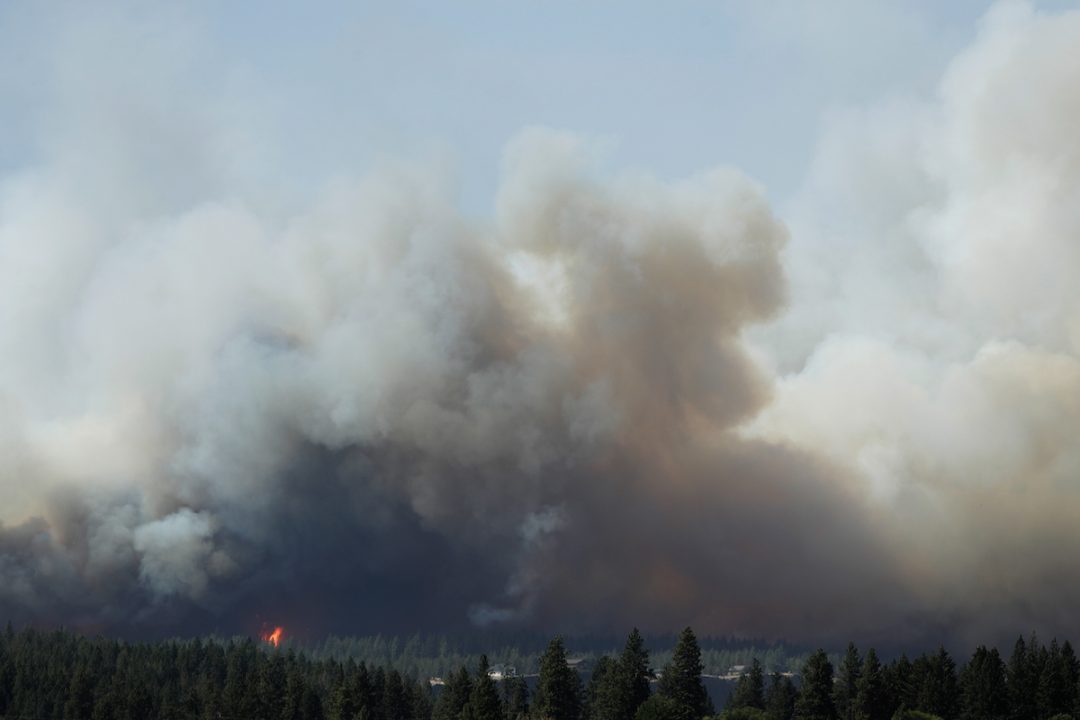
The Spokane fires are considered among the most devastating in the history of the city. Three blazes are raging: the Autumn Lane Fire, Old Trails Fire, and Fairview Fire. The fires, as of Tuesday, have burned more than 10,000 acres, destroyed more than 700 structures, and pushed 60,000 people to evacuate their homes. More than 4,000 people from 12 states and even Australia are working together to contain the blazes.
Spokane, like much of the Mountain West, is no stranger to wildfires. The local climate is arid, and by August, it’s common for the region to be bone dry. But the recent fires suddenly exploded.
Arrest
Authorities announced Monday evening that they arrested a 37-year-old convicted felon named Aaron Farinacci on suspicion that he started the Old Trails Fire, which has burned more than 3,600 acres. He is charged with 1st Degree Arson and being held on a $1 million bond.
Local officials said during a press conference that the suspect’s arrest happened after citizens reported suspicious behavior. According to local media,
concerned citizens notified authorities that they noticed a man who was bending down in the grass in the area around 12 p.m. Witnesses told officials that Farinacci looked nervous, and later on saw smoke coming from the area where he was standing.
Police found the suspect four miles from where the Old Trails Fire started. They initially let him go, but arrested him later after the Department of Natural Resources, Crime Check, and police detectives “developed probable cause to arrest him for arson.” They arrested him at his home, where, apparently, they happened to have also found waterproof matches and a butane lighter.
This isn’t the first time the suspect may have had something to do with wildfires. Detectives learned that Farinacci “had been contacted by Spokane police and the Washington State Patrol last year for two separate fire investigations.”
More Foul Play Suspected
As has become the norm, whenever a fire destroys so much infrastructure, widespread suspicion and skepticism that foul play is at hand abounds. As the allegations against Farinacci suggest, those suspicions have been already vindicated, at least partially. But what of the other three? Local reports say that “several fires exploded in size across Spokane County on Saturday afternoon.” Legacy media reports attributes this to a rare combination of extreme fire weather and especially dry fuels. “A historic 2026 snow drought, played a large role,” says one media outlet. This past winter was abnormally mild. There were also powerful winds in the area, which always fuel fire.
But the speed at which these fires engulfed so much has many scratching their heads. For reference, the Upriver Fire in Spokane County started on June 16. It was contained eight days later after it consumed 213 acres, 14 homes, and took one human life. The current fires exploded on Saturday, and after two days had already consumed nearly 8,000 acres.
All sorts of rumors have emerged regarding the source and motivations of the fires. People have suggested everything from arson to the use of directed energy weapons to motivations tied to a moratorium on data centers the Spokane City Council approved a few weeks ago. While it’s true that the City Council quashed two data-center proposals when it passed a moratorium, we have not found support for the suspicion that these fires may have something to do with that. Nor have we stumbled across proof that energy weapons were used.
Larger Pattern
The fact that arson likely ignited one of the most destructive fires is part of a pattern. Arson is also suspected in “one of the most devastating wildfires in Los Angeles history.” Reuters is referring to the Palisades fire. Jonathan Rinderknecht was an Uber driver in the area. He is accused of lighting a fire in the hills of Los Angeles after listening “to a rap song whose music video depicted things being set on fire.” Interestingly, authorities were notified and the blaze put out. But it was left smoldering, and a week later intense winds gave it new life. That blaze destroyed about 6,000 structures and killed 12 people.
Arson is also the determined cause of one of the largest fires in Arizona history, the Rodeo-Chediski Fire. Leonard Gregg, a tribal firefighter, told police he set the fire hoping to get hired by the Bureau of Indian Affairs to fight it. And that’s what happened.
Also, in 2006, a serial arsonist named Raymond Lee Oyler lit a series of small fires around Banning, California. He started in May with three small fires. Early in June, he lit another fire using a device made of three wooden matches and a cigarrete. The setup allowed him time to get away before the fire grew. Later in June, he changed his behavior. He started fires on slopes to boost their size and intensity. All the fires to that point were contained to no more than 10 acres. But the one he started late in October, the Esperanza Fire, ended up burning 41,173 acres and killing five firefighters. That fire was helped by strong winds that swooped into the area after he ignited them.
Oyler was eventually arrested. Prosecutors said he set as many as 25 fires, including one in 2003. In 2009, he was sentenced to death for igniting the 2006 Esperanza Fire.
These are only a small number of the alleged and convicted arsonists tied to some of the most devastating fires in U.S. history. And these are just the fires sparked by criminals who were caught.