
U.S. Pulls Bombers Out of England for Fear of Iranian Terror Raid
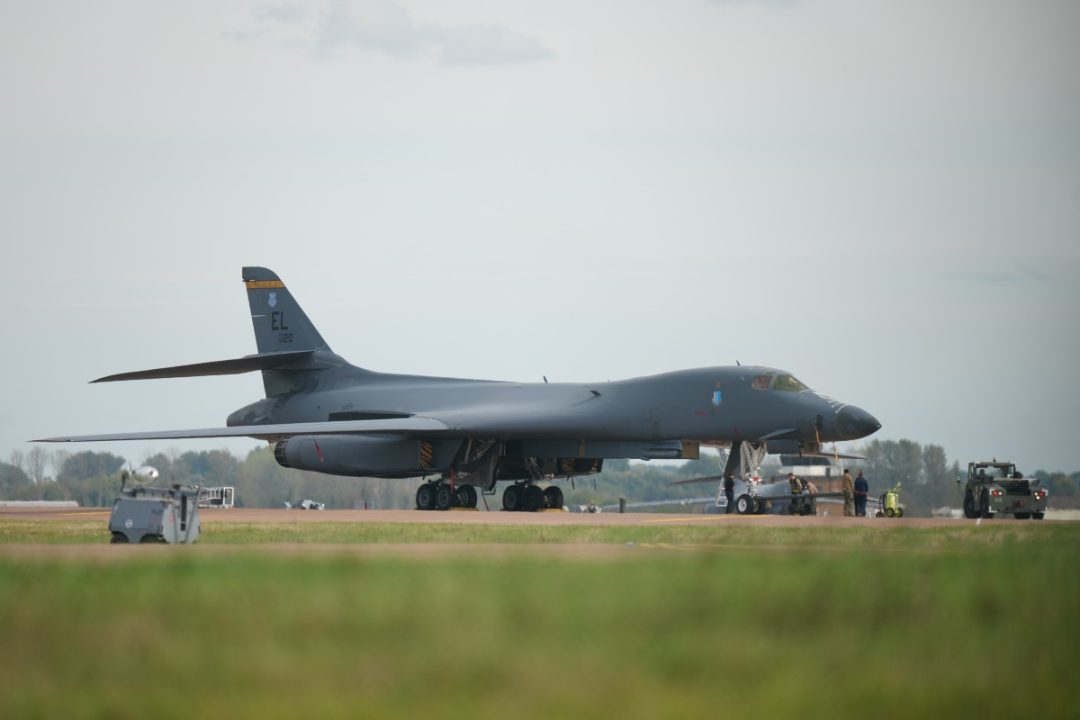
In another apparent victory for Iran, the United States has withdrawn its squadron of B-1 bombers from England.
The move to abandon the Royal Air Force base at Fairford came after British authorities foiled what might have been a terror plot targeting the base.
The withdrawal also followed last week’s final movement of U.S. forces out of Iraq.
Terror Plot, Withdrawal
As The New York Times reported last week, British cops arrested five men after three suspicious vehicles were spotted near the base. All “the men were all in their early 20s and were British nationals from London,” the Times reported:
The United States has used the base, R.A.F. Fairford, to deploy bombers against Iran during its war, but it is not yet clear whether the episode is connected to that conflict. On Monday, Iran’s embassy in London said it “categorically rejects and strongly condemns” speculation that Iran was connected to what had happened.
After police received a call, “authorities arrested five men on suspicion of ‘committing offenses under the Explosives Act’ and of ‘preparation of a terrorist act,’” the Times reported, citing police.
The base features a nearly 10,000-foot runway that can handle heavy bombers like the B-1 Lancer. The U.S. has used it since it opened in January 1944.
Cops found gasoline but no bombs in the trucks, and a dual British-Iranian national arrested by police was released on bail.
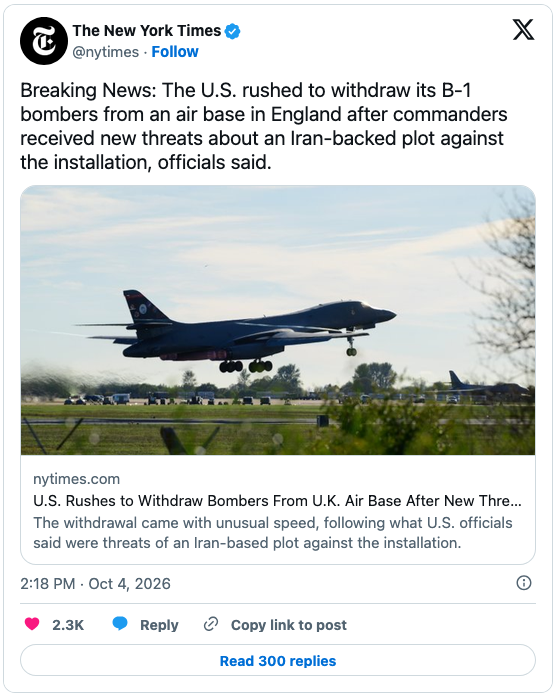
During the weekend, the Times reported separately, the Lancers flew back to the United States “after commanders received new threats about an Iran-backed plot against the installation, two U.S. officials said on Sunday.”
“The withdrawal was highly unusual,” the newspaper continued:
Such moves are rarely made so quickly from an allied air base in a peacetime country thousands of miles from a combat zone.
The need to move the bombers out of the base, R.A.F. Fairford, was deemed so urgent that some of the planes and their flight crews left while aerial refueling aircraft were still being scrambled to support their flights to the United States. At least three of the planes had landed at their home base in South Dakota by Sunday, the officials said, speaking on the condition of anonymity to discuss operational matters.
American officials were alarmed that Iran might target the base after Iran’s Revolutionary Guard warned that Britain’s allowing the U.S. to use the base to attack Iran “makes London responsible,” the Times explained:
“Any base used to launch attacks on Iranian territory,” the statement said, “is a legitimate target for our forces.”
In September, U.S. military commanders received a chilling warning from American and other Western intelligence agencies, according to U.S. officials briefed on the information. R.A.F. Fairford was the target of a potential Iran-backed attack.
The murky outlines of a plot had been pieced together through a combination of intercepted communications, informants and other intelligence. Israel’s prime minister, Benjamin Netanyahu, said his intelligence officials also warned their British counterparts of a probable Iranian-sponsored attack, though they did not provide a specific target. Follow-up attacks were likely to include drones, the confidential assessments warned.
“I think that we’re gonna be as careful as we possibly can be. Obviously, doing these missions is sometimes inherently risky, even flying a training mission, as we sometimes find out,” U.S. Vice President JD Vance told reporters at Joint Base Andrews near Washington, D.C., as he was leaving for a trip to Alaska:
Unfortunately, a training mission in the United States of America can be risky because these are very powerful, very next-generation pieces of technology. So, what you saw there is the Secretary of War out of an abundance of caution trying to protect our guys. We do feel with some confidence that the Iranians are, you know, they’re trying to do what the Iranian state has done for 49 years, which is engage in acts of terrorism against the United States and against a lot of other people … so we are being extremely cautious.
RAF Fairford is about 95 miles northeast of London.
U.S. Out of Iraq
Last week, U.S. forces left Iraq permanently after 23 years there. President George W. Bush started the war because Iraq supposedly had weapons of mass destruction. That claim, from the CIA, was false.
More than 4,400 Americans died in the Iraq War; 3,481 in hostilities.
The pullout suggests that Iran has a chance to exert more influence there, Reuters reported.
“Iraqi security experts say the withdrawal — agreed [to] in 2024 under President Joe Biden and carried out by Donald Trump’s administration even as it wages war against Iran — could give Tehran and its powerful allies free rein, while also allowing other US enemies to stage a comeback, including [the] Islamic State,” the wire service explained:
“Iran stands to benefit strategically from the coalition’s departure because it removes a military presence that for years acted as a counterweight to Tehran’s influence in Iraq,” said Jasim al-Bahadli, an Iraqi security analyst specialising in studying armed Shi’ite groups aligned with Iran.
He told the wire service that pro-Iranian militias would claim the U.S. withdrawal is a victory for Iran.
Islamic Resistance commander Abu Mojtaba al-Yasiri called the pull-out “a historic victory for the Iraqi Islamic resistance groups and honorable Iraqis, and a crushing defeat for the American project.”
The Islamic Resistance, a collection of Shia factions in Iraq, has attacked U.S. military facilities in the past. It killed three Americans with a drone in January 2024.