Report: Inside Peter Thiel’s Private Club, Where Oligarchy Builds the Future
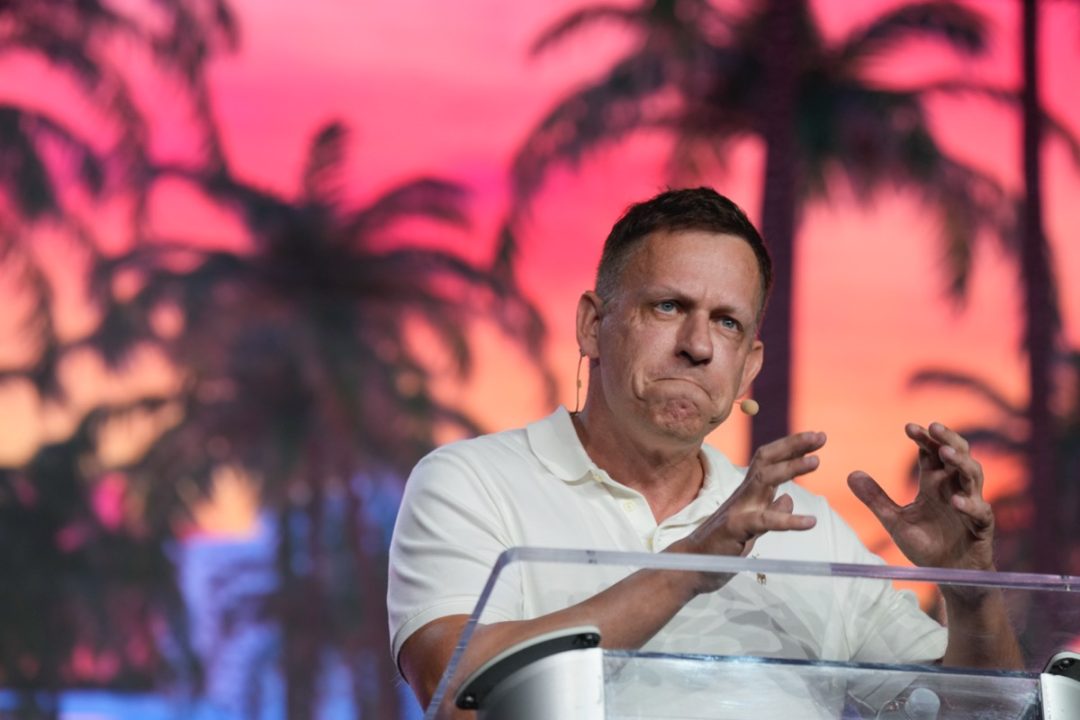
A leak from Peter Thiel’s private Dialog society offers a rare look at how America’s political, military, financial, and technology elites gather when they believe the public is not watching.
The result is not just embarrassing. It is revealing.
According to records reviewed by WIRED, Dialog is a private, invitation-only organization co-founded in 2006 by Thiel. Per the report:
It convenes US officials, foreign government figures, and Silicon Valley executives at off-the-record annual retreats. Dialog has spent two decades declining to disclose its members.
Now, internal records exposed online show who was invited, what they discussed, and what kind of world this circle is imagining.
Thiel is a co-founder of Palantir, the data-mining and surveillance company seeded by the CIA’s venture arm and now deeply embedded in government contracting across multiple administrations. He is also one of President Donald Trump’s most important Silicon Valley patrons and a Republican megadonor. And his name has surfaced in the Jeffrey Epstein orbit, with records and reporting describing meetings, correspondence, and Epstein’s own references to Thiel as a “great friend.”
Notably, WIRED also pointed to a Dialog connection in the Epstein files. In 2012, according to Department of Justice records, Harvard physicist Lisa Randall forwarded Epstein an invitation to a Dialog retreat and asked whether it was “worthwhile” to attend.
In that invite, the club’s ambitions were spelled out clearly: They wanted to “change the world.” The invitation says it brings together only a limited number of participants of “global” and “emerging” leaders “who can help implement the plans we develop.”
The Attendees
The leak shows Dialog as more than a networking retreat. It is a private forum that brings together power brokers from government, finance, technology, intelligence, surveillance, and politics.
As WIRED put it, “the documents show an extraordinary convergence of power.” It continues:
The registration records list General Alexus Grynkewich, NATO’s supreme allied commander of Europe and the head of U.S. European Command…. The website directory names sitting Trump administration officials, two U.S. senators, six members of the Paypal Mafia, a former Middle East chief of intelligence, and a sitting ambassador to the United States, along with the founders and directors of many of the country’s largest surveillance, data-broker, and advertising-data companies.
The report further points to prominent decision-makers in public finance and commerce. Among the attendees are
Treasury secretary Scott Bessent, whose department writes the rules on financial data, and Senator Ted Cruz, chairman of the Commerce, Science, and Transportation Committee, which oversees the Federal Trade Commission and its data-privacy authority.
There are others:
Randy Kroszner, a former governor of the Federal Reserve who now serves on the Bank of England’s Financial Policy Committee; Hallie Hoffman, a former general counsel and acting chief of staff of the Drug Enforcement Administration; Jonathan Greenblatt, the chief executive of the Anti-Defamation League; Peter Goettler, the president of the Cato Institute; Ryan Stowers, the executive director of the Charles Koch Foundation; and Roger Myerson, a Nobel laureate economist at the University of Chicago.
In other words, “just” an intimate private retreat where the people who write the rules meet the people who profit from them. As they say, “nothing to see here.”
The Names
Beyond the names already mentioned, the roster includes others who need little introduction:
- Senator Cory Booker (D-N.J.)
- Peter Goettler, president of the Cato Institute
- Jonathan Greenblatt, chief executive of the Anti-Defamation League (ADL)
- Representative Jim Himes (D-Conn.)
- Jared Kushner, President Donald Trump’s son-in-law and Middle East envoy
- Tom Lue, general counsel and head of governance at Google DeepMind
- Souad Mekhennet, former Washington Post reporter
- Wes Moore, governor of Maryland
- Neal Mohan, CEO of YouTube
- Jared Polis, governor of Colorado
- Rick Warren, evangelical pastor
- Ezra Klein, political commentator
The oligarchic class is well represented. The leak names the following billionaires (and one trillionaire):
- John Arnold, Centaurus Advisors and Arnold Ventures; $2.8 billion
- Nicolas Berggruen, Berggruen Holdings and Berggruen Institute; $2.9 billion
- Mike Cannon-Brookes, Atlassian; $7.7 billion
- Scott Cook, Intuit; $4.4 billion
- Marcos Galperin, MercadoLibre; $6.8 billion
- Reid Hoffman, LinkedIn and Greylock Partners; $2.7 billion
- Henry Kravis, KKR; $12.2 billion
- Joe Lonsdale, Palantir, 8VC, and OpenGov; estimated $2.8 billion
- Elon Musk, Tesla, SpaceX, X, and xAI; $1.3 trillion
- Eric Schmidt, Google and Schmidt Futures; $40.1 billion
- Barry Sternlicht, Starwood Capital Group; $3.1 billion
- Peter Thiel, Palantir, Founders Fund, and PayPal; $27.8 billion
“Off-the-record”
WIRED reported that the leaked materials include a registration list for Dialog’s 2026 retreat near Dublin, Ireland. The list names 222 registrants. Some are marked as “active member” or “guest.” Others are first-time attendees. Many appear to have registered with personal or corporate emails rather than government accounts.
That detail is not minor. If public officials attend sensitive gatherings through private channels, their participation can fall outside the normal paper trail of government accountability. The issue is not whether every conversation is improper. The issue is that the public cannot know what its “public servants” are discussing with the wealthy industries they oversee.
Dialog’s structure appears designed for precisely that kind of discretion. One internal moderator guide reportedly tells participants that everything is “off-the-record.” It also urges comments to be concise and “nonobvious.” That raises the obvious question: If senators, generals, government officials, investors, and executives are discussing matters that could shape the public’s future, why is the public the one party not allowed in the room?
The Agenda
The retreat agenda is striking because it includes sessions that sound almost like parody. Per the report:
The program of off-the-record sessions includes “Money (Does?) Buy Happiness,” “Bring Back Nuclear,” “Navigating WWIII,” “Battlefield Technologies,” and “How’s Your Sex Life?” Other talks include “Build-a-Cult,” moderated by the founder of the Christian networking site Pray.com, and “Build-a-Party,” run by a former White House national security official.
Those titles matter because they show the worldview of the gathering. This is not a civic conference about ordinary public problems. It is a private space where powerful people appear to discuss war, technology, sex, religion, political organization, and social control in the same breath.
The “Build-a-Cult” session is especially striking. America’s Founders built a constitutional system around distrust of concentrated power, personal rule, and political worship. They would have recognized the danger immediately. Ordinarily, the word “cult” is a glaring warning. In this setting, it appears as a workshop topic, particularly chilling against the backdrop of the Trump administration’s controversial blurring of the line between church and state, its misuse of Christian messaging and symbols in war propaganda and political communications, and its reliance on megachurch networks.
The “Battlefield Technologies” and “Navigating WWIII” sessions raise a different concern. Defense technology is no longer a narrow military subject. It is now intertwined with artificial intelligence, surveillance, drones, data systems, and private contractors. When senior officials and nominally private companies discuss those themes “off-the-record,” the public has reason to ask who benefits, and what it means for future conflicts.
The Data-state Nexus
The most troubling part of the report, however, is not the eccentric agenda. It is the overlap between nominally private data companies and public power.
Dialog’s chairman, Auren Hoffman, is not just a conference organizer. He is a data-industry operator and investor: the founder of SafeGraph and LiveRamp, companies tied to location data and identity resolution, and a general partner at Flex Capital, a seed-stage venture firm with a broad portfolio across the digital economy. That makes him a connector as much as an entrepreneur, someone whose network sits at the intersection of data infrastructure, venture capital, and political access.
Alongside Thiel, another Palantir co-founder, Joe Lonsdale, is also listed in the report. Lonsdale is another Trump donor. He helped fund Trump’s 2024 campaign through Elon Musk’s America PAC. He then advised the administration on “government spending and efficiency” through the now-infamous DOGE.
Buried beneath the loud political theater of long-promised government efficiency, DOGE’s true mission had been spelled out early: to “modernize government software” in line with an “AI First Agenda.” The result was not so much the exposure and cutting of government “waste, fraud and abuse” as the digitization of government itself. That is what DOGE appears to have successfully achieved.
Once that happened, the Trump administration contracted Palantir to fuse datasets on every American, potentially creating detailed profiles on every citizen.
At the same time, Palantir’s software is used across immigration enforcement, healthcare, defense, and intelligence systems.
The Tech Future
The leaked materials also show a group preoccupied with “artificial intelligence, longevity, and the near future.”
On that future, the Dialog elites are not optimistic. WIRED reports:
Asked on a sign-up form to predict what comes next, registrants returned again and again to the same theme: AI will reorder work, war, education and belief within a few years. Several foresee mass labor displacement and a swing back toward unions and government programs. Others predict an “AI winter,” domestic terrorism targeting data centers, criminal defendants choosing AI lawyers over public defenders, or religious revival provoked by the disruption.
“Societal degeneration,” one person predicted, “will continue to accelerate.”
That last phrase captures the mood. Dialog appears to be a place where elites debate societal collapse while remaining insulated from the people who would live through it. Thiel himself recently made news after “temporarily” moving his family to Buenos Aires, part of what wealth advisors now call “sovereign diversification,” a polite phrase for the billionaire search for backup jurisdictions, tax shelters, and places to ride out the crises they help create.
There is a long tradition of powerful people gathering privately to discuss the future. One example is the Bilderberg Group, hosted this year in Washington, D.C. Notably, Thiel is a member of its steering committee. But the AI era raises the stakes. A small set of companies and investors now control tools that could drastically transform labor markets, policing, warfare, education, media, and political persuasion. At the same time, those same people are finding ways to “penetrate government” itself, to borrow the infamous maxim, through lobbying, political spending, advisory roles, and the revolving door. Obviously, their private conversations with public officials should not be treated as harmless salon culture.
Republic vs. Oligarchy
The deeper irony of the Dialog leak is not that a private club failed to protect its own secrets. It is that the ultra-wealthy and well-connected people exposed in the leak are helping build a world where privacy increasingly belongs only to them.
Dialog reportedly collected political leanings, matchmaking answers, and private access tokens, then promised discretion. When the data spilled out, the lesson was obvious: The powerful value privacy when it is their own.
Everyone else is pushed into a different bargain.
It includes digital IDs, digital money, tokenized assets, biometric checkpoints, travel databases, location tracking, identity graphs, AI risk-scoring, and mass-data collection, all dressed up as convenience, safety, and modernization.
But what emerges is not a republic. A republic requires visible, accountable power and private, responsible citizens. An oligarchy reverses the order.
Dialog shows that reversal in miniature. Billionaires, data brokers, defense contractors, political donors, and public servants gather privately to “change the world.” The public is not invited into the room. It is forced to simply accept this new world and comply with its rules.
So the question is no longer whether powerful people are meeting in private. They always have. The question is whether a Republic can survive when those private clubs are building the instruments through which everyone else will be watched, measured, scored, and governed.