
FCC Authorizes Experimental Satellite to Illuminate Earth After Dark
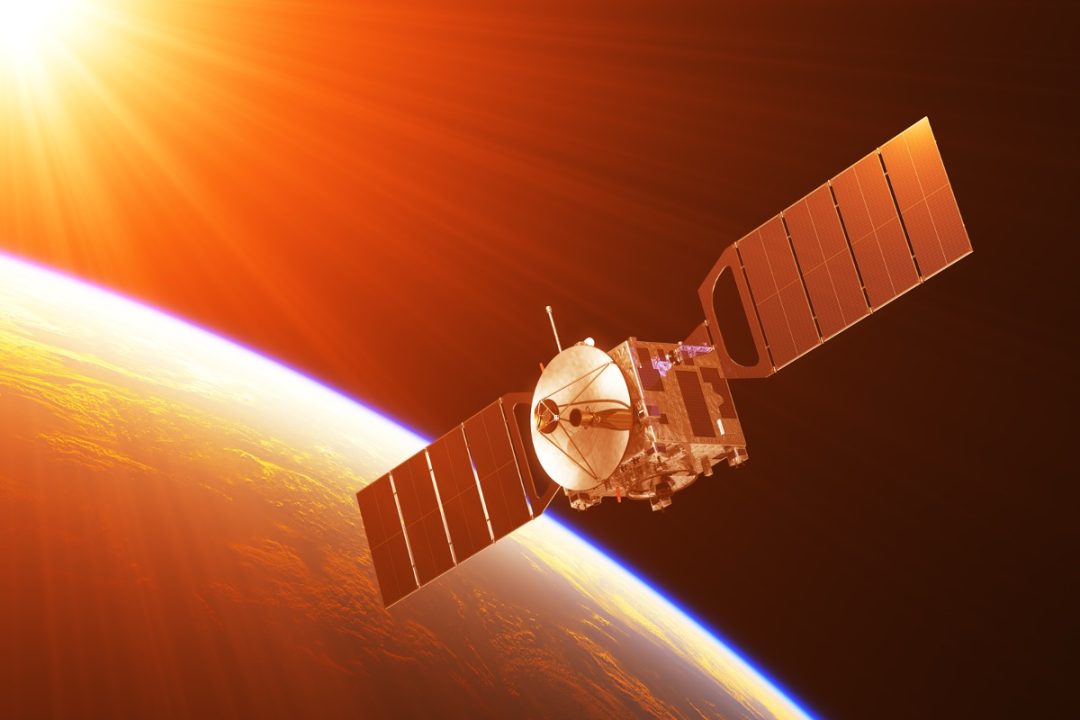
The Federal Communications Commission (FCC) has granted Reflect Orbital authority to deploy and operate a satellite designed to redirect sunlight onto Earth after dark.
For now, the approval covers one experimental spacecraft, not the enormous constellation the company hopes to build. Yet it gives Reflect its first federal foothold.
The FCC, one of many constitutionally dubious federal agencies, also drew a convenient boundary around its authority. Although it reviewed radio frequencies, collision risks, and orbital debris, it declined to decide whether a private company with powerful political and corporate connections should illuminate the night sky in the first place. Meanwhile, the company’s ambitions, and several of the uses it envisions for the technology, give its promise of “sunlight on demand” a distinctly dystopian cast.
Eärendil-1
Reflect Orbital announced the decision with undisguised enthusiasm.
“This ruling is hugely validating for our company and reflects America’s leadership in testing innovative space technology,” it said on X.
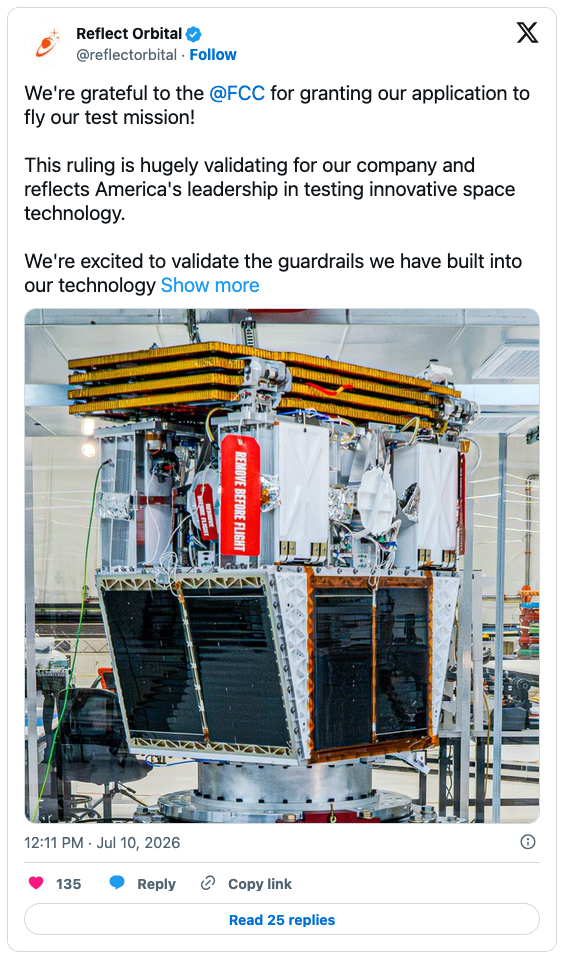
The company also stressed restraint, saying it had built “safeguards” into the satellite and would collect real-world data before expanding.
The FCC approval covers Reflect’s first demonstration satellite, called Eärendil-1. The name comes from J.R.R. Tolkien’s half-elven mariner, who sails the heavens carrying a radiant jewel that appears as both the Morning and the Evening Star.
According to the FCC, Eärendil-1 will fly about 625 kilometers, or 388 miles, above Earth. It will carry a deployable reflector made from highly reflective thin film. The mirror will measure about 18 meters, or nearly 60 feet, on each side.
The FCC described the reflector as “motorized and steerable.”
The license covers only one satellite, and lasts two years after Reflect places it into orbit. The company expects roughly one year of active operations, followed by less than one year of deorbiting. Eärendil-1 will carry propulsion for collision avoidance.
The FCC called the spacecraft a limited test of an emerging technology. Reflect views it as the first step toward something far larger.
“The Future of Sunlight”
Reflect bills its services as “the future of sunlight,” and says its technology will redirect sunlight from orbit “to any precise location on Earth.” It claims customers could switch the beam off, adjust its brightness, and direct it precisely without installing infrastructure on the ground.
The company promises “precise, uniform delivery,” and describes the system as “sustainable” and “responsibly deployed.” In effect, Reflect presents sunlight as a commodity available at a chosen place, intensity, and hour.
The website’s interactive “Explore” feature makes that vision more concrete. A user can move a broad beam of light across a map and direct it toward a selected location. The image resembles a powerful aerial searchlight sweeping the ground at night.
Though meant to convey convenience, the demonstration also reveals the reach of this technology.
The company envisions applications ranging from extending solar power generation, disaster response, industrial work, and agriculture, to public events, urban lighting, and military operations. In the wrong hands, however, the same capability could enable surveillance, expose people or facilities that depend on darkness, intimidate communities, or support unlawful police and military activity.
Co-founder Tristan Semmelhack placed the project inside a much larger energy argument. He said the world must “produce vastly more energy than ever before, at global scale, quickly enough to make a difference — all while keeping it clean. ”
The pitch is ambitious. But it effectively turns one of nature’s basic rhythms into something that can be ordered, redirected, brightened, and switched off. The unresolved questions are who controls the light, who authorizes its use, and what recourse people below would have.
A Grand Promise, Written in the Sky
In a nutshell, Reflect proposes to extend the “useful” hours of solar energy. Its satellites would direct sunlight to Earth after sunset or before sunrise.
The company stresses the responsibility, transparency, and meticulous care that such an undertaking requires.
“Reflect Orbital is earning the right to operate and to scale,” Semmelhack wrote. He said the company must prove that reflected sunlight can be controlled precisely, limited in brightness and duration, and used only in appropriate locations. He also promised coordination with affected communities and scientific institutions.
At the same time, he framed the risks of the project against a much larger — and familiar — moral emergency:
If the world fails to create abundant clean energy, the consequences will be measured in poverty, instability, preventable disease, lost opportunity, continued fossil-fuel dependence, and unnecessary human suffering.
The language is meant to reassure. It is also meant to place opposition on the defensive. Anyone who questions orbital mirrors may appear to oppose clean energy, human progress, or even the prevention of suffering.
That framing should not end the inquiry. State-favored corporations often promise careful stewardship and life-saving benefits. Big Pharma, Big Tech, and other politically connected industries have relied on the same vocabulary of responsibility, urgency, and grand public good. Yet the public is often left absorbing the consequences, sometimes with deadly results.
Reflect may prove more conscientious. But trust should follow verifiable evidence, not precede it. It should be stressed that decisions about whether, when, and where the night sky may be artificially illuminated should rest with the affected communities at the local level, not with a distant federal agency.
That point is especially relevant considering the company’s ambition. The plan is to grow its satellite fleet from two in 2026 to 36 in 2027. It then projects more than 1,000 in 2028, more than 5,000 in 2030, and more than 50,000 by 2035.
The Criticism
Astronomers and dark-sky advocates opposed the application.
For instance, the American Astronomical Society filed a petition asking the FCC to deny it, writing:
Considering the severe harm that Reflect Orbital’s [non-geostationary orbit satellite] is expected to create for professional and amateur astronomy, as well as the potential for light trespass and significant negative effects on human and environmental health, we assert that the satellite, as proposed, fails to meet the public interest standard required for Commission licensure.
The commission also received more than 1,800 individual letters echoing these and related concerns.
DarkSky International stated last December that even the test could become several times brighter than a full moon inside its illuminated area. The Arizona-based advocacy organization argued that darkness supports ecosystems, public health, cultural heritage, and science. The Hill reported that DarkSky “stated last week that it was evaluating any legal options to prevent the satellite from being launched and used.”
The FCC largely sidestepped the raised issues. It said the operation of the solar reflector, including its effects on optical astronomy and nighttime illumination, fell outside its review of the satellite’s radio communications. It also dismissed objections based on a future constellation as speculative because Reflect had applied for only one satellite.
That approach may fit the agency’s rules. It does not settle the public unease.
The Techno-political Orbit
Managing sunlight was once the province of nature. Now, some of the world’s most powerful technology billionaires increasingly treat it as an engineering problem.
Infamously, Bill Gates has funded research into solar geoengineering, including methods that would reflect a share of sunlight away from Earth, effectively dimming the sun. The concept provoked particular bewilderment and alarm on the political “Right.”
Harvard ultimately canceled its proposed SCoPEx field experiment before researchers released any reflective material. But the idea lived on.
It resurfaced last November, when the “Right’s” new darling, SpaceX chief executive Elon Musk, proposed that
a large solar-powered AI satellite constellation would be able to prevent global warming by making tiny adjustments in how much solar energy reached Earth.
Not surprisingly, Reflect Orbit has direct connections to Musk’s business network. Reflect’s co-founder and chief executive, Ben Nowack, previously worked as an engineer at SpaceX.
Further, the investment link runs through Shaun Maguire, a Sequoia Capital partner and Reflect director. Sequoia backed Reflect in 2024 and describes it as the firm’s first space investment since SpaceX. The firm identifies Maguire as its partner for both companies.
Maguire also has direct ties to President Donald Trump’s political circle. He announced a $300,000 donation supporting Trump after his May 2024 criminal conviction, and after the election joined the venture capitalists and Big Tech figures who spent time at Mar-a-Lago as Trump assembled his administration.
The political links later acquired an official dimension. This May, Defense Secretary Pete Hegseth appointed Maguire to the Pentagon’s Science, Technology and Innovation Board.
Reflect, meanwhile, received a $1.25 million Air Force research contract in 2025. The project focuses on using its satellite-reflector technology to provide energy resilience and responsive lighting for military operations.
All in all, the political optics have changed — but the underlying impulse has not. Whether the proposed intervention would dim the sun or redirect its light, a small technocratic elite still claims the authority to redesign the sky for everyone else.