

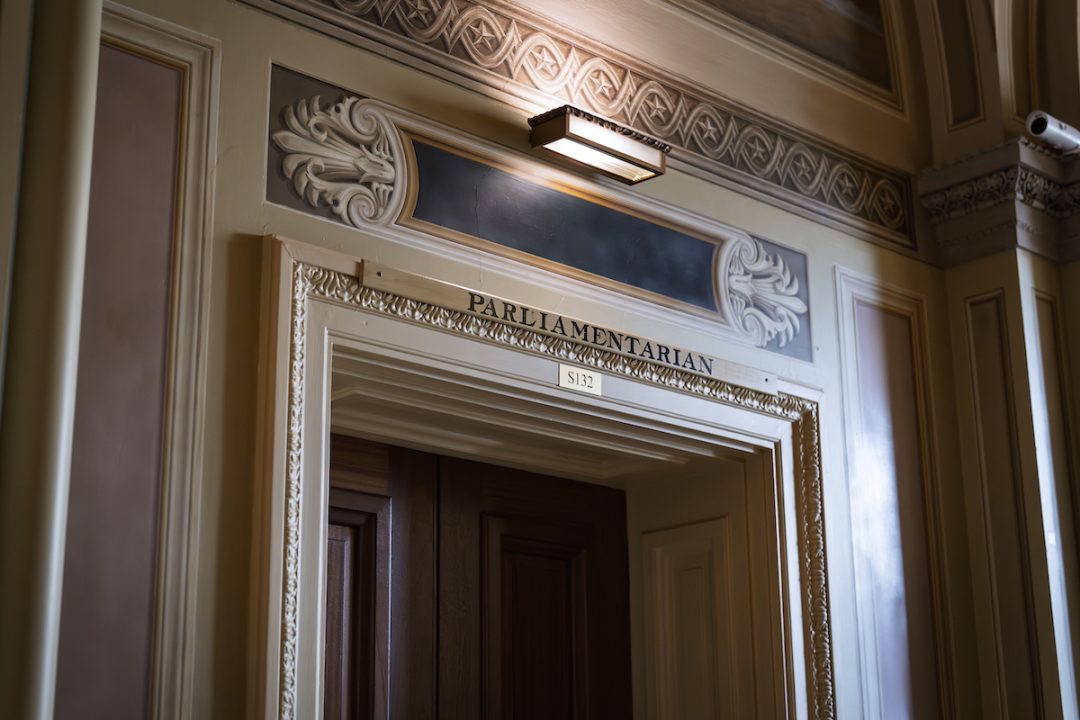
Trump’s Ballroom Blowup Becomes a Senate Power Test
President Donald Trump wanted $1 billion in taxpayer-backed security money tied to his new White House ballroom-turned-military bastion, a project he once vowed to finance privately. The Senate parliamentarian spoiled the plan by advising that the provision could not ride through a budget reconciliation bill as drafted without facing a 60-vote threshold.
So Trump did what Trump does. He turned a rules dispute into a loyalty test. He attacked a Senate official by name, demanded her removal, and told Republicans to kill the filibuster before they all lose their jobs.
The result was revealing. The ballroom money did not just run into Democratic opposition. It ran into Republicans who could read the room.
By Wednesday evening, Republican Senator John Kennedy of Louisiana said the money was out. “We were told that, and again, I haven’t looked at the text, but we’re told that the ballroom money is out,” he told reporters after a GOP meeting.
The Parliamentarian Blocks the Path
At the center of the fight is Elizabeth MacDonough, the Senate parliamentarian. Her job is procedural. She advises the Senate on whether provisions fit within chamber rules, including the strict rules that govern reconciliation bills.
That matters because Republicans are trying to move a roughly $70 billion immigration-enforcement package through reconciliation. The process would let them pass the bill with a simple majority and avoid a Democratic filibuster. But reconciliation comes with limits. The bill must stay tied to budget matters, and unrelated — or “extraneous” — provisions can run afoul of the Byrd Rule.
MacDonough’s advice effectively stripped the provision of reconciliation’s simple-majority protection. According to Senator Jeff Merkley of Oregon, the ranking Democrat on the Senate Budget Committee,
Today, the Senate Parliamentarian advised that the provision in the Judiciary Committee title of the Republicans’ bill that provides $1 billion for Trump’s gilded ballroom would be subject to a 60-vote threshold if it remains in the bill.
Associated Press reported that the proposal included about $220 million for security improvements related to the ballroom, with the rest going to a visitor screening center, training, and other Secret Service measures.
Republicans could have treated the matter as a technical ruling. Trump treated it as a betrayal.
Trump Turns on MacDonough
On Wednesday, Trump opened his Truth Social broadside with grievance and personal attack:
Shockingly, Republicans have kept the very important position of “Parliamentarian” in the hands of a woman, Elizabeth MacDonough[.]
He then tied MacDonough to old Democratic villains, saying she was appointed “long ago, by Barack Hussein Obama and a vicious Lunatic known as Senator Harry Reid.”
Reid appointed MacDonough in 2012 after longtime parliamentarian Alan Frumin retired. Obama was president, but he had no role, because the parliamentarian serves the Senate, not the White House.
MacDonough has also angered both parties over the years. But Trump framed the matter as if Democrats had planted an enemy agent inside the Senate rules office. In his telling, a dry institutional role became another captured fortress, and a ruling on reconciliation became proof that Republicans had once again failed to purge the system. He wrote,
Over the years, she has been brutal to Republicans, but not so to the Dumocrats — So why has she not been replaced?
That question carried the real message. Trump was not simply mad about one ruling. He was demanding that Republicans remove institutional obstacles that slow his agenda.
“There are many fair people who would be qualified for that vital job,” he added.
The Ballroom Problem
The fight over MacDonough grew out of the fight over the now-militarized ballroom project.
Trump has already moved forward with it. The old East Wing has been demolished and is set to be replaced by a 90,000-square-foot ballroom. According to Trump’s Tuesday update, the broader project would include complex military functions, most of them subterranean.
Trump had originally said the project would not require federal money. He and private “patriot donors” would cover the bill. That position changed as Republicans pursued $1 billion in taxpayer funding for security “enhancements” tied to the ballroom and its military and security functions.
To critics, the optics were obvious. A president asks for a massive security package around a grand ballroom while Americans struggle with groceries, gasoline, healthcare, housing, and debt. Predictably, Democrats seized on the opening and blasted Trump and his allies for warped priorities.
But the sharper problem came from Trump’s own party. The proposal was not just unpopular with Democrats. It made some Republicans uneasy, too.
Turning Rules Fight Into a Power Fight
Trump did not stop with the parliamentarian. He widened the attack:
The Republicans play a very soft game compared to the Dumocrats. It is their single biggest disadvantage in politics.
Then he moved from insult to accusation.
The Dumocrats cheat, lie, and steal, especially when it comes to Votes in Elections, but stick together[.]
Trump was pointing at a real problem, even if he wrapped it in his usual carnival language. The Democratic coalition has built a vast election machine out of litigation, bureaucratic rulemaking, donor-funded activism, ballot-access fights, media discipline, and federal pressure.
But that made Trump’s response more troubling, not less. He did not argue for restoring the constitutional order. He argued for breaking more restraints so Republicans could fight the same way.
The president also tied the fight to the SAVE Act, which The New American has rightly called a “totalitarian Trojan horse.” The bill would require proof of citizenship to vote in federal elections. Its supporters call it election integrity. In reality, it lays the groundwork for a national ID regime and greater federal control over elections, an area the Constitution largely leaves to the states. Trump, apparently, sees it differently:
We need THE SAVE AMERICA ACT passed, and NOW — And, likewise, kill the Filibuster, which would give us everything!
The latter call also exposed the deeper pressure campaign. Trump wants Senate Republicans to end the legislative filibuster. But his argument is not conservative in any meaningful constitutional sense. It is majoritarian and transactional. It treats Senate rules, state election authority, and institutional restraints as useful only when they help his side. When they do not, they become signs of weakness, betrayal, or enemy capture.
Preemptive Demolition
Trump then raised the stakes to existential terms:
If we don’t pass at least one of these two provisions quickly, you will never see another Republican President again.
The warning grew darker.
He claimed Democrats would create “2 additional States, D.C. and Puerto Rico,” gain “4 Senators, many Congressmen, and many additional Electoral Votes,” and pack the Supreme Court with “21 Justices.” Trump warned,
The Dumocrats will eliminate the Filibuster on the First Day that they get an opportunity to do so. The Republicans aren’t doing it because they say the Dumocrats will never do it, but the Republicans are WRONG.
Then came the threat to his own party:
Get smart and tough Republicans, or you’ll all be looking for a job much sooner than you thought possible!
The logic is familiar. Predict catastrophe. Blame restraint. Demand escalation. Then tell reluctant allies that survival requires obedience.
There is a real argument that Democrats would weaken or abolish the filibuster if it blocked a major objective. Many have already said as much in other contexts. But Trump’s solution is not prudence; it is preemptive demolition.
That is the contradiction at the heart of his position. He warns that Democrats will centralize power, rig elections, add states, pack the Court, and break Senate norms. Then he, in effect, urges Republicans to answer by doing the same thing first. In other words, the president does not defend the constitutional structure from abuse. He asks Republicans to abuse it faster that their counterparts “on the left.”