
Out-of-state Cash Powers Graham’s Primary Win
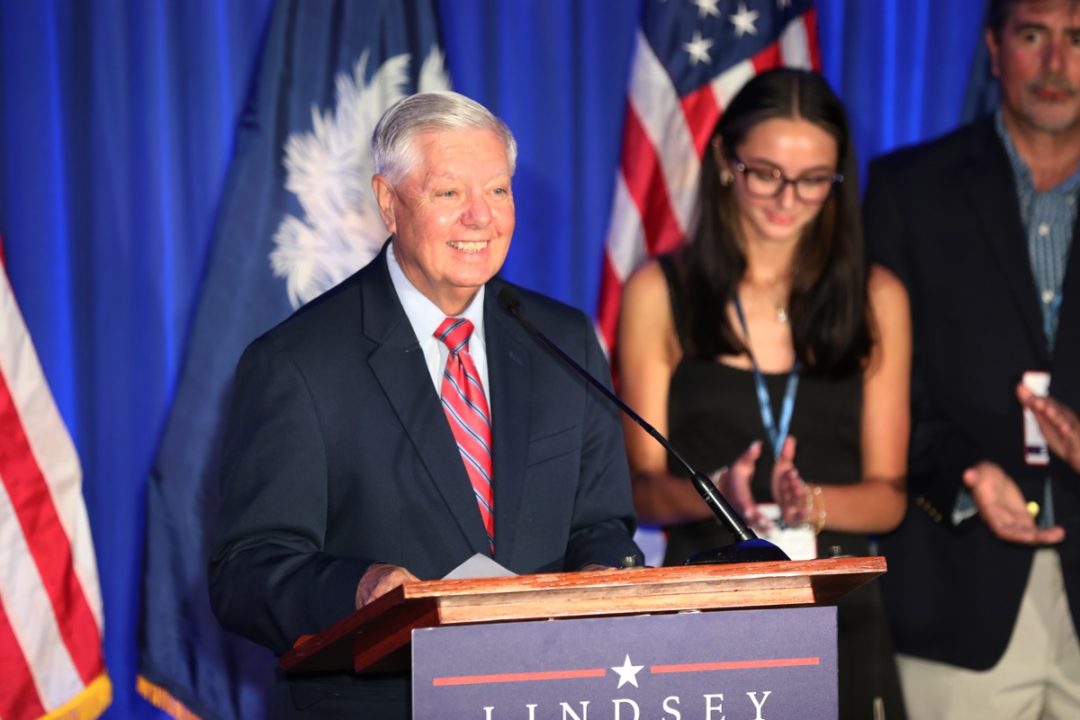
The warmonger from South Carolina won his primary race on Tuesday. Republican Senator Lindsey Graham raked in 58 percent of the vote, thanks to the $27 million his campaign spent to ward off five primary challengers. Most of that money came from out of state.
Out-of-state Donors
According to OpenSecrets, 77 percent of Graham’s reelection war chest came from outside South Carolina. The largest organizational donor, by far, was the American Israel Public Affairs Committee (AIPAC). According to Track AIPAC, Graham has received — by a wide margin — more money from AIPAC than any other South Carolina legislator. His haul registers at just over $1 million. Next is Republican Rep. Joe Wilson, who raked in just under $375,000.
Commentariats and legislators have proposed that AIPAC should be forced to register under the Foreign Agents Registration Act (FARA). Rep. Thomas Massie of Kentucky, who recently lost his reelection bid to a primary challenger backed by AIPAC, introduced legislation that would likely require AIPAC to register with FARA. And earlier this month, Rep. Anna Paulina Luna (R-Fla.) announced she was working to restore FARA enforcement.
Graham also had the support of weapons makers, energy companies, and Big Finance. Boeing, Duke, Fluor, and General Atomics were his next biggest organizational donors. Given Graham’s zeal for foreign wars, it makes sense that defense contractors would be among his top supporters.
Graham vs. Mark Lynch
Among his challengers, only businessman Mark Lynch recorded a showing against Graham. There was concern in the Graham camp that the incumbent would be forced into a runoff, so his campaign dumped $18 million into political ads this year alone.
Lynch took in only 28 percent of the vote. Among his stances, he believes that formal congressional authorization should be necessary before the U.S. embarks on any new military engagement, the opposite of what Graham believes.
Lynch’s war chest, which was also quite substantial, was filled mostly by people, groups, and businesses within South Carolina — 64 percent of it. His organizational donors included supplement companies, furniture stores, and real estate groups.
The differences between Graham and Lynch cannot be more pronounced. One is the favorite of lobbies for foreign countries and weapons makers, the other preferred by in-state business groups and vitamin makers.
Endorsed by Trump
Graham was also President Donald Trump’s choice. Shortly after the primary, Trump posted on his Truth Social account, “Congratulations to Senator Lindsey Graham of the Great State of South Carolina on his BIG WIN tonight. … Now Lindsey will be able to devote his time to passing the desperately needed, and long overdue, SAVE AMERICA ACT!”
In a thank-you post on social media that included a jab at his challenger, Graham acknowledged the power of Trump’s endorsement. “Thank you to the Republican primary voters for your confidence in me and rejecting garbage,” he said. “I have the best team in politics. President Trump’s endorsement is the gold standard in the Republican world.”
Trump’s endorsement is quite the turnaround from 10 years ago, when he called Graham a “disgrace” and “one of the worst representatives of any representative in the United States.” But it’s aligned with several reversals by Trump in his second term. Among those who noticed is a former member of Congress who quit early this year.
Former Congresswoman Marjorie Taylor Greene, who has stayed in the national conversation despite abandoning Congress, took a shot at Trump over Graham’s win. “Donald Trump ran for President claiming he would be the one to drain the swamp. Instead, he built a fortress around it, protected it, and fully became king of the swamp,” she said on social media. “Lindsey Graham has an F rating for his conservative voting score card and loves war almost as much as Mark Levin. This is repulsive.”
Sorry Voting Record
Only one federal legislator from South Carolina has a worse voting record than Graham, and that’s Democrat James Clyburn. Registering a dismal 17 percent on The New American’s Freedom Index, Clyburn’s voting record is among the worst in Congress. He has signed on to every bad fiscal policy and government program, and advocated support for foreign wars and international organizations. But Clyburn has an excuse: Democrats run on government intrusion and internationalism.
Republicans, on the other hand, have a platform that claims to value fiscal responsibility, limited government, and constitutional fidelity. Judging by his 57-percent Freedom Score, Graham doesn’t embody those values.
He is a big proponent of government surveillance, and voted to reauthorize Section 702 of FISA. And he’s a big fan of spending taxpayer money. He voted against reducing USAID funding. He voted against a measure that would’ve halted an increase in the debt limit, and voted against an amendment to reduce the national deficit. But he was happy to vote in favor of sending Ukraine, Israel, and Taiwan billions of dollars. And, of course, he has supported the unconstitutional war against Iran, the proxy war in Ukraine, and essentially any other acts that include America dropping bombs on other countries.
Nevertheless, assuming his reelection is legitimate, this is the man the voters of South Carolina overwhelmingly chose. The lesson is clear: American voters are electing an unprincipled class of legislators who support policies that are bad for them.