

U.S. Ambassador: Trump Offered to Sell American Weapons to China
The Trump administration, continuing the practice of previous administrations, casts communist China as America’s principal long-term geopolitical rival and one of its fiercest economic competitors. At the same time, Beijing is providing military support to other U.S. adversaries, including Russia and Iran.
Yet President Donald Trump has apparently asked Chinese President Xi Jinping whether China wants to buy American weapons.
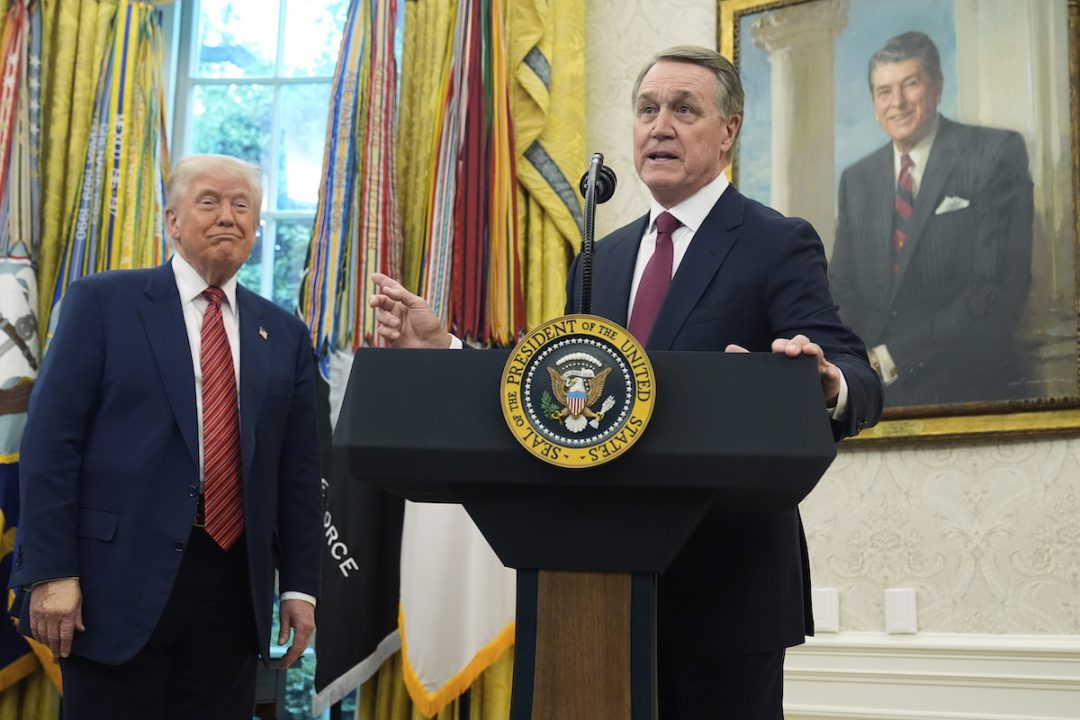
The disclosure came from U.S. Ambassador to China David Perdue, who said Trump raised the idea directly with Xi. The State Department quickly followed with a clarification: U.S. law prohibits such sales, and no deal is planned.
Sales Pitch
Perdue revealed the exchange Sunday on Fox News, just days after Xi completed a state visit to Washington.
Host Shannon Bream asked whether the administration was delaying weapons for Taiwan to appease Xi. Perdue rejected that suggestion.
He said Trump “is as strong on Taiwan as I’ve ever seen anybody” and defended the administration’s record by noting that Trump had already approved roughly 50 percent more arms sales to Taiwan than any previous president.
Then came the striking part. Trump, whose financial disclosures keep showing extensive stock trading in major defense contractors and whose family has expanded its investments in the defense sector, apparently turned the argument around and offered Xi the same opportunity.
Said Perdue:
But President Trump continues to say, “Hey, we sell arms to other people around the world.” He actually asked President Xi, would he like to buy some, at one point.
Perdue did not say when Trump made the remark. He also did not describe Xi’s reaction or identify any weapons that were discussed.
China, however, is hardly an ordinary customer.
The Pentagon’s 2026 National Defense Strategy makes deterring Chinese power in the Indo-Pacific one of Washington’s central military priorities. It calls for a strong “denial defense” along the First Island Chain and warns about the “speed, scale, and quality of China’s historic military buildup.”
Taiwan
Taiwan sits at the center of that confrontation. Beijing considers the self-governed island part of China and has not ruled out taking it by force. Washington does not recognize Taiwan as an independent country, but remains the island’s principal arms supplier.
China wants those sales stopped. Trump, meanwhile, is currently holding a $14 billion arms package that Congress had approved for Taiwan. In May, he described Taiwan arms sales as a “very good negotiating chip” in talks with Beijing.
That makes Perdue’s disclosure especially striking. Washington is debating how much weaponry to provide Taiwan so it can deter China, while Trump apparently asked Xi whether China itself wanted to buy American arms.
On Monday, Fortune captured the contradiction in a headline:
White House jokes that Trump could sell weapons to China and Taiwan at the same time.
A Sale That Would Collide With U.S. Law
The State Department quickly tried to shut down speculation about an actual sale.
“US law prohibits arms sales to China and there is no offer or plan to sell arms to China,” an official told the South China Morning Post.
China remains subject to a U.S. arms embargo.
The restrictions date to the aftermath of the Chinese government’s 1989 crackdown in and around Tiananmen Square. Washington suspended military sales and imposed additional restrictions following the violence.
Those restrictions remain embedded in U.S. export controls.
The Commerce Department’s Bureau of Industry and Security lists China in Country Group D:5, covering countries subject to a U.S. arms embargo.
U.S. export controls also restrict sensitive military components, software, technical data, and technology.
That matters because advanced weapons can expose far more than hardware, including radar, targeting, communications, encryption, and electronic warfare capabilities.
The Department of Justice (DOJ) is still prosecuting attempts to move such equipment to China.
In August, a Chinese national pleaded guilty to trying to acquire military grade satellite modems and radios manufactured for the U.S. military. Prosecutors said the equipment could not legally be exported without a State Department license, which the department generally does not issue for military goods and services destined for China.
Selling advanced U.S. weapons directly to China would therefore require much more than a presidential sales pitch.
It would collide with an export-control system built specifically to keep sensitive American military technology away from Beijing.
It would also create an obvious strategic contradiction. Washington would be supplying military technology to the same government that U.S. defense planners are spending enormous sums to deter.
The Broader Race With China
That contradiction becomes even sharper when viewed against the rest of Washington’s China policy.
The United States is racing China in artificial intelligence, semiconductors, advanced computing, drones, and military technology.
Washington has spent years restricting Chinese access to advanced computing chips and semiconductor manufacturing equipment. U.S. officials argue that such technology can accelerate China’s military capabilities, including advanced weapons and military AI.
Federal prosecutors have also pursued schemes allegedly designed to divert advanced American computing equipment to China. In March, the DOJ charged three defendants with conspiring to secretly divert billions of dollars worth of high-performance servers containing cutting edge U.S. AI technology to China.
Washington is simultaneously trying to reduce its dependence on Chinese drones and drone components. In August, the Trump administration imposed new tariffs on imported drones and drone components, citing national security and weaknesses in the domestic industrial base.
The Pentagon has long restricted Chinese-made drones and drone components over security concerns. The FCC has gone further, adding foreign-made drones and critical components to its “Covered List,” restricting authorization of new equipment.
The same concern extends to espionage and cyber operations.
U.S. agencies continue warning that Chinese state-linked actors are trying to penetrate sensitive American networks and obtain government, military, and commercial information. In August, the DOJ and FBI seized platforms allegedly operated by Chinese state sponsored hackers that targeted some federal agencies and other sensitive institutions.
From War Profiteers to Arms Sales
The Perdue episode also sits awkwardly beside Trump’s long-forgotten criticism of the military industrial complex.
In 2020, Trump accused senior Pentagon officials of favoring wars because defense contractors that “make the bombs and make the planes” wanted to “stay happy.”
During the 2024 campaign, he returned to that theme. At a September rally in Wisconsin, Trump promised what is worth recalling now:
I will expel warmongers. We have these people, they want to go to war all the time. You know why? Missiles are $2 million apiece. That’s why. They love to drop missiles all over the place.… I will expel the warmongers from our national security state and carry out a much-needed cleanup of the military industrial complex to stop the war profiteering.
That rhetoric drew a clear distinction between American security and the commercial interests of weapons manufacturers.
Perdue’s disclosure, if accurate, now lands as another bitter contradiction. Trump once warned that the defense establishment had a financial interest in keeping wars and weapons sales going. His own ambassador now says he asked America’s principal strategic competitor whether it wanted to buy American arms.
In a relationship already defined by military deterrence, technological containment, and growing economic rivalry, such a proposition is anything but trivial.