Trump Warns Iran: “Get Smart Soon.” WSJ: Iran’s Economy Is Crushed. Kent: End War Now, Declare Victory
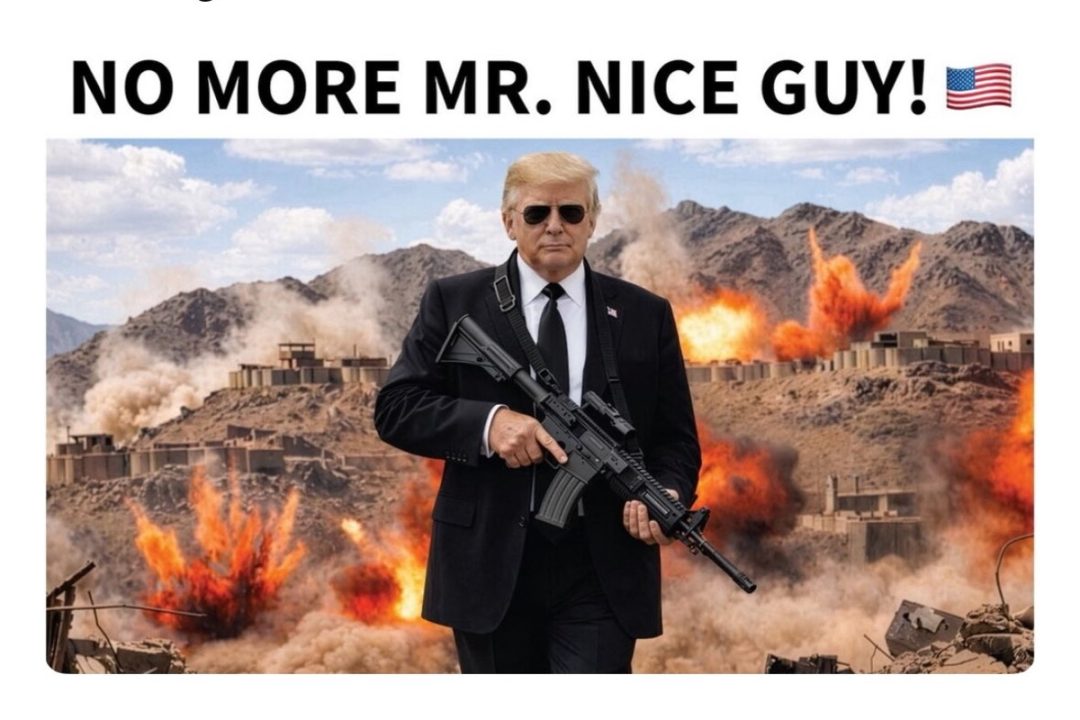
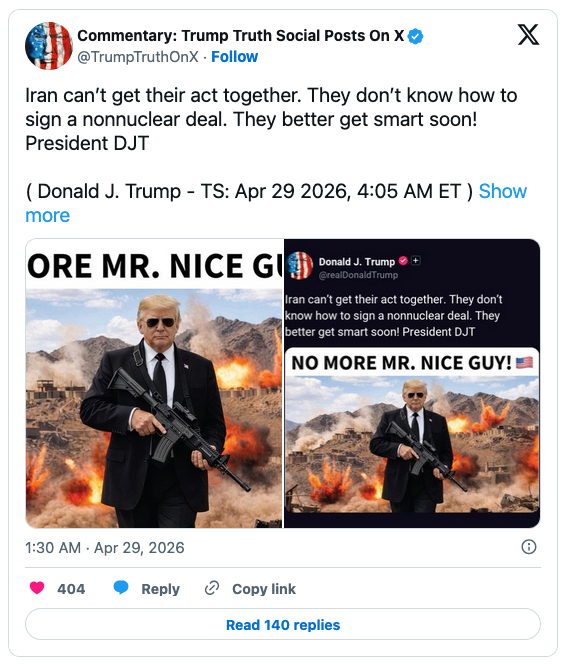
President Donald Trump warned Iran today that it had “better get smart soon” or “No More Mr. Nice Guy.”
He posted the threat on Truth Social over an AI photo of him holding what appears to be an AR-15 rifle and explosions in the background.
Yet Trump, if The Wall Street Journal is correct, isn’t prepared to restart a bombing campaign, and will simply continue the U.S. Navy’s blockade of the Strait of Hormuz, which, the Journal also reported, has wrecked Iran’s economy.
How is that affecting the U.S. economy? Former counterterrorism chief Joe Kent warned on X today that the U.S. could not sustain the blockade, and urged Trump to declare victory and quit the war.
Blockade to Continue?
Today on Truth Social, the bellicose Trump surfaced again.
“Iran can’t get their act together,” he wrote on Truth Social. “They don’t know how to sign a nonnuclear deal. They better get smart soon!”
Under that message, Trump posted a photo of himself in a suit with the rifle and wearing sunglasses. Behind him, six bombs explode.
Despite the threat, though, he “has instructed aides to prepare for an extended blockade of Iran, U.S. officials said, targeting the regime’s coffers in a high-risk bid to compel a nuclear capitulation Tehran has long refused,” the Journal reported:
In recent meetings, including a Monday discussion in the Situation Room, Trump opted to continue squeezing Iran’s economy and oil exports by preventing shipping to and from its ports. He assessed that his other options — resume bombing or walk away from the conflict — carried more risk than maintaining the blockade, officials said.
Has Iran Collapsed?
Yet Trump also claimed yesterday that Iran had informed him that its downfall is complete, suggesting that the country is ready to accept U.S. terms for ending the war.
“Iran has just informed us that they are in a ‘State of Collapse,’” Trump wrote:
They want us to “Open the Hormuz Strait,” as soon as possible, as they try to figure out their leadership situation (Which I believe they will be able to do!).
The U.S. Navy’s blockade of Hormuz, which carries 20 percent of the world’s oil supply, or 20 million barrels per day, seems to be working. Trump’s assertion that Iran confessed its dire condition comports with a Journal offering describing the country’s economic decline.
“War has imposed a heavy cost on Iran’s economy: more than a million people out of work, soaring food prices and a prolonged internet shutdown that has slammed online businesses,” the newspaper reported:
The question is how much more pain Iran’s leaders are willing to tolerate as they try to negotiate a favorable end to the war.
The pressure from the blockade, an Iran expert told the newspaper, might mean Iranians will “mobilize politically.”
If what the Journal reported is true, then Trump might not have been exaggerating in describing Iran’s predicament. Gholamhossein Mohammadi, an official at Iran’s Labor and Social-Affairs ministry, estimates that the war has put one million people “out of work directly and another million indirectly.”
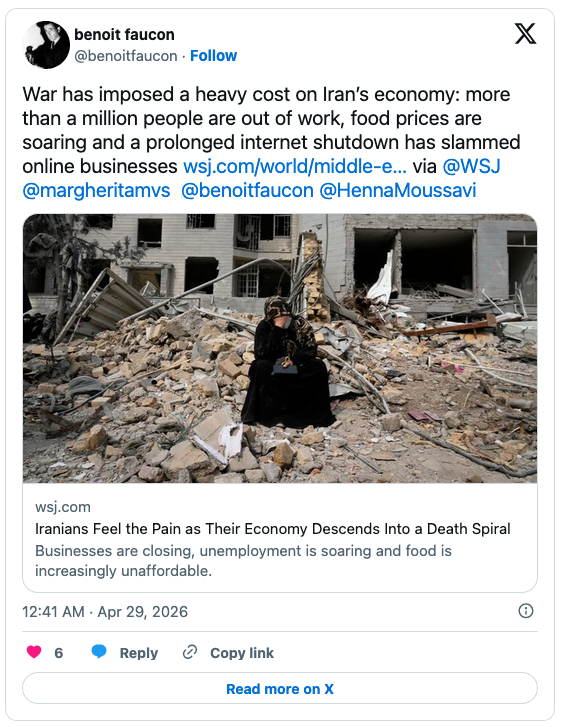
As well, “the cost of living has soared, with the annual inflation rate reaching 67% in the month through mid-April from the same period a year earlier, according to Iran’s central bank,” the Journal continued:
The subsidized price of red meat, which was mostly imported through sea routes, has gone up to the equivalent of around $3.60 a pound, beyond the reach of most in a country where the minimum wage is around $130 a month.
“Living is not affordable anymore,” said Mahdi Ghodsi of the Vienna Institute for International Economic Studies. “Iran is at its weakest point.”
Businesses across the country — from manufacturers to retailers — are closing, residents said. The lack of steel and other raw materials is hampering production in various industries.
Electronic goods, which are mostly imported, are in short supply and expensive.
Iran is trying to stop the bleeding by increasing the minimum wage, boosting government salaries, and subsidizing the price of necessities such as bread and gasoline. Cash handouts are going to the poor along with coupons to buy essentials such as rice and chicken.
“The government has appealed to Iranians to do their part by limiting their consumption of water, electricity and gas,” the newspaper continued. Drive less, officials told residents of Tehran, and take the bus.
Time to Get Out
After Vice President J.D. Vance and his team returned from peace talks earlier this month without a deal, Trump ordered the U.S. Navy to blockade the Strait of Hormuz and vowed to “finish up the little that is left of Iran!”
For its part, since Trump attacked Iran on behalf of Israel on February 28, Iran has closed, reopened, then closed the strait from its end.
Since the beginning, Kent — who quit his post as U.S. counterterrorism director because Trump attacked the country — has urged the president to end the war. The former Green Beret’s latest entreaty explained that the U.S. has nothing to win and should quit the effort.
“Continuing the blockade puts far more pressure on us than on Iran,” he wrote on X:
Iran has proven it can endure economic pain — it has been doing so since 1979. The blockade will not force Iran to abandon uranium enrichment, ballistic missiles, or its proxy networks.
Instead, the blockade is hurting the American people and creating serious domestic pressure on POTUS.
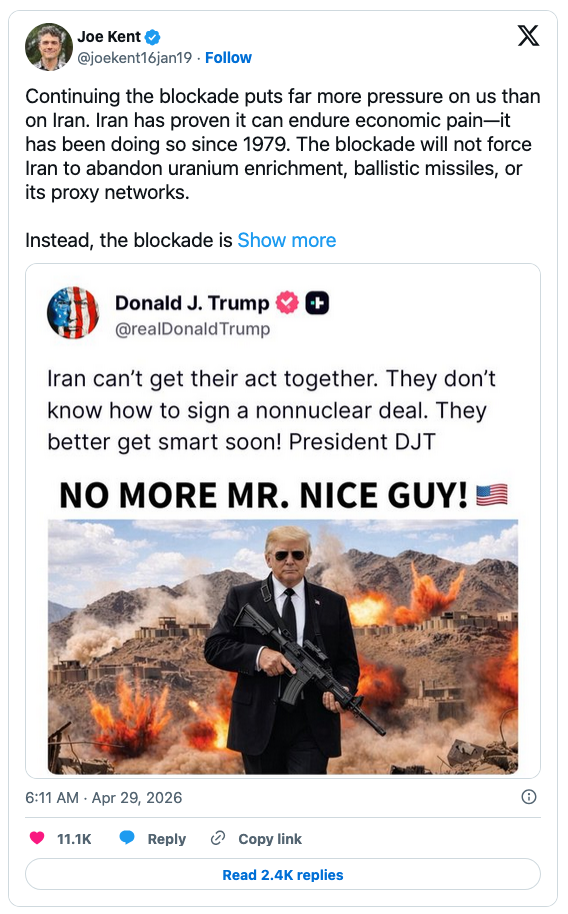
Kent wrote that increasing gas prices will harm the “the working class voters who overwhelmingly backed Trump and Republicans — putting GOP majorities in serious jeopardy.”
The blockade is unsustainable, he continued, noting that the fertilizer shortage it has caused will in turn end in “major food security crises and potential famines in vulnerable regions.”
“The smarter path is clear: withdraw, declare victory, and use sanctions relief as our negotiating leverage with Iran,” he concluded:
This resets the talks on our terms, avoids war, and prevents further escalation of the energy crisis at home and abroad.
The nationwide average price of gas today is $4.29, while the price for a barrel of benchmark Brent crude oil is $118.