

House Rules Committee Rejects Effort to Stop U.S.-Israeli Military Integration
The Israel-First U.S. House Rules Committee rejected an amendment from Representatives Thomas Massie of Kentucky, a Republican, and Ro Khanna of California, a Democrat, to delete a section of the 2027 National Defense Authorization Act that would entwine the U.S. and Israeli militaries and put U.S. national security secrets in grave danger.
The House Armed Services Committee OK’d the bill in early June with Section 224 — the measure that would give Israel carte blanche access to national-security secrets.
Massie and Khanna vowed to fight the imprudent measure. They did. And lost. The Rules Committee decided their amendment needed no public debate.
The Israel Lobby has donated almost $1 million to the GOP contingent on the committee.
Former Representative Marjorie Taylor Greene of Georgia concluded that Israel First neoconservatives control the GOP, and that MAGA was only a “dream.”
Section 224
As The New American reported weeks ago, Section 224 will “expand and accelerate bilateral defense technology research, development, testing, evaluation, integration, and industrial cooperation,” the measure says, by a number of means, including:
• identifying jointly developed or Israeli-origin technologies with operational utility for potential integration into United States systems and programs … ;
• ensuring collaborative research initiatives involving government, private sector, and academic institutions in the United States and Israel, … in a manner that protects sensitive technology and information and the national security interests of the United States and Israel; …
• establishing frameworks for joint ventures, licensing agreements, and United States-based co-production or manufacturing partnerships with Israeli industry.
The two militaries would cooperate on “missile and air defense technologies” as well as cyber-defense, electronic warfare, and artificial intelligence.
The measure gives Israel — notorious for hostile espionage against the United States, its main benefactor — unprecedented access to U.S. national-security secrets.
The measure “lays the groundwork for bilateral research and development, co-production of weapons, joint ventures, licensing agreements, and seemingly every manner of U.S.-Israeli military-industrial complex cooperation,” Ben Freeman explained for Responsible Statecraft as the House Armed Services Committee prepared to OK the measure:
The U.S. and Israel already work together heavily on missile defense, but this provision would greatly expand coordination to seemingly every area of defense tech, including AI, quantum, autonomous systems, directed energy, cyber, biotech, and many more. It also proposes “network integration” and “data fusion.” In other words, the U.S. military’s data could soon be the Israeli military’s data.
Beyond that, he continued, it would give the Israel Lobby even more power than it has now. That power already includes marshaling the tens of millions of dollars that bought Massie’s seat in the House for a largely unknown Israel-firster.
Section 224 will “give the Israeli government the opportunity to greatly expand one of the most powerful levers of influence in U.S. politics: jobs in the U.S,” Freeman continued:
By expanding or starting new co-production facilities like it already has in Mississippi and Arkansas, the Israeli government could boast of providing jobs on U.S. soil, thereby securing allies among members of Congress who represent the districts where those jobs lie.
The result could well be a U.S. political system even more susceptible to the whims of an Israeli government that seemingly has no qualms about drawing the U.S. into military conflicts in the Middle East.
Rules Committee Won’t Allow Vote
Thus did Massie and Khanna vow to fight against melding the two militaries. Khanna noted that the section oozed out of the brain pan of Israeli Prime Minister Benjamin Netanyahu.
“I was glad to receive your proposed Congressional resolution endorsing my plan to shift the framework for US-Israel defense cooperation from aid to partnership,” he wrote to Israel-first GOP Representative Marlin Stutzman of Indiana:
As I said in our meeting in Jerusalem on May 27, 2026, Israel deeply appreciates the financial component of the military aid the United States has generously provided us over the years. The time has now arrived for us to move from aid recipient to partner.
That didn’t bother the GOP-controlled Rules Committee.
Squelching the bill came through the committee’s process that “determines which of the more than one-thousand proposed amendments to the defense policy bill will be publicly debated and voted upon by the full House,” Freeman reported for Responsible Statecraft.
“After no debate” yesterday, Freeman continued, the committee squashed the Massie-Khanna measure when it “released a list of amendments that were ruled ‘in order’ for a vote on Monday night, and theirs was not on it.”
“It is unconscionable to not even have a vote,” Khanna fumed on X over a video statement:
We will be continuing on and will not be intimidated by the pro-Israel lobby.
The Senate’s companion measure passed its Armed Services Committee as well.
Israeli Espionage
Also writing for the Responsible Statecraft, former CIA operative Paul Pillar explained how dangerous an espionage threat Israel is. “In intelligence, Israel is more of an adversary than an ally. Being an adversary in intelligence means indulging in the hostile act of espionage,” he wrote:
Israel has a long record of conducting that type of hostile act against the United States.
About the same time the Armed Services Committee voted to meld the U.S. and Israeli militaries, NBC News divulged an internal Defense Intelligence Agency assessment that said the threat to U.S. secrets from Israeli espionage is “critical.”
“The designation stems from concerns within the Pentagon that Israel is making a particular effort to surveil top U.S. officials to get information on the Trump administration’s internal deliberations and decision-making on the conflicts in the Middle East, the officials said,” NBC reported:
The DIA assessment includes a seven-page document and features a chart, according to one of the current U.S. officials. The document says the assessment of Israel is that its ability to conduct human espionage and technical collection is at a “critical level,” according to the official.
An official told The New York Times that Israel’s anti-American espionage effort is “unhinged” and targeting top officials, including Mideast envoys Steve Witkoff and Jared Kushner.
Those efforts don’t count the notorious case of American traitor and Israeli spy Jonathan Pollard.
Israel Lobby $$$
One reason the Rules Committee blocked Massie-Khanna America First effort: The Israel Lobby pays its members — handsomely.
Figures assembled from the AICPAC Tracker show that the lobby donated $898,891 to GOP committee members.
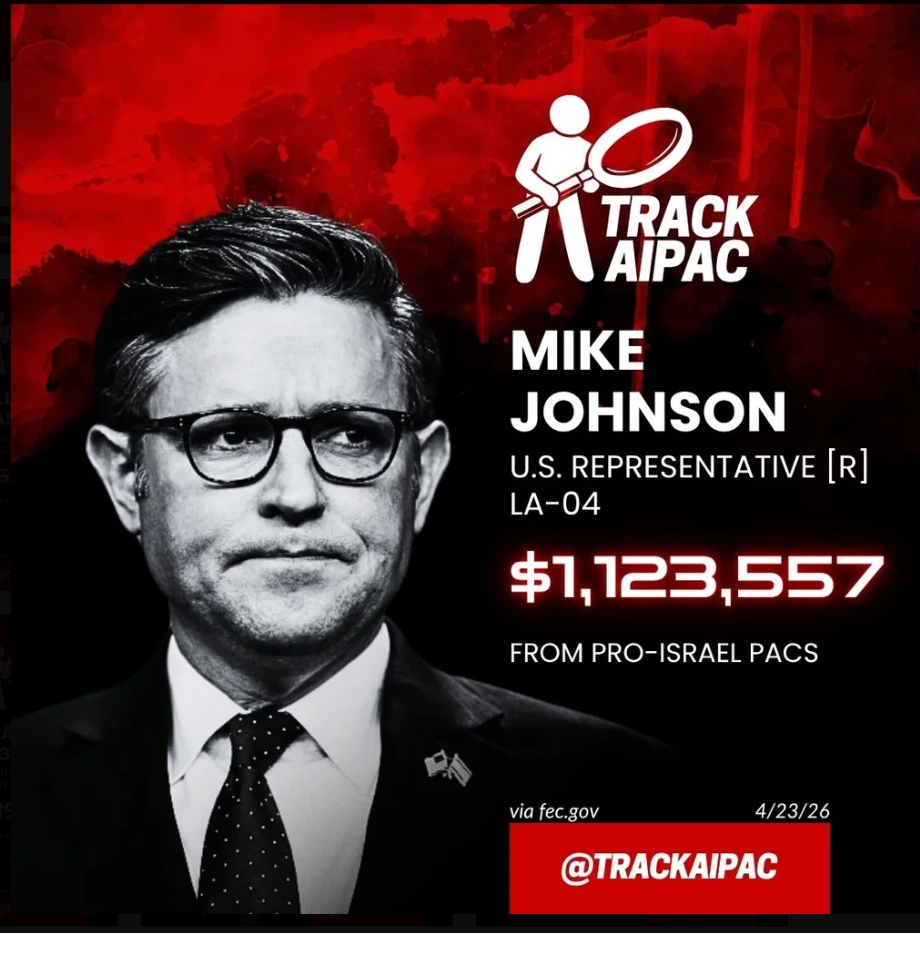
Then again, the Rules Committee acts at the behest the U.S. House Speaker, Mike Johnson.
“The Rules Committee is the Speaker’s Committee and passes or blocks only approved legislation by the Speaker, and often times and especially in this case, the White House,” Taylor Greene wrote on X:
Republicans are fully controlled by Neocons now.
The mask is off, MAGA was just a dream.
AIPAC Tracker reports that Johnson has received $1,123,557 from the Israel Lobby.