


Middle-class Wages Rise Faster Under Trump; Poverty Rate at Historic Low
Much of what governs how people vote isn’t reality, but perception of it. Just consider the economy. We’re supposedly experiencing an “affordability crisis.” It is true, too, that Iran-conflict disruptions have raised oil prices. Yet there’s also much good economic news — though you wouldn’t know it listening to the legacy media.
We can start with the expanding middle class (formerly “the shrinking” one). American Thinker reports today that according to Federal Reserve data,
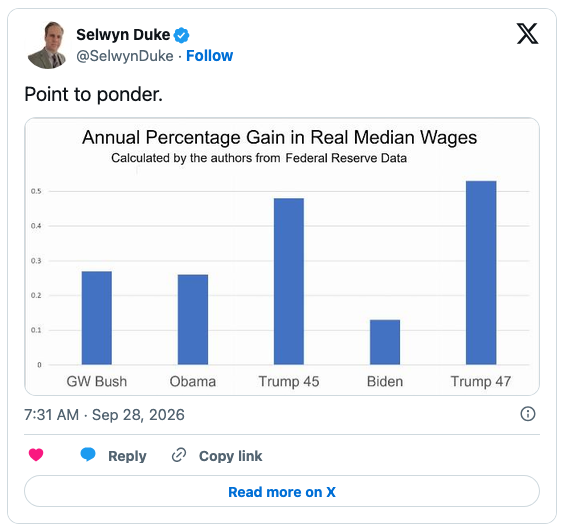
the wages and salaries of full-time middle-class workers rise faster, after subtracting for inflation, when Trump is president, as compared with other recent presidents.
The following chart illustrates data published by the Federal Reserve which shows “Median usual weekly earnings: Wage and salary workers: 16 years and over.” The gains shown are the percentage gain per year, after subtracting for inflation. They are “median,” which means that they are not skewed by averaging in a few very high salaries. In general, median data is middle-class data because half of workers make less and half make more.
There’s more good news, too.
As commentator Allan J. Feifer wrote yesterday:
The Census Bureau’s latest data show real median household income reached its highest level in history in 2025 [this partially reflects the middle-class income increase]. The Atlanta Fed’s GDPNow model is estimating 5.1% annualized GDP growth for the third quarter. The official poverty rate has fallen to 10.2%, the lowest level on record. American innovation has not stopped. The United States remains a global leader in research, high-technology industries, venture capital, and the commercialization of new technologies.
The poverty-rate triumph certainly would be ballyhooed as such were Democrats in charge. It warrants a bit more ink, too. As Reuters reported last week:
The decline marked the … [third] consecutive annual drop in the poverty rate and brought it to its lowest level since the bureau began tracking the measure. It came as policymakers debate the impact of federal spending cuts on safety-net programs.
The poverty rate — the percentage of people living in poverty — dipped 0.5 percentage point. …
Economic Freedom’s Fruits
In fairness, it isn’t likely that all the above is attributable to what President Donald Trump has done. What must also be noted, however, is what he didn’t do.
To introduce this, as I pointed out September 1 in “Socialism: Savior or Seductress?”:
Consider that man’s historical norm is not wealth — it’s grinding poverty. As German economist and statistician Max Roser informed in an Our World in Data essay updated in 2024, in 1820, nearly 80 percent of the world’s population endured “extreme poverty.” “Only a small elite enjoyed higher living standards,” he elaborated. Yet the worldwide standard of living is now the highest it has ever been in man’s history. In fact, though socialism was never generally adopted, “the share of extremely poor people has fallen continuously [since 1820],” Roser wrote. “More and more world regions industrialized and achieved economic growth, which made it possible to lift more people out of poverty. In 1950, about half the world lived in extreme poverty; in 1990, it was still more than a third. By 2019, the share of the world population in extreme poverty had fallen below 10%.”
In other words, the United States’ historically low poverty rate is the continuation of a long-standing worldwide phenomenon. But this brings us to what Trump didn’t do.
He didn’t embrace socialist-like policies — or institute burdensome new regulations — that would inhibit wealth creation.
As is said, the best thing the government can do for the economy is to stay out of its way.
Nonetheless, many would give Trump’s policies at least partial credit for the economic successes. For example, providing its own explanations for them, American Thinker opines:
- Tariffs. Trump’s tariffs upon imported goods encourage the building of new factories within the United States, and manufacturing jobs tend to pay higher wages than service-sector jobs.
- Investment. Trump has been receiving promises from businesses to greatly increase their investment in new U.S. facilities, and workers benefit when businesses expand.
- Deregulation and Tax Cuts. Trump has been reducing business regulatory burdens and cutting business taxes, which encourages businesses to expand.
- Immigration. Trump keeps out and sends back illegal immigrants who drive wages down when they compete for jobs.
- Prices. Trump fights inflation by encouraging the production of inexpensive fossil-fuel energy instead of expensive green energy.
Reality
Of course, tariffs jump out on that list as controversial measures. They are, too, essentially taxes and, owing to the “tax incidence” phenomenon, are ultimately paid by consumers via higher prices. Yet more perspective is necessary.
Insofar as these tariffs are offset by tax and regulation reduction, mightn’t this be a preferable revenue-raising method? After all, tariffs then offer the benefit of not just increasing federal receipts, but doing so while encouraging domestic production. (This isn’t to imply that decreasing taxes and regulations completely offset tariffs’ effects.)
Moreover, however one views tariffs, they certainly are traditionally American. To wit: From 1789 until the War Between the States, tariffs supplied approximately 80–90 percent of federal revenue.
Lastly, returning to affordability, the Democrats are running on the issue this campaign cycle. Yet do they actually explain how they’ll deliver lower prices? And what’s their track record?
Well, let’s look at our so-called “laboratories of democracy”: the states. Here’s a list of the 10 least affordable ones from the Missouri Economic Research & Information Center:
- Hawaii
- Massachusetts
- California
- New York
- Alaska
- New Jersey
- Maryland
- Washington
- Vermont
- Maine
Notice anything? Nine of the 10 have Democratic trifectas; meaning, the Democrats control the governorship and both state legislative chambers. The exception, Alaska, has a GOP governor and mixed legislature, but is an anomaly. It’s not on the Lower 48 road-and-rail grid, and most everything (e.g., food) must be shipped in. Moreover, northern Alaska’s Arctic climate makes heating costs formidable.
Oh, by the way, nine of the 10 most affordable states have Republican trifectas. The only exception, Kansas, has a Democratic governor but GOP legislature.
Say what you will about what that means, what it’s not is perception — it’s reality.