

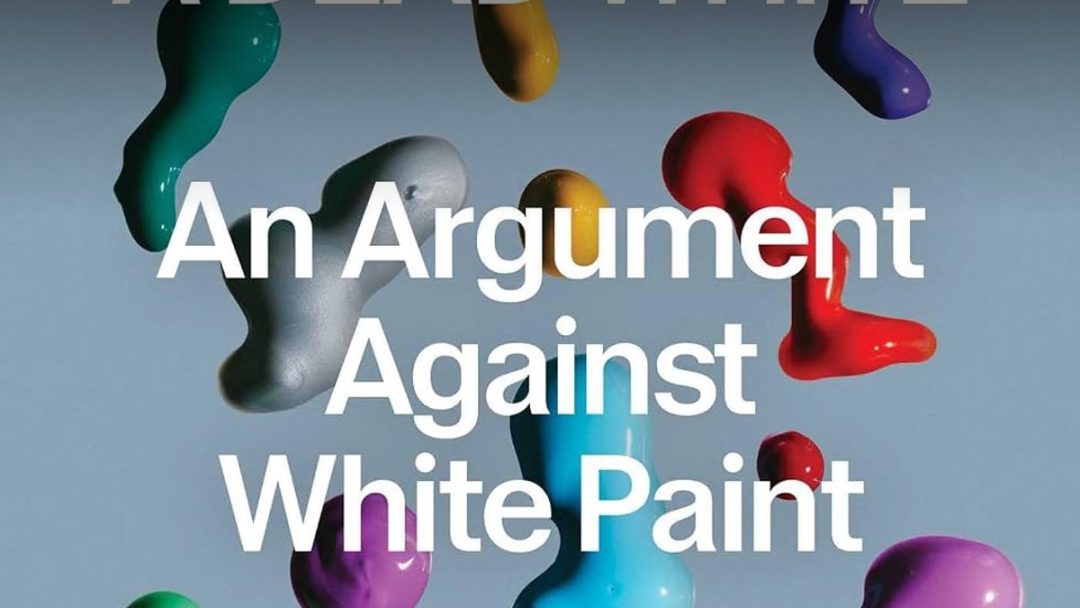
Book Award Winner Complains About White Paint Because of Its “Purity” and “Cleanliness”
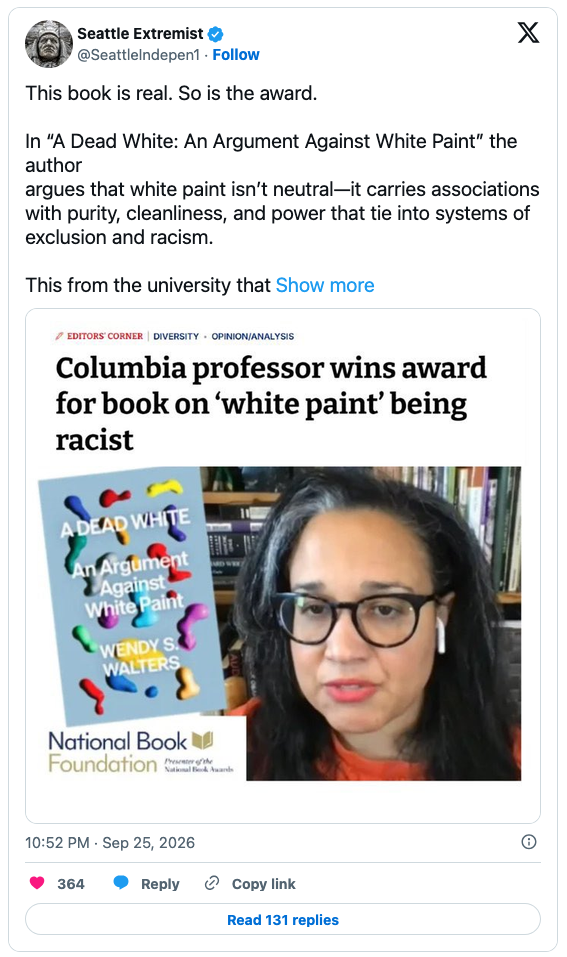
In yet another of the year’s intellectually embarrassing events, a book called A Dead White: An Argument Against White Paint has won a National Book Award for nonfiction.
“White paint,” argues authoress and Columbia University Professor Wendy Walters, is too pure and too clean. And that, of course, means it is racist and white supremacist.
The screed reflects many of the winners of this year’s award, all which seem to be a cri du coeur about the white Christian man’s oppression of everyone around him. And Walter’s argument is rather akin to the claim from Rutgers University Professor Brittney Cooper that the white man stole time from the black man to oppress him.
The Book
Scribner / Simon & Schuster published Walters’ preposterous proposition. “It’s hard to identify a material that takes up more sensory space and has received less critical examination than white paint,” the company’s note says.
Such paint is the “the default color of our built environment,” and “asks us to believe that it’s neutral — that it has no signifiers or, perhaps more troublingly, that what it does signify, whether it be calmness, cleanliness, blankness, or purity, is unassailable and value-free,” the description goes on:
In this expansive, impassioned examination, cultural critic Wendy S. Walters interrogates all that we have taken for granted about the substance that colors, or fails to color, the structures and objects that surround us — and what the collective impulse toward white paint can tell us about culture, politics, and individual desire.
You know that means: White paint oppresses the black man. It is racist. It is white supremacist.
The College Fix’s Micaiah Bilger followed Walters’ internet footprints to find out what was in the book, which won’t be released until next month.
“The idea for the book originated with the Ivy League professor’s ‘genuine and visceral dislike of white paint — a feeling that is at times overwhelming,’ she explained in a 2021 video for Creative Capital Foundation on YouTube,” Bilger explained:
But Walters pushed back on the idea that her emotional response is “possibly irrational.”
“As I tried to understand why my response to white paint was so strong, I discovered numerous examples of the way that it figured into systems of erasure, exclusion, violence, and the masking of power in the social and natural world,” she said in the video.
Those examples “linked white paint to racism.” White supremacists used white paint to vandalize Rothko Chapel in Houston, Texas, in 2018 and a “100th anniversary memorial gallery to the Tulsa race massacre in 2021.” Another target for white paint: A rainbow crosswalk for organized buggery in Canada.
“‘I hope to encourage the reader to think about how practices of decoration and adornment might allude to hidden narratives of power, whether or not they recognize them as being so,’ she said in the video,” Bilger reported:
The publisher’s description of her work does not mention racism or white supremacy, and the book isn’t scheduled for release until October.
However, in the 2021 video, Walters linked the book to her past writings about racism. According to her university bio, she “writes regularly about visual culture, political geographies, climate, and race and identity.”
Walters isn’t alone, Bilger reported, in connecting white paint to racism.
Other Winners
Other books that received awards are similarly obsessed with oppression:
- Seasons of Fury: Four Families and the Rise of Islamophobia in America;
- The Midnight Special: The Secret Prison History of American Music;
- The War Within a War: The Black Struggle in Vietnam and at Home; and,
- Spawning Season: An Experiment in Queer Parenthood.
And those are just the nonfiction winners.
Time Is Racist
But returning to Walters, white paint isn’t the only manifestation of racism and white supremacy with which the oppressed are ever surrounded.
White oppression is so bad it even includes time, Rutgers Professor Brittney Cooper told us years ago in a TED Radio Hour on National Public Radio. The title of her talk? “How Has Time Been Stolen From People Of Color?”
“If time had a race, it would be white,” averred the professor of Women’s, Gender, and Sexuality Studies and Africana Studies. “White people own time.”
And why is that?
Because “time comes out of histories of European and Western thought. … After the Industrial Revolution we begin to talk about time as spending time. It becomes something that is tethered to monetary value” and the “hourly wage,” and so we now “talk about time in terms of wasting time or spending time. And that’s a really different understanding of time than, you know, like seasonal time or time that is sort of merely passing.”
Time is whitey’s whip to keep the black man down, Cooper averred.
“When white, male European philosophers first thought to conceptualize time and history,” she said, “one famously declared, ‘Africa is no historical part of the world’.” Blacks were “outside of history” and “had no impact on time or the march of progress.”
Africa was sorta kinda “outside of history” before Europeans colonized it, but forgetting that, blacks are “either alternately outside the bounds of time or stuck in the past.” So when a black person says “racism still matters,” someone else, “usually white,” will say, “why are you stuck in the past? Why can’t you move on? We have a black president. We’re past all that.”
Colored People Time
Amusingly, while Cooper confessed that her hard-working mom raised her to be rather obsessive about punctuality, the good professor did explain that many blacks operate on CP, or “colored people’s time.”
“In the African-American communities from which I come, we have a long-standing multigenerational joke about what we call CP time or colored people time,” she said:
Now, we no longer refer to African-Americans as colored. But this long-standing joke about our perpetual lateness to church, to cookouts, to family events and even to our own funerals remains.