


Minneapolis Repeals Law Banning Bathhouses That Passed to Stop Spread of AIDS.
The Minneapolis, Minnesota, city council passed a law that repealed the nearly 40-year-old ban on adult bathhouses.
Passed during the height of the AIDS epidemic, the law was repealed, partly, because it was “homophobic.” Proponents say times are different, and might just believe such diseases as shigellosis and enteric gonorrhea aren’t quite as bad as they used to be. Settled science shows that isn’t the case.
City dwellers can expect an explosion of disease.
Amusingly, far-left Mayor Jacob Frey signed the bill on the 57th anniversary of the Stonewall Riot in New York City’s Greenwich Village. On that fateful day, homosexuals and transvestites stood “bra strap to bra strap against an invasion of the helmeted Tactical Patrol Force,” as one news account reported, which raided the Mafia-run joint.
Why the Ban
The trouble began at the height of the AIDS epidemic, a disease brought on by infection with the HIV virus. Notorious bathhouses attracted hordes of homosexuals who repaired there for anonymous sex.
“In 1988, Minneapolis passed an ordinance to ban bathhouses,” Minnesota Public Radio noted:
There were three bathhouses that existed in the city: Hennepin Baths, Locker Room Baths and Big Daddy’s Bath House. All of them closed prior to the ban. Locker Room Baths was known as the 315 Health Club at the time of closure.
Despite the obvious — that bathhouses obviously contributed to the spread of the disease — “some health experts at the time said closing the venues did more harm than good,” the website continued:
A community health department study by Hennepin County, done at the request of the council, showed that adult bathhouses and LGBTQ+ bars were providing patrons with sexual health education like condoms and HIV tests. In the current day, many adult bathhouses in other cities have kept sexual health education at the forefront of their business model.
The study reads: “Closing one facility type or another is unlikely to drastically affect transmissibility of the AIDS virus — since the behavior will continue while the person changes location. The key is behavior change, which public policy needs to be addressing — for the use of both heterosexuals as well as homosexuals.”
In 1979, three years before the first positive HIV test in Minneapolis, police regularly raided bathhouses. At the time, the city also had laws against sodomy, which advocates say were used to arrest patrons.
Minneapolis was still sane back then, and wiser heads prevailed. Even a top homosexual councilman, Brian Coyle, voted for the ban. AIDS killed him in 1991.
Repeal, Disease Incubators
That was then. Times have changed. Last week, the far-left city council voted 9-2 to repeal the ban.
“A small group of less than a dozen cheered when the council voted in favor of the repeal,” MPR reported:
Patrick Scully, a local artist and activist, was in attendance for the vote. Scully said he remembers what Minneapolis was like before the ban and the homophobia he said followed.
“I’m frustrated and angry that it took this long, but it just speaks to the sex negative, homo-hating world that we live in,” he said. “I’m glad that we won today, and I look forward to the momentum of this moving forward and getting these gay-negative laws off the books.”
That’s the long way of saying he wants to get back to the baths.
Honest health officials know what’s ahead: contagious disease. Aside from AIDS, “certain enteric ailments are particularly common among homosexual men,” reported Pharmacotherapy in 1982:
They are primarily infectious diseases and include not only such common venereal diseases as gonorrhea and syphilis but also infections not usually regarded as being sexually transmitted. Among the latter are shigellosis, salmonellosis, giardiasis, and amebiasis.
More than 40 years later, nothing has changed. The Centers for Disease Control’s monthly journal Emerging Infectious Diseases just this month published Suspected Sexual Transmission of Dermatophilosis among Men Who Have Sex with Men, Lyon and Paris, France, 2025–2026.
The journal reported a “genomically linked cluster of 9 Dermatophilus congolensis cutaneous infections diagnosed within 2 months among men who have sex with men in Lyon and Paris, France, 2025–2026. Genomic similarity and shared sexual exposures strongly suggest interhuman sexual transmission of this zoonotic bacterium.”
In other words, homosexuals transmitted a disease typically found in animals.
“Dermatophilus congolensis is a gram-positive, facultatively anaerobic actinomycete responsible for dermatophilosis, an exudative dermatitis of animals,” the journal explained.
Translation: It’s a bacteria that grows like a fungus.
The common name for dermatophilosis is mud fever, rain rot, or rain scald.
The disease predominantly affects cattle, sheep, and horses, mainly in tropical and subtropical climates. It typically manifests as benign, crusting superficial skin lesions but occasionally progresses to extensive disease, sometimes resulting in significant mortality in cattle herds.…
Human infections are rare and considered accidental zoonoses.…
During December 2025–February 2026, a total of 9 men sought care at the sexually transmitted infections (STI) clinics of the University Hospital in Lyon, France, for skin infections that were determined to be caused by D. congolensis.
Signed on Anniversary of Stonewall Riot
Not that Minneapolis Mayor Frey read that report. He turned fuschia with glee that he could sign a bill that might well help spread a disease that kills cattle.
“Minneapolis stands with our LGBTQIA+ neighbors — we always will,” Frey wrote on X on June 28, the day he signed the law:
That’s why I’m proud to have stood with members of the City Council and community advocates to sign the Bathhouse Repeal Ordinance and Pride in Policy package into law.
On that date 57 years ago, New York City cops raided the Stonewall Inn in Greenwich Village.
The late Jerry Lisker described the event in the New York Daily News. Headline: “Homo Nest Raided, Queen Bees Are Stinging Mad.”
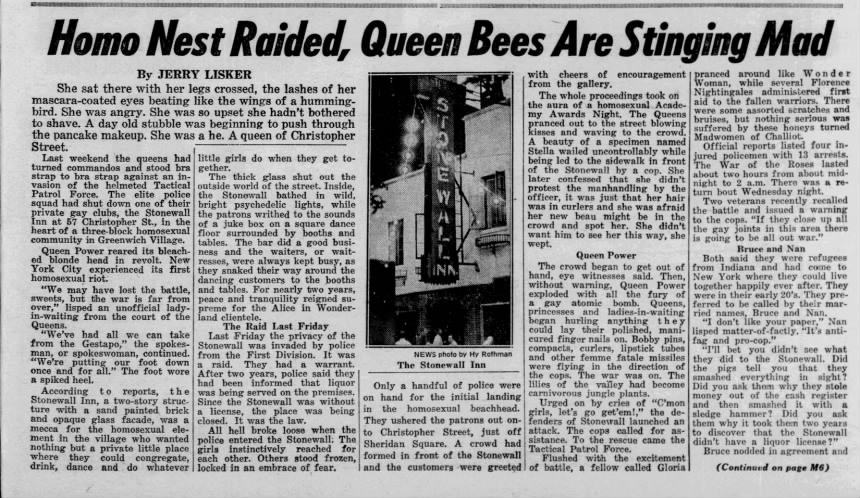
“Queen Power reared its bleached blonde head in revolt,” Lisker wrote of the riot:
New York City experienced its first homosexual riot. “We may have lost the battle, sweets, but the war is far from over,” lisped an unofficial lady-in-waiting from the court of the Queens.
“We’ve had all we can take from the Gestapo,” the spokesman, or spokeswoman, continued. “We’re putting our foot down once and for all.” The foot wore a spiked heel.