


LGB-free? Many Young Teen Girls Are Ditching “Gay” and “Bi” Identification
Are we seeing a return to the days when “gay” meant happy? While I wouldn’t hold my breath waiting for that, a societal transition is afoot. Sexual devolutionary (“LGB”) identification, once all the rage among young people, is now diminishing. The group leading the decline is, too, the same group inordinately responsible for the increase in such identification in the first place: young teen girls.
My, my, it could almost make a cynic think this was all just a fad.
And that relates to the bad news here. This social change likely doesn’t represent recognition of Truth — just realignment of tastes.
The Washington Post reported on the story Thursday, writing:
Young teenagers are less likely to identify as lesbian, gay or bisexual than they were a few years ago, according to a new analysis of Centers for Disease Control and Prevention data.
The decline is particularly striking among ninth-grade girls, according to Jean Twenge, a professor of psychology at San Diego State University who published her analysis of the 2025 data on her Substack “Generation Tech.” In 2021, 30 percent of ninth-grade girls identified as lesbian or bisexual. Last year, 17 percent did.
“It really does look like a free fall,” Twenge said. “But what’s causing it is unclear.”
… The rate of boys who identify as gay or bisexual has remained roughly the same over the past decade. But a few years ago, after the pandemic shutdowns, the CDC data showed big upticks in the percentage of high school girls identifying as lesbian or bisexual.
Now, could this have anything to do with a consequence of the shutdowns: kids spending far more time online? (Girls are more influenced by social media.)
Coming to mind, too, is the old saying, “An idle mind is the Devil’s workshop.”
Twenge emphasizes the sex-related difference at her Substack, stating:
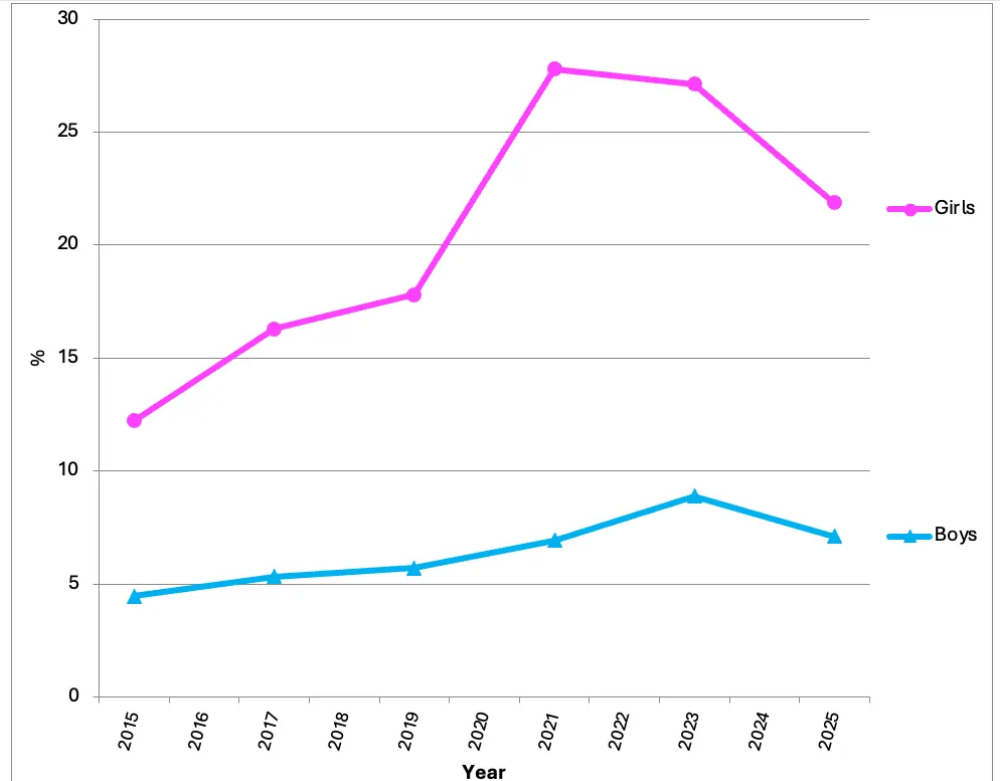
The decline appears to be driven almost entirely by girls. Identifying as LGB dropped from 27% in 2023 to 22% in 2025 among girls, and from 9% to 7% among boys.… The previous increase in identifying as LGB was also larger among girls, with a 128% increase (more than doubling) from 2015 to 2021 among girls and a 99% increase (doubling) from 2015 to 2023 among boys.
… The decline is by far the largest among 9th grade girls, where identifying as LGB dropped from 30% in 2021 to 17% in 2025, nearly cutting the numbers in half.
A chart Twenge provides (below) illustrates the sex-difference phenomenon well.
Inexplicable?
While Twenge finds the reason unclear, the “common man” with common sense may beg to differ. Just consider the top two MSN commenters under the Washington Post article. Brock Sampson writes:
It’s no longer trendy. I bet a lot of the people who said they were one of the expanding alphabet of alternative lifestyles didn’t actually ‘follow thru’ in reality.
And cutting to the matter’s heart even more, Garrett I states:
It was always clear…. Kids thought it was cool, and so it was a fad. They saw advantage in it, and so they did it. They wanted to be ‘special’ and ‘belong to a special group’.
I mean…. it isn’t exactly rocket science. Pretty much human nature 101.
It’s also Female Nature 101. That is, girls’ predominance in the sexual devolutionary increase and decrease tells the tale.
Basic psychology informs that males are the more biologically anomalous sex. In contrast, no matter the quality or trait, females will be more densely clustered around the mean (the average). For example, there are more very tall and short men than very tall and short women. The majority of geniuses are men; so are the majority of idiots. (Though males’ IQs are three to five points higher on average.) Most hemophiliacs and color-blindness sufferers are boys, and so are most highly gifted children. The point?
If being homosexual — or some other sexual revolutionary status — really were biologically determined, boys would assuredly be overrepresented. When you see girls dominating numerically, it’s not a biological phenomenon; it’s a social phenomenon (e.g., a fad). This is especially obvious when witnessing girls’ sexual devolutionary numbers suddenly rising, greatly outstripping boys’ numbers.
Or does someone think the female sex-chromosome complement suddenly changed in 2015? Because, well, that would be news.
Transitioning Out of Sanity
The MUSS (Made-up Sexual Status; aka, “transgender”) phenomenon also illustrates this social-contagion factor, as the same male-female pattern is apparent. Boys had always constituted the majority of children with sexual-identity disorder (aka “gender dysphoria”) — through approximately 2010. In fact, the male-female ratio had once been as great as 6.6 to 1. Starting around 2011, however, girls began dominating MUSS identification, and now the male-female ratio is about 1 to 2.6. What changed during that period?
“Transgenderism” became fashionable.
Consequently, the lasses were there with rainbow-colored bells on.
It’s no secret that females are the more social sex, that teen girls (especially) are creatures of the flock. In contrast, most all loners are male. This is one reason why there would years ago be mountain men and not mountain women. (A man’s peaceful solitude is often a woman’s loneliness.) It’s why, typically, a woman may look forward to having guests while her husband may grumble. It’s also why boys will be less likely to trod the socially prescribed path, right or wrong.
And girls will be more likely to trod the socially prescribed path, right or wrong.
It’s no mystery, either, what the sexual devolutionary draw was (and still largely is).
What you reward, you get more of.
A Ticket to Ride
Where sexual devolutionary statuses were once stigmatized, now they’re normalized if not glamorized. They make you a legally-protected “class” under the law. Embrace such an identity, and schools will bend over backward to accommodate you. You get applauded for bravely being “yourself” (even though what takes real courage today is opposing such perversion). You get extra protection from criticism and a free pass to condemn your critics. You’re viewed as “cool” and in — not as just a plain-vanilla straight person.
But is the coolness factor now fading? After all, what may sexual devolutionary statuses now often be to 14-15-year-olds?
Something those ancient people — 30-year-olds — did. It’s now an establishment behavior.
This said, there’s no moral/spiritual resurgence apparent among these girls. A 17-percent lesbian-bi identification figure is still distressingly high. And the moral of this story?
Choose your stigmas and socially-approved statuses wisely. Most of all, too, good people had better be the ones to choose them. For if you don’t control the culture, the culture will control you.