Communists Suffer Major Blow in Brazil Election, but Fight Goes On
The communist movement that has used Brazil as its most important operational base in the Western Hemisphere just lost the first round of the fight it spent four years preparing to win.
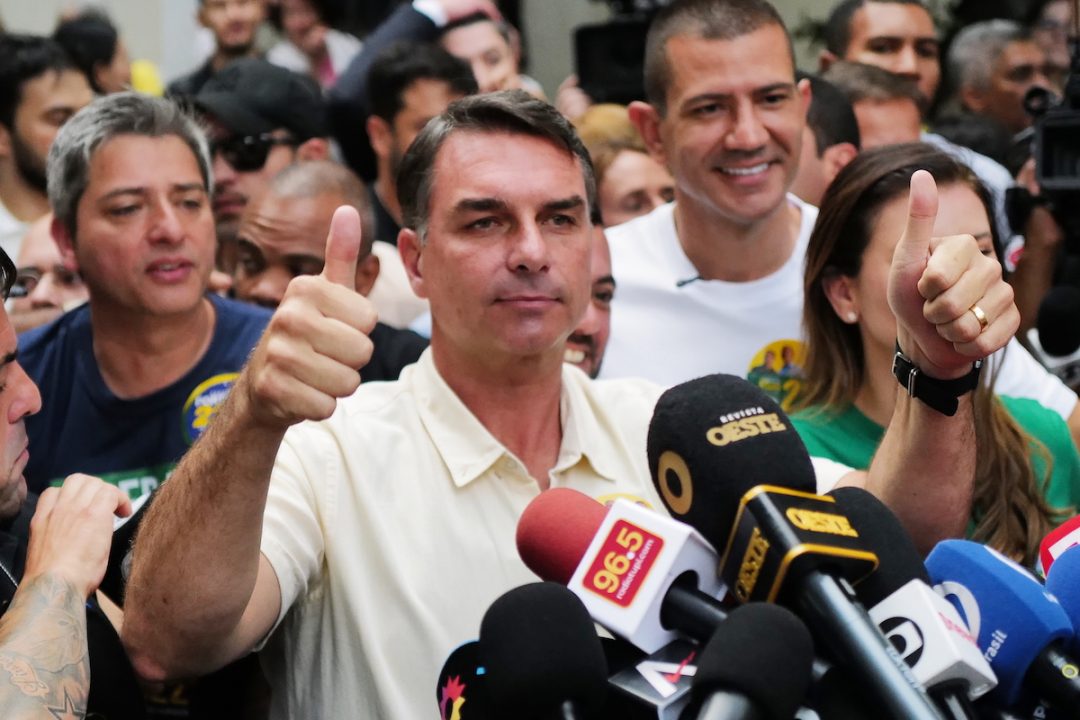
With 100 percent of the ballots counted from Sunday’s presidential election, Senator Flávio Bolsonaro of the Liberal Party took 47.03 percent of valid votes — 56,104,503 ballots. President Luiz Inácio “Lula” da Silva of the Workers’ Party finished second with 45.16 percent, or 53,879,538 votes.
Neither man cleared the 50 percent required to avoid a runoff. The second round will be held on October 25.
Of the almost 160 million registered voters, 78.92 percent cast a ballot, about 125.3 million people, and the Superior Electoral Court published the result the same night. The margin was roughly 2.2 million votes, the narrowest first-round presidential gap since Brazil returned to direct elections.
In Brasília, Bolsonaro told supporters the count marked “the end of an era” for Lula’s party. “Lula has fought seven presidential elections,” the senator said. “He’s worried about power. I am worried about the future of Brazil.”
Bolsonaro said he was “very happy with the vote of confidence” of nearly 56 million Brazilians and “happy with the result in every region.”
On X, he wrote: “Thank you, God! Thank you, Brazil! The country has spoken at the ballot boxes for change and for the future! Not only in the Presidency of the Republic, but also in the Senate and the Chamber of Deputies. The overwhelming majority we achieved in Congress will bring back the legal security that the country so desperately needs to grow. The federal Legislature is set up for a President like Flávio Bolsonaro!”
He also pledged to put the people above party and to fight “narcoterrorism” together with governors and mayors. “Just a few days left until Brazil’s rescue,” added the conservative lawmaker.
The São Paulo Forum Suffers a Blow
That is not the evening the São Paulo Forum planned. The Forum was founded in São Paulo in 1990, months after the Berlin Wall fell, by Lula, Communist Cuban dictator Fidel Castro, the communist Sandinistas, and the Marxist narco-terror organization FARC in Colombia.
The late Brazilian philosopher Olavo de Carvalho called it “the strategic command of the communist and pro-communist movement in the continent.” Lula chaired it for more than a decade. His first two presidencies, from 2003 to 2010, turned Brazilian diplomacy, Venezuelan oil money, and Cuban intelligence into the engine of the so-called Pink Tide.
When he returned to the Planalto presidential palace in 2023 in an election mired in credible allegations of fraud, the communist project resumed. In 2023 he told a Forum gathering that being called a communist or a socialist “does not offend us. On the contrary, it makes us proud.”
Under that third term Brazil loaded up on Russian energy and sent Lula to Vladimir Putin’s Victory Day parade. A U.S. congressional review this year described a secret Chinese Communist Party military space facility in Bahia. At home, Supreme Court Justice Alexandre de Moraes turned the high court into an instrument of political control.
In September 2025, former President Jair Bolsonaro — Senator Bolsonaro’s father — was sentenced to more than 27 years in prison by the regime. His “crime”? Plotting a supposed “coup” run from the same playbook as the phony January 6 “insurrection” supposedly orchestrated by Trump. The former president is currently serving his sentence under house arrest due to health issues.
In June 2026, meanwhile, his son Congressman Eduardo Bolsonaro received four years and two months after urging American sanctions on the judges involved. Federal Congressman Gustavo Gayer told this writer in 2024 what millions of Brazilians already believed: “Americans must understand that Brazil is no longer a democracy.”
Voters Defy the Polls and the Press
The establishment press spent the campaign treating a Lula plurality as the responsible outcome. The voters did not cooperate.
The establishment media coverage was apoplectic. According to the far-left U.K. Guardian, the result was a “shock first-round victory” and a “far-right tsunami.” Supposedly “progressive” voters left the night “reeling,” the paper claimed. El País said the senator had brought “Brazil’s far right closer to power.” Valor noted that the Right had posted its strongest first-round presidential result since the return of democracy in 1989.
Flávio’s 47 percent was 3.8 points above his father’s 43.2 percent in the first round of 2022, and a point above the Bolsonaro movement’s 2018 showing. A Quaest survey released the day before the vote had Lula at 46 percent of valid votes and Flávio at 45. The ballot box reversed the poll.
The rest of the field collapsed. According to Valor, every candidate outside the top two combined for 7.79 percent of valid votes, the lowest share since 1945. Augusto Cury of Avante took 2.89 percent, Renan Santos of Missão 2.24 percent, former Goiás governor Ronaldo Caiado of the PSD 2.18 percent, and former Minas Gerais governor Romeu Zema of Novo 0.27 percent. Caiado, Santos, and Zema together drew more than 5.5 million votes.
Santos said he would endorse neither finalist and called both “crooks.” Zema said he would vote against Lula’s Workers’ Party. That math is why analysts who do not share Flávio’s politics are already treating him as the favorite.
Political scientist Miguel Lago told the Guardian that miracles are possible in politics, “but I don’t see that happening” He added: “I don’t see Flávio losing this election now.” The same paper noted a harder historical fact: Since the return of elections in 1985, the first-round runner-up has never come back to win the second ballot.
A Right-wing Wave Beyond the Presidency
The map explains why the Forum is nervous. Metrópoles and CNN Brasil reported that Flávio carried the entire South, the entire Southeast, and the entire Center-West, plus Acre, Rondônia, Roraima, and Tocantins. Lula carried all nine Northeastern states — 71 percent in Piauí, 66 percent in Bahia — and parts of the North. In São Paulo, with the country’s largest electorate, the Bolsonaro advantage widened to 14 points from seven in 2022. In Minas Gerais, Flávio took 48.4 percent and Lula fell to 43.1 percent, below even Jair Bolsonaro’s 2022 share there. For the city count across São Paulo, Minas Gerais, and Rio de Janeiro, G1 found Flávio ahead in 1,089 municipalities and Lula in 501.
Congress moved with the presidential vote. Flavio’s Liberal Party is set to hold 28 of 81 Senate seats, the largest caucus in the chamber. And Bolsonaro supporters or political allies won 14 governorships outright, with Lula-aligned candidates holding only five.
The Guardian reported a broader right-wing Senate bloc of about 43 seats and noted that pro-Lula figures Marina Silva, Benedita da Silva, and Simone Tebet lost. Jair Bolsonaro’s wife, Michelle, and his son Carlos both won Senate seats. His youngest son, Jair Renan, and his brother Renato won seats in the Chamber, too. Popular conservative lawmakers Nikolas Ferreira and Lucas Pavanato, known for their popularity on social media, each cleared three million votes.
In other words, even if Lula were to somehow maintain his grip on the presidency, the legislature stacked against his Workers’ Party severely limits what he could do.
Lago, the political scientist, said he expects Jair Bolsonaro to be freed and to remain “very important” in a Flávio presidency. “Flávio will be running the country and Bolsonaro will be doing what he has always done: leading the revolution,” he said. In reality, it is more of a counter-revolution.
Speaking in São Paulo, Lula tried to sound unshaken. “We have just had a lesson in Brazilian democracy,” he said. “The result is often unexpected. We can never get everything we wanted. I confess to you that I was convinced I was going to win the election in the first round. But we have a second round.”
Lula claimed the two-candidate campaign would make Bolsonaro’s “dark past” clearer and “show the difference between our proposals for Brazil.” But the Guardian described the mood at his event as a funeral.
The World Reacts
Outside Brazil, the reactions tracked the stakes. Firebrand Argentine President Javier Milei, known for his strong hostility to communism and government, could barely contain his glee. “FREEDOM ADVANCES IN BRAZIL,” he posted online. “Congratulations, dear friend Flavio Bolsonaro, on this historic election against the communist Lula.”
“The American continent belongs to citizens who want to live in freedom,” continued the Argentine leader, an ally of Trump. “I hope that soon we can start working together so that Argentina and Brazil continue to be great trading, cultural, and political partners. The opportunities for our nations, working together, are infinite. LONG LIVE FREEDOM, DAMN IT!”
Israeli Prime Minister Benjamin Netanyahu wished Flávio luck in the final, called the first round a great victory, and said he looked forward to “restoring the extraordinary friendship between Israel and Brazil.”
U.S. Secretary of State Marco Rubio, the nation’s top diplomat and a longtime foe of Latin American communism, was more reserved. “It’s going to a second round. I think everybody expected that,” he told the press. “We’ll see how that plays out.”
But President Donald Trump, an enthusiastic supporter of Bolsonaro, posting on Truth Social, seized on the count itself to draw attention to voting issues domestically. “125 Million People voted today in the first round of Brazil’s Presidential Election. The results came out shortly after the vote closed, on the SAME DAY!” he said. “In Detroit, Philadelphia, California, and numerous other U.S. Cities and States, the results, with much smaller numbers, will often take weeks to Rig, I mean, calculate. Voting in America is CORRUPT!!!”
Trump’s jab was aimed at American practice. But the deeper point is the one this magazine has made for years. A hacker had already penetrated the systems of the Superior Electoral Court for months around the 2018 election in Brazil. For good reason, tens of millions of Brazilians never accepted the transfer of power that followed the last presidential contest.
Washington, pressed by the same foreign-policy establishment that once transferred billions to Petrobras and midwifed the FARC “peace” deal, treated Lula’s return as a fact to be managed. Of course, Sunday does not retroactively settle the controversies of 2022. But it does show that the resistance that the Lula regime tried to jail, censor, and bankrupt still commands a powerful following in Brazil — and, based on historical data, has the advantage going into the runoff.
The Fight Is Far From Over
None of that means October 25 is finished. Lula has survived imprisonment, the impeachment of his handpicked successor, and the burial of the Lava Jato cases that once put him behind bars. Abstention was 21.07 percent, slightly above 2022, and his allies will spend the next three weeks hunting those voters.
Meanwhile, Lula’s friends from the Forum in Caracas, Havana, and Beijing will not sit the round out. What changed on Sunday is the burden of proof. The communist movement that rebuilt itself inside the São Paulo Forum after the Soviet flag came down is now the side that must reverse a first-round defeat in a country where, for four decades, that has not been done.
Brazil has more than 200 million people, enormous resources, and a coastline that commands much of the South Atlantic. It is the giant of Latin America. A consolidated Forum-backed regime in Brasília must be understood as a beachhead in the Western Hemisphere. Brazilians, in numbers the regime’s own polls did not predict, have said they want that era to end. But the battle is far from over.
Related articles:
Communist Movement Desperate to Preserve Base in Brazil
Resurgent Communism in Latin America
Exposure of Radical CFR Latin America Boss Offers Broad Insight