

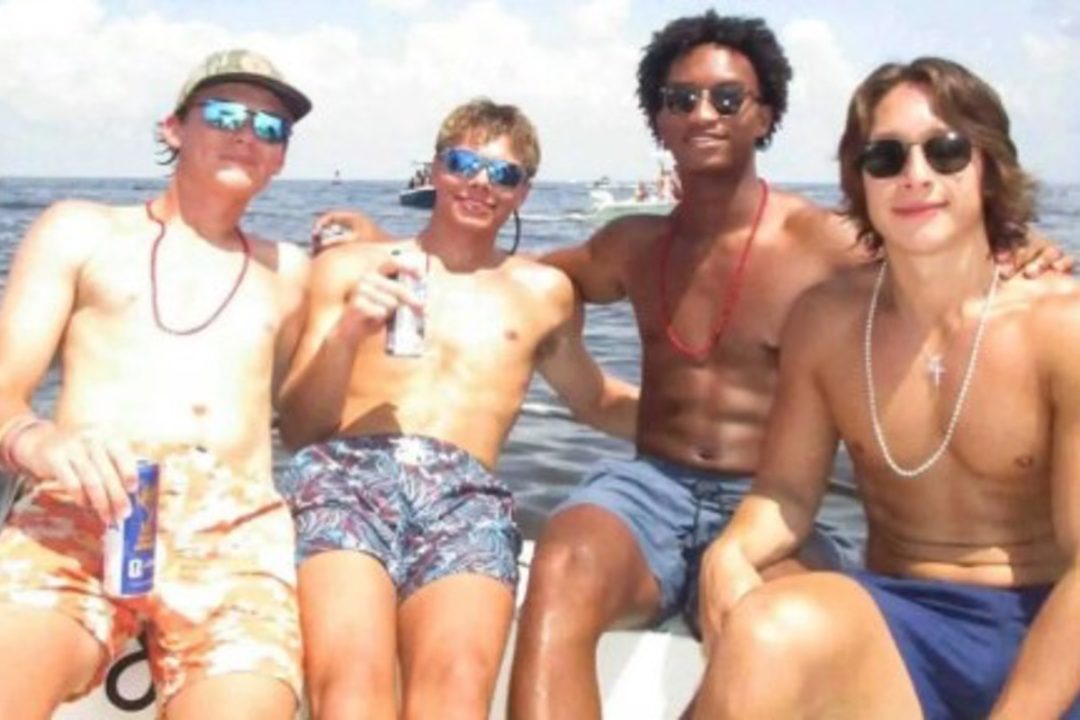
Black Teen Nolan Wells Dies Down South; Race Hustlers Want Mississippi Burning
Many black people are “rooting for, hoping — seemingly praying — that Nolan Wells’ white friends killed him.” So said commentator Jason Whitlock, himself black, last Thursday about the recent death of black youth Wells.
The case is receiving much national attention. Nolan Xavier Wells, an 18-year-old college football player from Ocean Springs, Mississippi, went missing on Independence Day after partying with white friends. An extensive search was launched, and he was found deceased July 6, the victim of an apparent drowning. Police suspect no foul play, but the investigation is ongoing.
From the reaction in certain quarters, though, you’d think the poor young man was found hanged. Race hustler Al Sharpton and “civil-rights” attorney Ben Crump have gotten involved. Anti-white sentiment on the internet has been stoked. And entities such as HuffPost are claiming that the “story we’ve been given about Nolan Wells doesn’t add up.” Is this, however, only because such observers have a math problem?
For sure, HuffPost writer Sage Howard makes the quoted claim in her title. Yet nowhere in her piece does she explain how it “doesn’t add up.” The closest she comes is pointing out that Wells’ cellphone and keys ended up at a friend’s house. If anything, however, this actually speaks well of that young man (more on that later).
Unfortunately, most people commenting on this case, likely including Howard herself, don’t know the facts of it. Too many are running on prejudice. That is, Wells died in Mississippi, and his friends were white, so the lynch mob is indicting both. (Howard herself wonders if the “Mississippi police can be trusted.”) Yet since those friends have gotten death threats, and since racial division is being sowed, the facts should be understood.
What Actually Happened
To be clear, none of us knows what happened. (There’s a difference between knowing and suspecting, or calculating probability.) As to the facts, however, let’s begin with a timeline of events as compiled by Grok artificial intelligence:
- July 3: Wells has dinner with family, then stays overnight with friends.
- July 4 (morning/afternoon): Wells and a small group of friends (reportedly three White male friends) boat to Horn Island for holiday celebrations. The island had a large party atmosphere, with around 300 young people (mostly high school/college age, former classmates).
- About 3 p.m.: Wells is last seen on the beach. He reportedly stayed behind (friends say he met a girl or wanted to fix boat issues) and planned to catch another ride home.
- Evening: Friends return to the mainland without him. His phone and keys reportedly stayed with them.
- Approximately 11 p.m.: Family receives a call from a friend and reports him missing.
- July 5-6: Search efforts intensify. Body is found in the water near the northwest shore on July 6.
- Ongoing: Autopsy and toxicology results pending (independent autopsy requested by family). No foul play suspected by authorities so far, but investigation active.
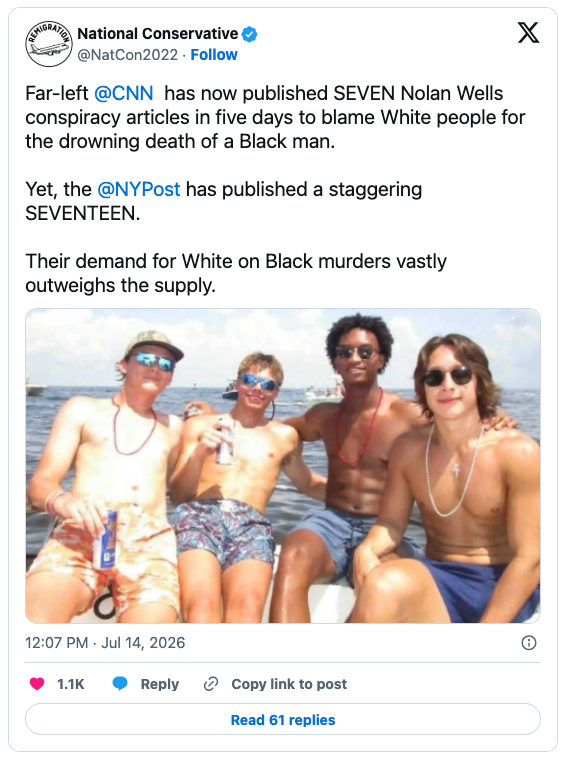
The above information adds perspective. Some commentary would have you believe Wells was alone with his white friends on some lonely island. In reality, it was a well-attended, major celebration. A photo of the teen with his friends is below.
It Adds Up — to, Likely, an Accident
There are more facts and considerations, too:
- Wells’ parents, Elmore and Christine Wonsley, indicated he’d been to Horn Island multiple times previously during the past year. These excursions were possibly with some of the same friends, too. Now, did the latter suddenly discover, on July 4, that Wells was black and decide to commit a race-motivated killing?
- While the hundreds of young partiers were predominantly white, there reportedly were other black kids present.
- Horn Island has spotty to nonexistent cellphone reception. It’s common for visitors to leave phones behind on boats, sometimes in dry bags.
- Horn is a barrier island with shifting shores, channels, and open Gulf exposure. Its waters can have strong currents and riptides that can endanger even a strong swimmer.
A relevant anecdote: I was caught in a riptide as a child in Florida. I instinctively let it take me and was “released” a good deal farther from shore. I understand, however, and this is especially true with strong swimmers, that fighting a riptide can be deadly. This is because you can enter a “stalemate.” You can’t break free — and the riptide can’t take you to its terminus (where it weakens and dissipates). You drown.
As indicated, too, much has been made of a friend having Wells’ phone and keys. But question: Would you murder someone and then keep those things and incriminate yourself? It seems unlikely.
More probable is that these were the actions of a friend, holding the items for safe keeping. And regarding this, it’s not uncommon for a guy to meet a girl in these situations and leave his friends.
One more matter: There are indications that Wells, along with his friends, might have been drinking. This is relevant because many water-related accidents/tragedies are alcohol-related.
Racial Fantasies
Of course, and again, we don’t “know” what happened on July 4. The point, however: It’s far more likely that Wells died accidentally than what the racially paranoid propose. As an example of the latter, Sage Howard writes:
Our community knows that systemic racism dictates that when you’re the only Black person in a room full of white people, you are at heightened risk of experiencing violence (whether that’s just a microaggression or real bodily harm). Especially when we consider the history of state-sanctioned violence against Black people in Mississippi — multiple sources report that between 1877-1950, Mississippi had the highest number of lynchings on record.
Seventy-six to 149 years ago? Really? That’s a bit like me saying I won’t visit Italy because Roman centurions may grab and enslave me. (The Romans took slaves from one of my ancestors’ lands — ages ago.) It’s now 2026, and the reality is quite different. I’ll illustrate this with another personal anecdote.
When I was an aspiring tennis player, I for a time practiced at Stadium Tennis in the Bronx. It’s in an area that’s almost entirely black and Hispanic. Well, one day, when I was perhaps 16, I was in a rush and running hard toward the courts. This black kid I was approaching, who was about my age, flipped around, suddenly, breathing hard and clearly terrified. He was relieved when he saw me.
You see, whomever the poor kid feared, it wasn’t someone who looked like me.
It was someone who looked like himself.
This reality was expressed by late “civil-rights” activist Jesse Jackson, too, when he said:
There is nothing more painful to me at this stage in my life than to walk down the street and hear footsteps… then turn around and see somebody white and feel relieved.
The Stats
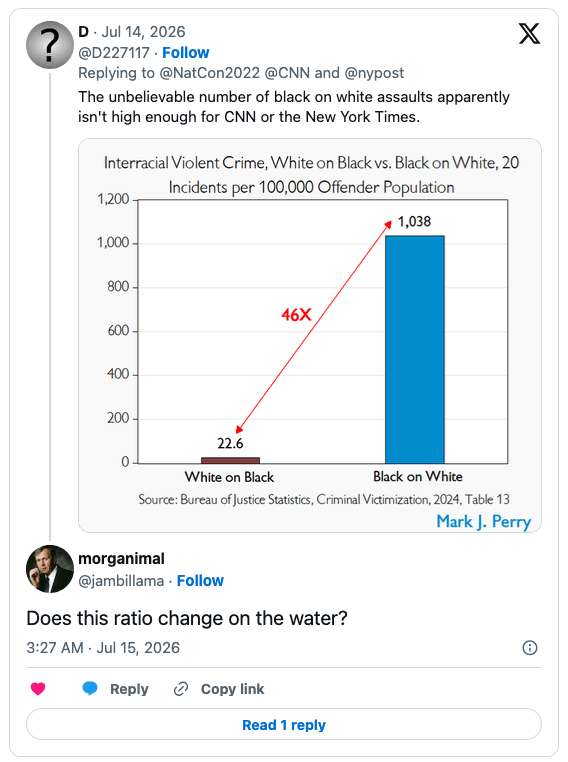
The reality: Approximately 91 percent of black homicide victims are killed by other blacks. And some of the rest are murdered by Hispanics. In other words, Wells, and any other black youth, is statistically far safer around white kids than amid other black kids.
By the way, white kids are safer around other white kids, too, as the below chart reflects:
In truth, though, many of the black racial hustlers know the above. Jason Whitlock seems to contend that they’re in denial, driven by racial patriotism and prejudice. They want Wells’ friends to be guilty to help maintain a Mississippi Burning illusion of a “white supremacist” America.
This said, the Wells investigation — which the FBI is now involved in — should be thorough. It surely will be, too. But will it matter?
If it’s confirmed that the teen drowned, the race hustlers may just wonder, “Who pushed him overboard?” Prejudice doesn’t yield to facts, righteousness, or reason.