

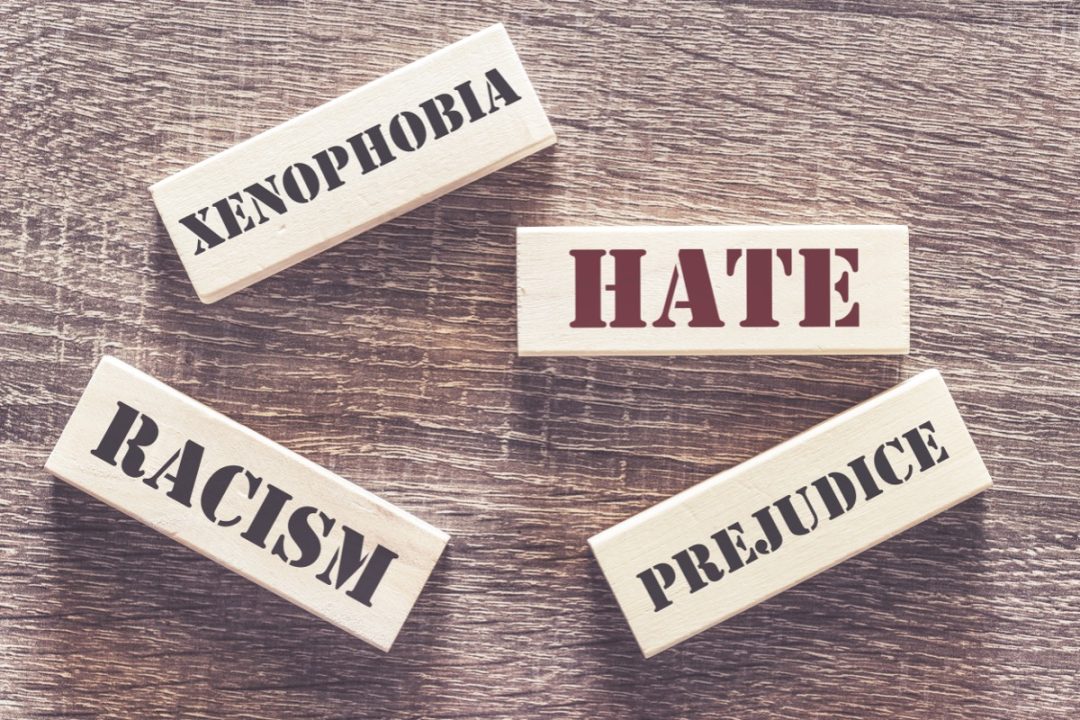
An Anti-“Hate Crime” Scheme Fails — Again
Since committing a “hate crime” brings more prison time, we could wonder:
Does committing a “love crime” reduce one’s sentence?
This may sound silly, a bit like countering feminism with “masculinism” or Islamophobia with “Islamophilia.” Yet it also may put in perspective how silly the accepted terms are.
Whatever the case, I’m old enough to remember when “hate crime,” per se, was not a thing. There’s a good case, too, for eliminating the category from the books. For not only does it allow for bias — that of the government in prosecution — but these laws appear otherwise counterproductive, too.
Nutmeg State Nuttiness
For example, consider what CT Insider’s Howard R. Zern reported Monday about Connecticut’s hate-crime efforts. “The state’s Hate Crimes Advisory Council and legislature’s roadmap to reduce hate crimes is flawed and has simply not worked for years,” he laments; “hate crimes are trending up.”
This isn’t surprising. It’s just as with the studies indicating that “unconscious bias training” can do more harm than good by increasing resentment. This said, two questions must be asked: Are hate crimes “trending up”?
Or is authorities’ tendency to label crimes as “hate crimes” trending up?
(It could be both, too.)
And this is just one problem with this category of law. Murder is murder; you have a dead body. Theft is theft; there is stolen property. Assault is assault; there are the bruises and maybe broken bones. But when determining whether the murder, theft, or assault is a “hate crime” is where the authorities’ bias reigns supreme. Note here, too, that it’s natural for entities, private or public, to want to perpetuate themselves. So you can bet that the “Hate Crimes Advisory Council” doesn’t advise being conservative in hate-crime classification.
Related to this, Zern reports:
According to FBI data, Connecticut has two primary targets who are attacked far and above other groups: Jewish people — 34 with 3.4% of the state’s population, and Black people — 27 with 10.8% of the population. Together, they comprise 57% of all 2024 Connecticut hate crimes. For the first time in Connecticut’s history, hate crimes against Jewish people exceeded those of Black people. The next largest group targeted is gay males (eight). While Connecticut underscores Islamophobia, there was only one hate crime committed against Muslims in 2024.
Now, given recent-years’ rising anti-Jewish sentiment, it’s certainly believable that attacks on Jews have increased. But question:
Where are whites, generally, in the above equation?
Subjectivity Strikes
That is, whites as represented by the following:
- In 2000, Wichita, Kansas, black brothers Reginald and Jonathan Carr went on a week-long spree. They robbed, raped, and murdered five white people. (This included forcing victims to perform sexual acts on each other before execution-style shootings.) No hate-crime charges were filed.
- In 2007, white couple Channon Christian and Christopher Newsom were carjacked, kidnapped, raped, tortured, and murdered by a group of black perpetrators. Ditto — no hate-crime charges.
- In 2020 at Ohio State University, there were two separate campus incidents involving black suspects hurling racial slurs at and then physically assaulting white victims. The Ohio State Department of Public Safety was consequently compelled, by law, to explicitly label the incidents “hate crimes.” But student groups protested. One dismissed anti-white racial slurs, claiming they’re “not based on a history of violence & oppression towards White people.” So the mob had spoken and, ultimately, authorities filed no hate-crime enhancements.
So the message is clear. Just as “blacks cannot be racist,” under cultural devolutionary thinking, whites cannot be victims of hate crime. And this philosophy is supported by research that aligns with common sense’s determination: Anti-white hate crimes are under-represented.
Historian Nathan Albright elaborated on why last year, writing:
Law enforcement, prosecutors, and policymakers operate in a climate where addressing anti-White bias is politically fraught. Acknowledging Black-on-White hate crimes could be seen as undermining the focus on systemic racism against minorities, leading to underreporting or reluctance to pursue hate crime charges.
Shorter version: Telling the truth would destroy the “narrative.”
Inviting Tyranny
Yet it gets worse. Zern further complains:
The Advisory Council also conflates hate crimes and bias incidents (“Acts of prejudice that are not criminal”) and their remedies. Incidents are difficult to legislate against and depending on the source are not always a reliable bellwether to predict hate crimes.
Note, however, something about “bias incidents,” which are sometimes merely the expression of un-woke sentiments.
Thousands of people are arrested yearly in Britain for “committing” them.
And while our First Amendment has thus far prevented this in America, there’s reason for concern. After all, is it possible that we’re already punishing thoughts and words — via our hate-crime laws? How? Consider this example:
Two crimes are committed, identical in terms of the action undertaken, but are prosecuted differently. The first crime’s perpetrator is deemed to have been motivated by a fashionable sin, covetousness. He receives five years in prison. The criminal in the second incident, however, was supposedly animated by “hate.” He gets 15 years.
Now, the act itself apparently warranted five years. That’s what was handed down, after all, when only it was considered. So we have to then ask: What were the extra 10 years given to Mr. Hate for? Could they perhaps be for the thoughts expressed through the act?
This brings us to the point. If government can criminalize certain beliefs’ expression within one context, it’s that much closer to criminalizing them within any context.
Despite all the above, Zern is merely lobbying to change the subjective judgments. “The problem,” he writes, “is hate crimes are all treated the same regardless of the disparate impact on [their] targets.”
No, the problem is that the same crimes are often treated differently — despite the same impact on their targets (e.g., they’re dead) — because they’re tendentiously labeled “hate crimes.” But is it really wise giving government a mind-reader role and cudgel for punishing unfashionable beliefs and groups?
Entrusting people who may not know the difference between boys and girls with that power may, well, not exactly be a Founding Father-esque move.