
Board of Peace: Is Globalism Being Undermined, Supercharged, or Re-imagined?
With the emergence of a powerful new global organization dubbed the “Board of Peace,” Americans and people everywhere are asking some big questions. Is globalism being undermined, super-charged, or given a makeover? What will happen to it after President Donald Trump? Will it truly bring peace? Is it even legal or constitutional?
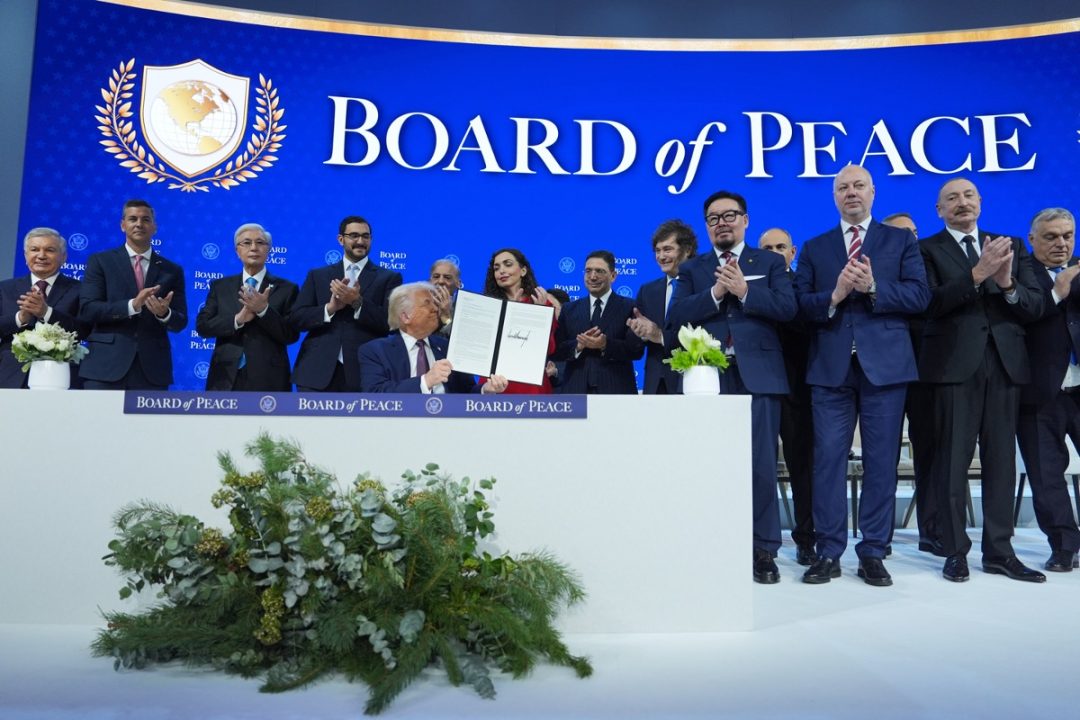
The details are still being ironed out, it seems. But the Board of Peace — launched with much fanfare just months ago — continues to make headlines worldwide. Its first big project: Turning Gaza into what supporters say will be a model of peace and prosperity even as critics are slamming the plan as a prototype for future technocratic 15-minute cities.
American taxpayers have already been hit with some big bills. The State Department quietly transferred $1.25 billion to the new body. And President Trump has pledged a staggering $10 billion in U.S. support, without any hint of congressional approval. The organization is hard at work, mostly behind closed doors. And it has a lot of money.
But it is also drawing criticism and skepticism. Author and researcher Patrick Wood, one of the world’s top experts on technocracy, is among those sounding the alarm. From legal concerns to criticism of the structure and the people involved, Wood argued last month that the Board of Peace was an illegitimate institution aimed at building world order by undermining national sovereignty piece by piece.
Wood said: “Its scope is unlimited. Its chairman is permanent. Its legal basis is fabricated. Its headquarters is a seized building whose ownership is contested in federal court. Its operating capital is money stripped from disaster relief funds without a vote of Congress. Its operational staff comes from the Chairman’s son-in-law’s personal network. And it was launched beneath the Great Seal of the United States — the one symbol that tells the world: this is official, this is legitimate, this is America.”
Details of the Board of Peace
While almost 30 governments have joined as full members, many key U.S. allies are sitting on the sidelines for now. Inaugural meetings have wrapped up, praise from allies in the Middle East is flowing, and optimistic statements from administration officials paint a picture of hope for a region and a world long plagued by conflict.
President Trump, who is serving as the board’s inaugural chairman and potentially chairman for life “independent of his presidency of the United States,” has hailed the outfit as “one of the most consequential bodies ever created.” In his words, it offers “the first steps toward a brighter day for the Middle East and a much safer future for the world.”
U.S. Secretary of State Marco Rubio echoed that sentiment, crediting Trump’s “vision and courage” for achieving what many thought “impossible.” Special Envoy Steve Witkoff and others have spoken of hostages returned, hope restored, and a chance to apply free-market principles to give Gazans dignity and opportunity rather than endless aid dependency and perpetual war.
Even Trump’s son-in-law Jared Kushner, dubbed “Special Envoy for Peace” as he co-leads aspects of the Gaza effort and serves in multiple key roles in the administration’s Middle East policy, has emphasized shifting from 85 percent aid-driven GDP to real economic activities. Kushner ally and associate Aryeh Lightstone is one of the primary players involved in the new outfit.
On the surface, this sounds like classic “America First”/“Make America Great Again” leadership: bold, results-oriented action to end decades of suffering without dragging the United States into another forever war. It’s already making all the right people mad. Jacobin magazine was outraged at what it called the “board of naked power.” And no one can deny the appeal of practical efforts for peace after decades of failed globalist interventions, power-hungry international bureaucracies, and endless neoconservative wars.
Where Does the UN Fit In?
But despite commentary suggesting that the Board of Peace might be an effort to sideline or even replace the United Nations — multiple governments have said this is what appears to be happening — Trump himself has been clear that this is not the case. In fact, the UN, while “flawed,” has “tremendous potential,” Trump said. Meanwhile, the president promised that the board will operate “in conjunction with the United Nations,” rather than replacing it or seeking to duplicate its efforts.
U.S. Ambassador to the UN Mike Waltz, a longtime neoconservative who was demoted from national security advisor early on in Trump’s second term, has pushed back against claims that America is “turning its back on the world.” Instead, he insists, “that couldn’t be further from the truth.” It is merely engagement done right, he claims. In a recent Senate hearing, Waltz celebrated the “tremendous potential” of the UN that he said “it needs to realize.”
Of course, the UN was created from the start to serve as a future world government. Even key U.S. officials such as Secretary of State John Foster Dulles admitted as much at the time (see his book War or Peace). Another top American involved in the process, Alger Hiss, who led the conference that created the UN and served as its first boss, was a spy for mass-murdering Soviet tyrant Joseph Stalin.
With that in mind, it is easy to see why so many Americans would love to see the UN retired, even if it meant another organization might rise in its place. However, platitudes about peace notwithstanding, it is essential that Americans examine this new Board of Peace not in light of talking points or wishful thinking, but through the lens of constitutional principles and historical lessons.
The intent behind it may be noble. Indeed, many Trump supporters and freedom-loving Americans rightly cheer any genuine efforts to stop globalist wars and promote genuine peace — especially if it can be done without meddling from the disgraced dictators’ club known as the UN that has wrought so much tyranny and misery around the world.
But structures matter, and precedents endure. When an international body with broad, vaguely defined powers is created by executive fiat, launched on the world stage at the globalist World Economic Forum (WEF) in Davos, and empowered to “do pretty much whatever we want,” as Trump put it, red flags must be raised and considered.
Is It Constitutional?
The first question is whether the plan is consistent with the Constitution all elected officials swore an oath to uphold and protect. On that front, there are some major red flags.
Understanding the scheme and answering these critical questions must begin with the facts, drawn directly from the board’s own charter and recent developments. The organization was formally created on January 22, 2026, during the WEF’s annual gathering in Davos, Switzerland — the very epicenter of the very globalist elites who have spent decades pushing “New World Order” schemes that undermine national sovereignty.
Without any advice or consent from the U.S. Senate, President Trump personally “ratified” the charter there in a high-profile ceremony. Of course, the Constitution requires any treaties with foreign powers to be approved by two thirds of senators. That has not even been sought in this case. The U.S. entry into other international organizations has always required either ratification by the Senate or a vote by both houses of Congress.
The outfit does seem intent on committing the U.S. government. A key objective of the organization is outlined in its preamble, which argues that this is about a “sustained, results-oriented partnership, grounded in shared burdens and commitments.” It also resolves to assemble “a coalition of willing States committed to practical cooperation and effective action.”
Article 1 tasks the board with “peace-building functions in accordance with international law,” including “the development and dissemination of best practices capable of being applied by all nations and communities seeking peace.” Per Article 5.1, the board relies on “voluntary funding from Member States, other States, organizations, or other sources.” No mandatory annual dues exist, though permanent membership requires a $1 billion contribution for “unspecified use.”
Who’s in Charge?
At the heart of the structure sits extraordinary power vested in the chairman. Article 3.2 declares: “Donald J. Trump shall serve as inaugural Chairman of the Board of Peace, and he shall separately serve as inaugural representative of the United States of America, subject only to the limitations of applicable United States law. The Chairman shall have exclusive authority to create, modify, or dissolve subsidiary entities as necessary or appropriate to fulfill the Board of Peace’s mission.”
Article 3.3 adds that the chairman “shall at all times designate a successor,” and that replacement may occur “only following voluntary resignation or as a result of incapacity, as determined by a unanimous vote of the Executive Board.”
In other words, Trump is in charge, for life if he wants, and he will designate his own successor. Clearly, this is not a typical multilateral body with rotating leadership or at least pretend checks and balances among equals. It is a chairman-driven entity with Trump at the helm and having sweeping discretion.
Supporters have argued that this setup allows quick, decisive action — something the bloated, anti-American, UN bureaucracy has never delivered. Trump has emphasized working “with many others, including the United Nations,” and the board received UN Security Council backing for its initial Gaza role.
What Will It Do?
Gaza’s High Representative Nickolay Mladenov and Chief Commissioner Dr. Ali Sha’ath have publicly thanked the administration for giving Gaza “a new chance” and “a new future.” The goal of forging “everlasting and glorious peace” is one mainstream, everyday Americans would certainly support.
Yet herein lies the tension. The board was not submitted to the Senate as a treaty for advice and consent, nor was it authorized by Congress through legislation. Instead, it sprang into existence via presidential action, with billions in taxpayer funds redirected by the executive branch — $1.25 billion already moved from State Department accounts, part of a larger $10 billion commitment.
Article 3.2 offers a nod to “the limitations of applicable United States law.” But history shows that once international bodies gain momentum and funding, they develop lives of their own. And the language suggests that unless Congress passes a law specifically prohibiting some action by the Board of Peace, the outfit recognizes no limits to its powers or its freedom to act.
The charter’s language is broad enough to expand far beyond Gaza, too. “Peace-building functions” and “best practices” applicable “by all nations” could easily morph into anything from governance templates to enforcement mechanisms. And the chairman’s exclusive authority to spin up or shut down subsidiaries raises serious questions about accountability.
Future Abuses Looming?
It is true that President Trump has delivered some serious blows to globalism and the Deep State. From exiting dozens of international organizations and slashing funding for the globalist agenda to gutting the “climate change” machine and massively rolling back the regulatory assault on the U.S. economy, this presidency has been a whirlwind.
But even the best of intentions cannot repeal the Constitution. Article I, Section 8 gives Congress the power to regulate commerce with foreign nations, declare war, and appropriate funds. Article II, Section 2 requires Senate consent for treaties.
Bypassing these safeguards, however well-meaning, sets a precedent that future executives — perhaps less committed to national sovereignty and constitutional limits — can and certainly will exploit.
Americans have seen this movie before: the League of Nations, the World Bank, the International Monetary Fund, the Bank for International Settlements, the UN itself. These endless entangling alliances that promised peace instead have delivered war, entanglement, and a breathtaking erosion of sovereignty. And they are constantly usurping more powers and consuming more resources.
Consider the venue and the optics, too. Davos is no neutral ground; it is the annual pilgrimage site for the very architects of “multipolar global governance” that The New American has documented and exposed for decades. Convicted child sex trafficker and Deep State fixer Jeffrey Epstein once suggested the WEF could even replace the UN.
Just weeks after the launch of the Board of Peace, globalists affiliated with the WEF were still scheming for a “world order.” While the tactics may be shifting, the agenda marches on despite Trump’s victories. Launching a major international peace body on that stage, even if intended to sideline the corrupt UN, will undoubtedly import the same problems: opaque decision-making, massive funding streams creating de facto globalist slush funds, and mission creep justified by “international law” rather than American law.
Trump himself has said that once the board is “completely formed, we can do pretty much whatever we want to do,” all in conjunction with the UN. That flexibility is being justified as a feature for a strong leader pursuing peace. However, it can and will become a bug if the machinery outlives the man who built it. And that is the plan.
Show Me the Money
Funding transparency is another concern. The charter speaks of “voluntary” contributions and “shared burdens.” Yet the U.S. government’s commitment of American taxpayer money dwarfs most others. With $10 billion pledged and $1.25 billion already flowing — redirected without specific congressional appropriation — questions arise about oversight.
Where exactly will the money go? Reconstruction in Gaza is at the top of the list for now. But vague “subsidiary entities” or “best practices” disseminated worldwide could become perpetual foreign-aid pipelines masquerading as “peace” initiatives.
Kushner’s public statements about free markets and prosperity for Gaza may be commendable. However, history teaches clearly that international bureaucracies do not shrink once funded — they grow, and grow, and grow.
The UN’s own “peace-building” efforts have often subsidized corruption and anti-Western ideologies, too. Americans deserve to know their tax dollars are not funding yet another tool or layer of “global governance.”
It is easy to see why so many Trump supporters would be enthusiastic: A chance to end the never-ending disaster that is Gaza, an opportunity to sideline the corrupt and hostile UN, and more. But celebration and wishful thinking must not blind Americans to risks. The Deep State thrives on good intentions paving the road to expanded bureaucracy and government power.
Sovereignty Is Critical
Globalist institutions have a way of capturing even the most sovereignty-minded leaders over time — through flattery, international prestige, or the sheer inertia of “partnerships.”
The bigger picture demands attention. For generations, Americans have been sold the lie that sovereignty is outdated, that “global problems require global solutions,” and that the Constitution is a quaint relic ill-suited to the modern world. The Board of Peace, for all its promise, fits into that narrative if not carefully bounded. It risks creating yet another body that answers not to We the People, but to an amorphous “international community.”
Article 1’s nod to “international law” should give every constitutionalist pause. America’s Founders rejected such vague external authorities in favor of self-government under God-given rights and the U.S. Constitution they fought so hard to create.
Going Forward
The real threat is not any single president, of course. The real danger comes from the permanent bureaucracy and elite networks behind it that view national independence as the enemy. The Council on Foreign Relations, Bilderberg, Trilateral Commission, and WEF crowd have long sought to erode borders, dilute sovereignty, and centralize power.
Even a Trump-led board, if allowed to operate without strict congressional guardrails, could inadvertently advance pieces of that agenda — especially with its Davos birthplace and UN entanglements.
This is why vigilance must be the order of the day. Supporters of President Trump and the America First movement are right to hope for peace rather than top-down globalism and endless war. But hope is no substitute for safeguards. Congress must assert its constitutional role by demanding detailed audits of every dollar and refusing to rubber-stamp executive overreach in foreign affairs.
Lawmakers should scrutinize the whole operation. Hearings would be useful to find out exactly what is going on. The American people, meanwhile, must educate themselves and their representatives. They must insist that no international body — however well-intentioned — is able to bypass the Constitution or undermine U.S. sovereignty.
The United States was founded on a written Constitution designed to limit government, protect liberty, and prevent the foreign entanglements George Washington warned against in his Farewell Address. President Trump has repeatedly shown he understands the stakes. His administration’s broader record of defunding wasteful UN agencies and rejecting globalist overreach shows promise. Yet eternal vigilance remains the price of liberty.