
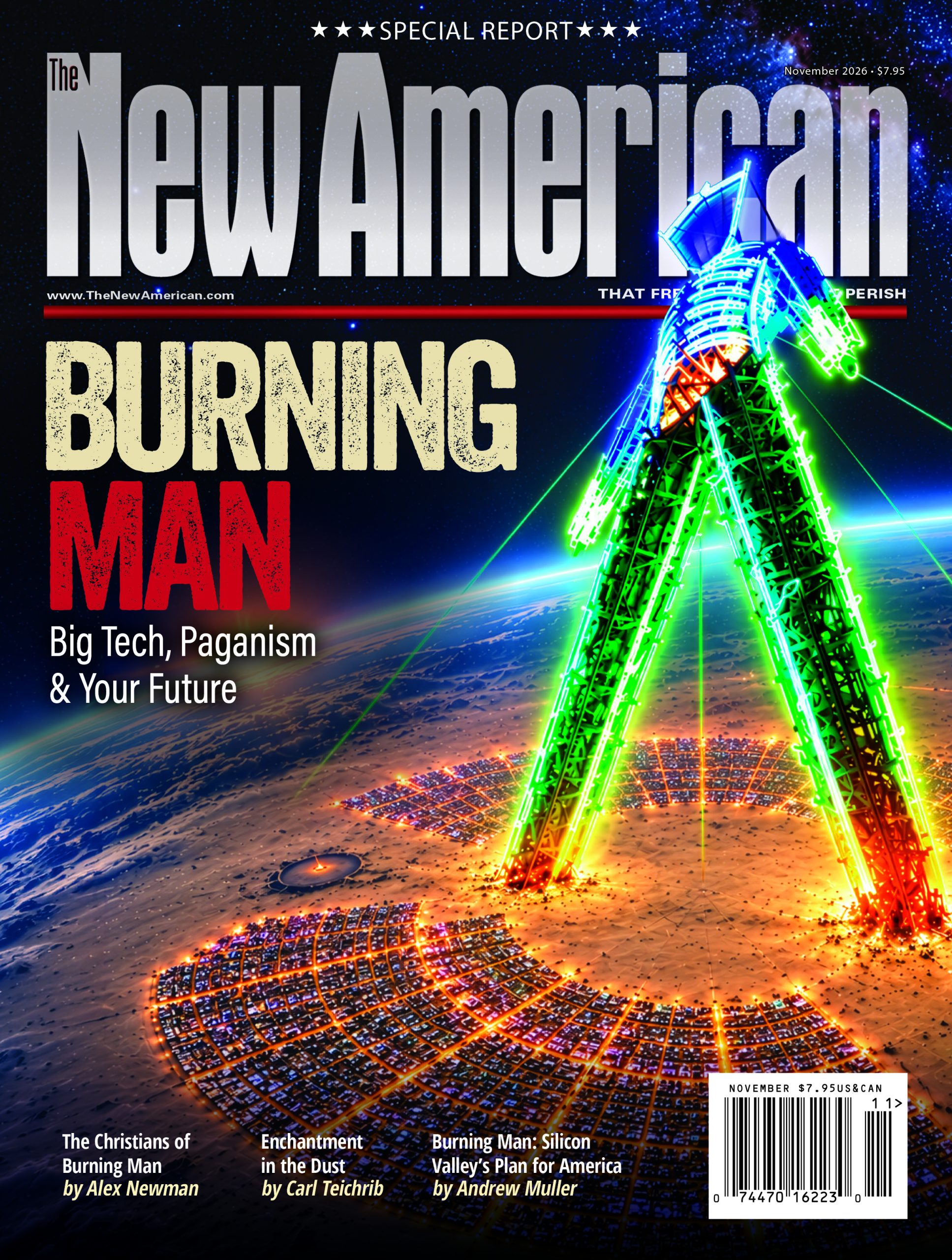
Vol. 42, No. 11
11/01/2026
Burning Man — Big Tech, Paganism & Your Future
AT A GLANCE
• Burning Man is not just a music or arts festival in the desert, though it has those elements.
• It also is not just a haunt for paganism and perversion, though it is that, too.
• It is a model for the post-Christian new world order the elites intend to create.
• It must be taken seriously because of the rich and powerful who embrace it.
BLACK ROCK CITY, NEV. — A man with blinking glasses and a space suit who said he was from “Andromeda” explained the nature of reality into the microphone. As he did so, a car made up to look like a giant octopus and shooting flames from its movable arms inched ever closer amid a deafening cacophony of techno music. Similarly outrageous “mutant vehicles” covered in LED lights and flame throwers lined up in every direction, blasting their own music to draw in the whirling masses. It was pandemonium, in the truest sense of the term. Before long, a fairy offering “Free Spankings” showed up to see who needed a slap on the rear from her horse whip. Earlier in the day, attendees were enjoying everything from the “orgy dome” to “art.” But now, with the sun below the nearby mountains, everyone was waiting anxiously for the climax of it all: The burning of “the Man.” In less than an hour, a more-than-100-foot-tall structure with an effigy of a wicker man on top would go up in flames in a dazzle of fireworks and celebration. As soon as it collapsed, tens of thousands of “Burners,” as they are known, were ready to rush in. Hundreds of them would soon strip off their clothes before circling and dancing around the smoldering remains of the “Burning Man.” Before long, with incense burning, anything-goes sex acts could be seen in every direction. More than a few children looked on in disbelief.
Even without the aid of hallucinogenic drugs, being at Burning Man felt like what a never-ending LSD or magic mushroom trip might feel like — at least as the experience was described by the high priest of the church of psychedelics, who spoke here at length alongside hundreds of other self-styled religious and spiritual gurus ranging from pagans and satanists to witches, warlocks, and everything in between. It was beyond surreal. In fact, it might as well have been another planet — or another dimension.
Burning Man cannot be easily explained in words, even by its creators or the tens of thousands of self-styled Burners who have been coming for decades. No two gave the same answer about what Burning Man is, or what it means. But regardless, it is one of the most important events happening anywhere in the world. More than a million people have attended so far, including many of the wealthiest and most powerful people alive. There are more than 100 satellite “burns” worldwide, and there are big plans for the future.
With Burning Man’s “10 Principles,” there is a near-total inversion of the concepts of freedom. “Do what thou wilt shall be the whole of the law,” the infamous statement by satanist leader Aleister Crowley, was one of the most commonly seen taglines at Black Rock City. Orgies, sexual debauchery, unrestricted drug use, demon worship, sorcery, witchcraft, necromancy, and more are all welcome. However, openly preaching the Gospel (free speech), journalism without submitting to Burning Man’s rules and supervision (freedom of the press), firearms possession (gun rights), and other basic God-given rights are all frowned upon, if not banned outright.
While it has flown largely under the radar of mainstream America so far, Burning Man is the tip of the spear in a planetary effort to bring about global transformation. The apparent goal of the brain trust behind it all: smashing what is left of Christian civilization and replacing it with a new world order based on pagan, New Age, occult, and totalitarian values. It is perhaps the clearest manifestation of what Lucifer Publishing Company founder Alice Bailey described as “externalization of the hierarchy” (more on that later). More than a few leading voices call it demonic. And it’s easy to see why. In one video of co-founder Larry Harvey sitting at an “art” installation that he describes as “Satan’s throne,” he boasts that attendees can come and “have their souls sucked physically from their body.” That is par for the course here.
The movement is very deliberately bringing back pagan practices that the spread of Christianity suppressed — for good reason. In fact, being there and watching all this, one cannot help but contemplate the pagan ceremonies of the ancient Canaanites described in the Old Testament. All that was missing was child sacrifice. It had the feeling of Sodom and Gomorrah with LEDs. No doubt that ethos is part of the reason for the hatred of Christians and disdain for Christianity shown by so many Burners, to the point where one Christian camp was literally expelled.
It might sound like a dystopian cross between a high-tech Mad Max and Woodstock, with a bit of Bohemian Grove thrown in — an event or community for hippies and drug users on the fringe of society. But between terrible dust storms and rain that turned the ground into an impassable, glue-like muck that made it almost impossible to move, private airplanes and helicopters carrying CEOs and senior executives from some of the most important technology companies in the world were rolling in at the makeshift Black Rock City airport by the dozens. It is said to be the busiest temporary airport in America for a whole week.
For many attendees, the festival, or movement, or city — nobody can seem to agree on what Burning Man really is — is merely about “art” or “partying,” or both. For some, it is about “community” and gift-giving — except for ice purchases, no buying or selling is allowed in this ephemeral place, and everyone is expected to bring gifts for fellow attendees.
But according to Burning Man founder Larry Harvey, who launched it 40 years ago on a beach in San Francisco, what is happening is actually an “ethical, cultural revolution.” Speaking in 1997, Harvey made clear that Burning Man was creating a new culture to supplant the remnants of the old Christian civilization rapidly disintegrating across the West and beyond. “I believe that what we’re doing is a model for the future,” he explained. Countless Burners agree. And they are shaping the emerging world order from behind the dust veil.
The Tech Significance
Harvey’s claims could easily be dismissed as the ramblings of a dope fiend or a lunatic. But over the decades since this began, Burning Man has attracted many of the wealthiest and most influential people in the world. And despite the apparent inability to recruit enough young people with the money to attend, the influence of this movement continues to grow as its tentacles spread across the world in regional burns from China and Israel to South Africa and Miami.
Trillionaire Elon Musk has publicly credited his trips to Burning Man for some of his most significant business ventures. “Burning Man is Silicon Valley,” Musk explained. “If you haven’t been, you just don’t get it. You could take the craziest L.A. party and multiply it by a thousand, and it doesn’t even get *%^@#%# close to what’s in Silicon Valley.” Musk should know. He is a mega donor to the organization, and his brother served on the board until his ties with Jeffrey Epstein were exposed (Epstein repeatedly mentioned Burning Man in his emails with transhumanist and technocrat elitists).
Musk says Burning Man is one of the things he does for “fun.” In an interview with a podcaster, he said one year he went dressed as Darth Vader. He actually launched one of his most significant Tesla models there. But his comments about the fusion between the Big Tech companies and Burning Man are deadly serious. It is something of an open secret that Burning Man is essentially an extension of Big Tech and the companies that are now creating the new digital panopticon that humanity increasingly lives in.
Inc.com, a publication for business leaders, famously described Burning Man as “the place where Silicon Valley’s wealthiest tech entrepreneurs escape for a week over Labor Day weekend.” Some major technology company leaders have even offered to pay for employees’ tickets in order to stimulate “creativity.” While people came from all over the world — foreign flags outnumbered American flags at least 100 to one — San Francisco was massively overrepresented.
Meta/Facebook founder and chief Mark Zuckerberg, who famously censored conservatives for years and even deleted the U.S. president’s account for exposing voting irregularities, showed up in a private helicopter one year. Jeff Bezos of Amazon fame, one of the wealthiest men in human history, first attended in 1999, according to Forbes. The founders of Uber, Dropbox, Reddit, Airbnb, and countless other major companies have been spotted there regularly, too.
Another one of the most powerful companies in the world, Google, is also well represented there. In fact, the company that dominates humanity’s access to information today has been inextricably linked to Burning Man since it first emerged with powerful help from key figures and organizations in the U.S. intelligence-military-industrial complex. A drawing of the Burning Man served as the company’s first-ever “Google Doodle” in 1998.
Google’s founders and top executives have been a staple at the event for decades. Co-founder Larry Page explicitly invoked Burning Man as a model for spaces in which technologists can experiment outside normal societal and legal constraints. “I like going to Burning Man,” he said, describing it as “an environment where people can try new things.”
Longtime Google CEO Eric Schmidt, who became executive chairman of parent company Alphabet, famously got selected for the top post based on his ties to Burning Man. According to a report by Business Insider, his documented attendance at the event showed Google’s Burner co-founders that Schmidt could supposedly let go of his ego and fit into the company’s unique corporate culture. “I had been going before, and they had also gone, and so we found a kindred spirit there,” Schmidt said during a 2017 talk at Stanford University.
“It’s well documented that I go to Burning Man,” Schmidt told the leftwing U.K. Guardian. “The future’s driven by people with an alternative world view. You never know where you’ll find ideas.” In a speech at the Burning Man-influenced Further Future gathering, the Google boss described the crowd in Burning Man’s Black Rock City as “a high percentage of San Francisco entrepreneurs.”
CEO Tony Hsieh of online shoe-retailing giant Zappos (now owned by Amazon) described Burning Man as an experience that activates what he described as “the hive switch.” “Basically, if you look at nature, you discover that certain animals, like chimpanzees and wolves, compete for food and mates, while others — bees are the best example — organize themselves for the greater good,” he told Playboy magazine. “They live together as a unified force because the DNA is the same. Bees are always working together for the benefit of the hive.”
The feeling of unity Hsieh associates with this hive mentality is what draws him to Burning Man, he said. “The art, especially at night, just puts you in a state of awe,” the tech bigwig added. “These things are hard to describe until you’ve experienced them, I guess.” That sentiment was repeated literally hundreds of times by Burners to The New American’s team on the ground.
Many leading AI CEOs have attended as well. OpenAI boss Sam Altman, for instance, admitted on the Life in Seven Songs podcast in 2024 that he had been to Burning Man five or six times — and that he has taken hallucinogenic drugs there, which transformed him. “This is one possible, like, part of what the post-[artificial general intelligence] world can look like,” Altman said. “Where people are just focused on doing stuff for each other, caring for each other, and making incredible gifts to give each other.” Think: Universal Basic Income meets the New Age.
The AI-occult connection continues to surface in public. Musk, one of the most prominent Burners and currently the wealthiest individual in the world, famously referred to AI as “sort of summoning a demon.” U.S. Vice President JD Vance, backed by Big Tech overlord Peter Thiel, recently said in a podcast that there is a “really, really weird spiritual dark energy” around some AI. He noted a major tech firm was even holding a “burial ceremony” for a discontinued AI version as a new one got introduced.
Of course, Burning Man attendees are literally the people who produce the algorithms, AI models, and technologies that determine what you and billions of other people around the world see amid endless doomscrolling. And at this very moment, these same Big Tech companies and leaders are seizing power and building an entirely new world. As UN Secretary-General António Guterres put it recently, humanity is currently witnessing “the greatest transfer of power of our times — not from governments to people, but from governments to private technology companies.”
Guterres is right: Technology companies are increasingly dominating every facet of life and society, including government. That is concerning enough on its own. Now, consider that it is almost impossible to tell where those “private” technology firms begin and Burning Man ends.
What Is Burning Man?
For many Burners, Burning Man is “home.” In fact, at the gate, volunteer greeters welcome arrivals with the same two words they have used for years: “Welcome home.” Some call it an “event” or a “festival.” For others, it is a “city” with global reach. But many longtime Burners bristle at the terminology. It is a “transformative movement,” they say.
Ask a hundred Burners what Burning Man is and you will get a hundred answers. Indeed, the FreedomProject Media and New American team did just that. Officially, the Burning Man Project insists it is not a festival. It is “a global cultural movement” and an “annual experiment in temporary community,” built for a week on a dry lake bed, or playa, in Nevada’s Black Rock Desert and then erased.
Volunteer “AJ,” the “playa name” of a veteran of nearly 20 burns who now works the city’s edges, described it as “an experimental community of people who are a little bit counterculture.” They come, she said, “to enjoy great art and make friends and camp.” It is “the most wonderful place on the planet” — but only for “the right people,” those willing to camp in extreme conditions and live by a shared ethic, AJ added.
Speaking to The New American on a couch in front of a fire on the desert floor next to blasting techno music, 16-year Burner “Alex” put it more bluntly: “You’d have to be crazy to be here. But yet every year we come again.” Nothing works reliably. Bikes break, generators fail, dust and rain swallow plans. That hardship, he said, is the point. “You put in a hard time and then go enjoy yourself.”
The physical form of the place is as distinctive as the rhetoric. The city is laid out like a clock: curved streets named for hours, radial avenues, the open playa at the center. At the hub stands the Man, a towering wooden effigy that is burned on Saturday night in fireworks and roar. Nearby is the Temple, a quieter structure that burns later, after people have written letters, pinned photographs, and left objects they want to release.
AJ told The New American that the burning of the Man is “about joy and letting go”; the Temple is “about grieving and also letting go of things, but in a different way.” First-timer Benedict, a Stanford researcher from Germany who was camped near TNA’s team, saw the Man as spectacle more than sacrament, though he noticed that for many fellow attendees it was “really like a spiritual event.”
Austin, who first came in 2019 as a Burner and returned years later with a Christian mission camp, called the Man burn “idolatrous” and the Temple a place where people try to burn away pain that, in his view, only God can truly take away.
What holds the city together, at least on paper, are the 10 Principles Larry Harvey wrote down in 2004: radical inclusion, gifting, decommodification, radical self-reliance, radical self-expression, communal effort, civic responsibility, leaving no trace, participation, and immediacy. Money is almost useless inside the gates. Everything is supposed to be “gifted.”
Throughout the “city,” theme camps offer free tea, yoga, tacos, hand massages, foot washing, lectures, music, dance, art, and lessons in polyamory, bondage, masochism, homosexual sex, and even more explicit fare. “Kidville” features large numbers of children — some of them totally naked — amid a sea of LGBT flags. So-called mutant vehicles crawl the playa blasting fire and music. The survival guide tells participants there are no trash cans; you pack out what you pack in.
The official line is that this is participation, not consumption. In practice, the range of experience is enormous. One first-year sculpture installer, exhausted after a week without a shower and fighting festival logistics he found “more antagonistic than helpful,” told The New American he would never come back: “Go to Electric Forest [music festival in Rothbury, Michigan]. Don’t go to Burning Man. This sucks.”
Others speak of “playa magic” — uncanny meetings, sudden help in a dust storm, a sense that anything is possible. Burner Alex said Russians and Ukrainians, Israelis and Palestinians, share camps without the reflex to choose sides found in the “default world” — the Burner term for the world outside Burning Man. “Here, you don’t do that. I don’t know who you are with your background, and it’s not even relevant,” he told The New American.
The darker inventory is harder to romanticize. Deaths, overdoses, sexual assaults, and at least one homicide investigation have marked recent years. Some Burners shrug. “You get the burn you need, not the burn you want,” more than a few said. The New American team heard a woman screaming in the dark as a man abused her; dozens walked past until the TNA crew intervened and the man fled. Reports of victims being discouraged by Burning Man “rangers” and “Zendo” helpers from going to law enforcement are ubiquitous every year.
On the way out, the volunteer at the gate, a dirty girl with disheveled multi-colored hair and tattoos all over, was shouting wildly at cars, asking for more free stuff. “Does anybody have Plan B [abortion pills] so I can kill my baby?” she hollered matter-of-factly between frantic requests for sex toys, batteries, and other random items. After four days at Burning Man, it did not even seem weird anymore.
Critics outside the gates reduce the event to drugs and sex. Burners answer that those things exist everywhere. And while they are more open and perhaps prevalent in Black Rock City, it is part of the human experience, Burners say. “People are people,” Alex said. “Burning Man is no different.” What is different, they insist, is the openness: Strangers sit down, share tools, and talk.
A high-level executive who goes by the playa name “Moses” offered one of the cleaner summaries: Even if organizers refuse the word, the simplest way to explain it to outsiders is “a festival of humanity.”
Christian researcher, author, and journalist Carl Teichrib (see article on page 47) rejects the “festival” label altogether. Burning Man, he told The New American, is “a container where social change is lived out in real time. It’s the future being experimented with in the present.” People call it a gathering. He calls it an incubator — for art, for community, and for a worldview that is meant to travel home.
That last claim is the one that matters beyond the desert. Harvey himself said in 1997 that the project was “an ethical, cultural revolution” and “a model for the future.” Whether one accepts his terms or not, tens of thousands of people now treat one week in the dust as the template for how life should feel the other 51. Eventually, they hope to bring the whole world with them.
The Spiritual Implications of Burning Man
Burning Man presents itself as a culture of radical inclusion and self-expression. But on the playa it functions, for a great many participants, as a new religion. In fact, the spiritual element is perhaps the most stunning and obvious feature of it all. As the Man was burning with naked people dancing around it, this writer could not help but think of the monstrous pagan rituals that were suppressed as Christianity spread across the ancient world.
Burning Man founder Harvey once said that every religion began with somebody in the desert. “You can’t help but be thinking cosmically because there’s nothing here but the earth and the sky,” he said. “The Man is like a ladder between the two.” Ironically, the 2026 theme, “Axis Mundi,” is a term used by occultists to denote a center connecting humankind with demonic realms. Burning Man describes it as “a celestial column connecting us to powers greater than ourselves.” Asked if he had a dream, Harvey answered that they were going to take over the world — “sooner than you might think.”
Many Burning Man leaders use religious terminology. Kimbal Musk, brother of Elon Musk and long involved in the organization’s leadership, is widely quoted as saying the playa is “the Vatican” and all the affiliated satellite burns are a “church.” More than a hundred official and unofficial regional burns carry the same false liturgy around the world.
The liturgy is visible to anyone who cares to look. People process to the Temple with photographs of the dead, wedding dresses from failed marriages, letters of grief. When the structure burns, the crowd often falls silent. Dust devils and smoke are spoken of as “spirits.”
Billionaire Nicole Shanahan, the ex-wife of Google co-founder Sergey Brin, who attended for nearly a decade before defecting and labeling it demonic, stayed at Burning Man’s “First Camp,” which houses Burning Man’s founders, organizers, etc., with Harvey and Burning Man CEO Marian Goodell. After becoming a Christian, Shanahan described the Temple burn as a moment that reduced her to tears among tens of thousands “worshiping the flames in silence.”
“For many, Burning Man is nothing short of a religious experience, especially for those who make a pilgrimage to the Temple,” she said. “When it burned, it was meant to be a collective release. As the structure collapsed, great spirals of smoke would rise into the sky, and dust devils would swirl across the desert floor. Among Burners, these were spoken of as ‘the spirits.’”
The supposed “performance” before the burning of the Man, she added, was about “invoking.” “Their movements and chants served as ceremonial openings, calling on ‘spirits’ to bear witness,” Shanahan said. Indeed, Harvey once told her that the burning of the Man symbolized “the release of the soul.” “But I cannot help but ask: to whom is that soul being released?” she said. And while she admitted to being new to the study of demonology, “there is clearly something dangerous at work here.”
Looking back, she called the whole event “a powerful vehicle for deception” and “one of the most effective tools for Satan to misdirect souls away from our Heavenly Father.” She recalled Harvey pulling a sketch of the Delphic oracle stone from his pocket, planning to embed it inside the Man. One year’s design invoked Chacc, a Mayan rain god historically associated with human sacrifice.
Altars and “confession” booths appear across the city — some mocking, some apparently earnest — where people offer sins and petitions to idols and spirits rather than to God. Dance troupes circling the Man before the burn look, to those watching with different eyes, less like entertainment than invocation. A leading psychedelic researcher associated with the Multidisciplinary Association for Psychedelic Studies spoke of hallucinogens as a way to communicate with dead relatives, including Israeli parents seeking contact with children killed on October 7. The God of the Bible refers to necromancy as an “abomination,” putting it in the same sentence with sacrificing one’s own children to idols. It was a capital offense in Old Testament Israel.
In other camps, speakers described mushroom trips in which a serpent delivered the message “do more mushrooms,” conversations with “God” about why the universe exists, and a theology in which every soul is a tentacle of a cosmic octopus. Yahweh, the biblical God, was dismissed as an oppressive tyrant.
One presenter, the high priest of the church of psychedelics (which has close to 150,000 members worldwide), said taking enough mushrooms can take a person “physically to another world.” Asked by this writer about the demonic, he answered that opening those doors can admit evil — “that’s a real thing” — while insisting that “we are all god experiencing itself.” He even spoke of encountering evil spirits “collecting souls.”
There were camps representing just about every world religion imaginable, from Hinduism and Buddhism to witchcraft and sorcery. About the only religious view and practice not acceptable: open, biblical Christianity. In fact, to many Burners, Christianity is public enemy number one. This writer witnessed numerous examples of the mere mention of the name of Jesus causing people to recoil in horror, shout obscenities, or worse. There was even a camp dedicated to striptease and sexual perversion on stage while blaring Christian worship songs and children’s music.
Christian missionary Taylor Skidmore, who has attended three times and works with churches trying to reach spiritual seekers, called Burning Man the “mothership” of a global circuit of transformational festivals attended by tens of millions of people worldwide. The older New Age hope is explicit: the Age of Pisces (the fish, Christianity) is ending; the Age of Aquarius will enlighten humanity beyond earthly limits. Partygoers and serious pilgrims share the same dust. The communal intention is transformation and transcendence.
Whether one hears that as liberation or as a counterfeit liturgy, the evidence on the ground is consistent. People come to burn something — grief, identity, the default world, the patriarchy, authority, sometimes a wooden man they treat as a ladder to the sky. The question the missionaries keep asking, and that Shanahan now asks from the other side of conversion, is simple: To whom is the offering being made, and what comes back when the fire dies?
Call to Action
Despite being known as a party or an art festival, Burning Man is much more than that. It is the cutting edge of a new, demonically inspired culture that is being deliberately birthed into the world. And it is being helped along by many of the wealthiest and most powerful people on the planet. Understanding that politics is downstream from culture, the significance of this should be clear. And with tech now dominating human life, the ruling class and Burning Man are hard to tell apart.
Like the infamous pincers strategy used by communist strategists to take down and enslave Czechoslovakia, the pressure ushering in this global transformation is coming from above and below. And with every year that passes, it is gaining strength. Christian civilization and morality — along with the liberty, prosperity, and peace they produce — are steadily being eroded. In their place, debauchery, paganism, and tyranny are making a major comeback.
For hundreds of years after the violent torture and murder of Jesus Christ at the hands of powerful political and religious leaders, His followers were massacred and persecuted by legions of people engaged in many of the same practices as those on display at Burning Man. It took centuries for those practices and views to be overtaken by the Gospel and what eventually came to be known as Christendom.
Successfully resisting this global transformation in all its dimensions — political, economic, and spiritual — will require serious, organized effort, along with divine aid. The first step in pushing back is understanding what is happening. As ancient Chinese military strategist Sun Tzu explained, winning demands a thorough knowledge of the enemy and oneself. That means Americans must study, get organized, and get involved. The danger should be clear. Time is short. Sound the alarm and get involved today. What remains of Christian civilization is burning. It is time for the fire brigade to put out the flames with love and truth.