

Report: Half of $300B Investment for Iran Committed. Companies Across Globe Signed On to Rebuilding Effort.
More than half of the $300 billion private fund for Iran that is included in the memorandum of understanding to stop the war is already committed, a source has disclosed to Reuters.
The massive pot of money reportedly does not include U.S. taxpayer money. Instead companies across the globe will invest in Iran.
Critics worried that taxpayers would foot the bill to rebuild infrastructure in a country that the United States had unnecessarily destroyed. But a government investment would never have received approval on Capitol Hill. Or from Americans who opposed the war from the beginning.
No Foreign Investment for Decades
“The fund is designed to give both sides an economic incentive to conclude a final deal, said the source,” Reuters reported. “Companies based in the U.S., the Gulf Arab states, Asia, South America and Africa have agreed to commit financing.”
The source told Reuters that investments include just about all the major components of the Iranian economy, including “energy, logistics, manufacturing and transport.”
Iran asked for $400 billion from the United States to compensate for the destruction. The Trump administration refused, which triggered the idea for what will be named a Reconstruction and Development Fund, Reuters continued, citing an Iranian source:
The mechanism envisages regional countries contributing in various ways, the Iranian source said. These include securing loans, establishing credit lines or directly financing the reconstruction of sites damaged in the war, including facilities such as the Mobarakeh Steel complex, refineries, airports and, more broadly, infrastructure affected by the conflict.
Iran, one of the Middle East’s largest economies, has attracted almost no significant foreign direct investment in the past four decades, frozen out of global capital markets by successive waves of U.S. and international sanctions.
The rebuilding effort is important, Reuters noted, because Iran sits atop the planet’s second largest deposit of natural gas and fourth-largest deposit of oil.
No Fund Until Deal Is Done
“The investment fund is entirely separate from a parallel negotiating track over the lifting of U.S. sanctions and the release of Iranian sovereign assets frozen abroad, the source said, describing the two as distinct financial mechanisms with different purposes and timelines,” Reuters continued:
The fund will not be created or become operational until a final and satisfactory deal is concluded. The memorandum of understanding, once signed, is intended to structure the process over the next 60 days.
“It’ll only be created once the final deal is signed,” the source said. “During these 60 days the fund administrators will work with Iranians and investors to plan and scope projects.”
Reuters’ source did not disclose who will manage the fund. The source said corporations from “South Korea, Japan, Singapore, Malaysia and the United States are among those that had made commitments.”
Iran Worth a Bet
X commentator Mario Nawfal wrote that the investment fund “reframed the entire” deal to end the war.
“A government commitment to reconstruct Iran was always going to be politically impossible to sell in Washington,” he wrote:
A private investment fund with $150+ billion already committed before the ink is dry is a different animal entirely.
That’s a coalition of global capital that has decided Iran’s economic reopening is worth betting on, and it creates a constituency for the deal’s success that goes well beyond any government’s political will.
The fund is a major financial incentive not only for the investors but also Iran, which is “one of the most resource-rich and underleveraged economies on earth.”
Former GOP Representative Marjorie Taylor Greene — typically correct in her denunciations of Trump — spoke too soon about the deal.
She claimed the $300 billion would come from American taxpayers in an X video.
“Now, I’m assuming this comes from the American taxpayer, and I want to tell you that’s a bunch of bullsh*t,” she said:
This is a war that Americans did not support. As a matter of fact we said no more foreign wars and that’s what we voted for in 2024. Well, Trump decided to bomb Iran and go to war against Iran on behalf of his good friend, Bibi Netanyahu.
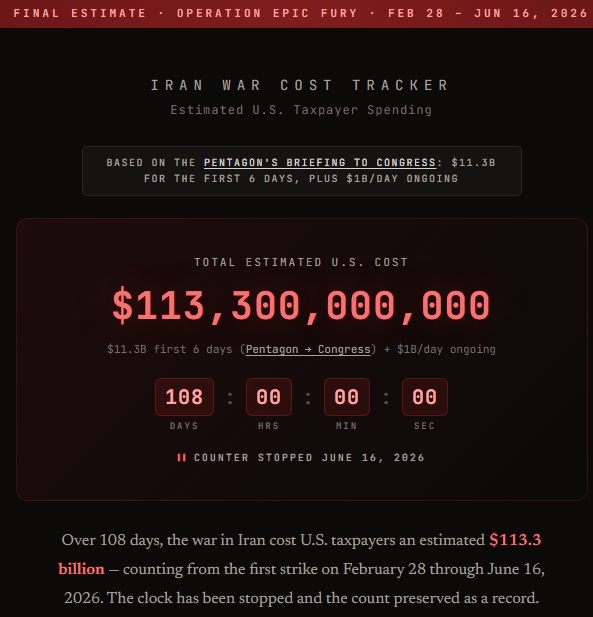
Taylor Greene exaggerated the cost of the war by $1 billion per day. The cost of the war is $113.3 billion through its 108 days, the Iran War Cost Tracker estimates, or about $1.05 billion per day. The tracker stopped counting today.
“We may have to pay an additional $300 billion to rebuild what Trump and Netanyahu decided to bomb?” she asked:
This is a bunch of bullsh*t.
Estimates of Iran’s losses vary from $144 billion to $270 billion of Iran’s economy. Or $400 billion, given Iran’s demand for reparations, which the Trump administration rejected, leading to the $300 billion investment fund.
But Taylor Greene’s erroneous estimate aside, American taxpayers invested $113 billion to destroy a country’s economy and infrastructure, which opened the door for private companies to profit handsomely by rebuilding them.
Those profits won’t likely reimburse the Americans who paid for the unnecessary war.