

“I Come From Your Future”: A Frenchman’s Warning for American Midterms
“A government that robs Peter to pay Paul can always depend on the support of Paul.” So noted famed English author George Bernard Shaw, lamenting the British political system in 1944. And now a Frenchman, lamenting the French political system today, has a warning for Americans.
Don’t be Paul.
Paul believes promises. He gets pain — and maybe even poverty.
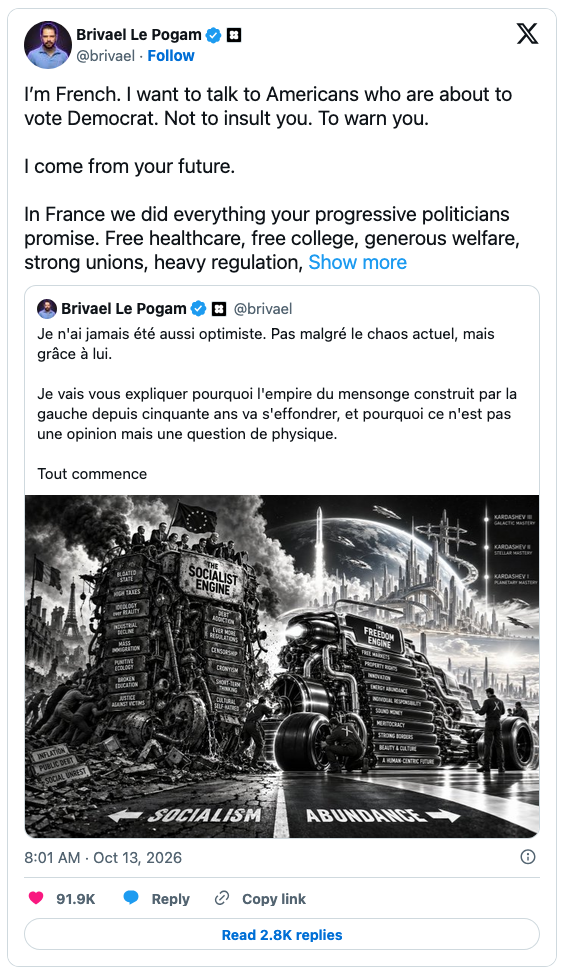
Issuing this message was Brivael Le Pogam, “co-founder and self-proclaimed ‘techno-emperor’ of the French AI company Argil,” to quote Fox News. His nation has figured prominently in the media lately, being wracked by riots from Paris to Pau. But on Le Pogam’s mind recently was something else: Our nation — and our upcoming election.
As the tech entrepreneur wrote on X last Tuesday in a post that went viral:
I’m French. I want to talk to Americans who are about to vote Democrat. Not to insult you. To warn you.
I come from your future.
In France we did everything your progressive politicians promise. Free healthcare, free college, generous welfare, strong unions, heavy regulation, high taxes on the rich, a state that takes care of everything. Public spending close to 57% of GDP, one of the highest on the planet. On paper, it’s the dream.
Here’s what it looks like from the inside. France hasn’t passed a balanced budget since 1974. Our debt is above 3,300 billion euros. Interest on that debt is becoming one of the biggest items in the national budget. Our hospitals are collapsing despite record funding. Our schools rank lower every year. Young people with degrees can’t afford an apartment in the city they were born in. Our best engineers leave for London, Zurich and San Francisco. And the rich you wanted to tax? They left too, and took the jobs with them.
The promise was protection. The result is stagnation.
The worst part is that nobody in France voted for decline. Every single step sounded generous, compassionate, reasonable. One more program. One more regulation. One more tax to fund it. Each step alone makes sense. Fifty years of them, and you wake up in a country that can no longer build a nuclear plant on time or keep its streets safe.
What’s untrue in the above: Many Frenchmen did vote for the decline — they just didn’t want it. There’s a difference. (Translation: The electorate often doesn’t know what it’s voting for.)
Le Pogam then concludes:
I love America because it’s the one place on earth where people still believe they can build something from nothing. I came to Silicon Valley as a self-taught kid and it changed my life. That spirit is the most precious thing your country has.
Before you vote, ask yourself one question: is the program you’re voting for making America more like America, or more like France?
Trust me. You don’t want to be France.
Note: There is at least one area in which we already are France — only more so. That is, national debt, which in our case tops $40 trillion. The upshot: While France’s debt-to-GDP ratio is bad at approximately 115 percent, ours is worse at about 123 percent. On the other hand, we do enjoy the advantage of the dollar being the world’s reserve currency. This helps us manage our debt.
This said, our interest payments on the debt are now greater than our defense budget. It’s a staggering thought.
Le Pogam’s tweet is below.
There Is No Money Tree
In a few words, France’s problem is a common one: the welfare state. And as Nobel laureate economist Milton Friedman warned, “You cannot simultaneously have free immigration and a welfare state.” France has long had both — and the halal chickens are coming home to roost. As ZeroHedge wrote last Wednesday:
Higher borrowing costs make funding the welfare increasingly impossible. Spending more on debt service leaves the government less flexibility to fund services, absorb economic shocks, or deliver the next round of handout promises as services continue to degrade.
The choices of what the government has proposed become increasingly uncomfortable: higher taxes, spending cuts, or still more borrowing.
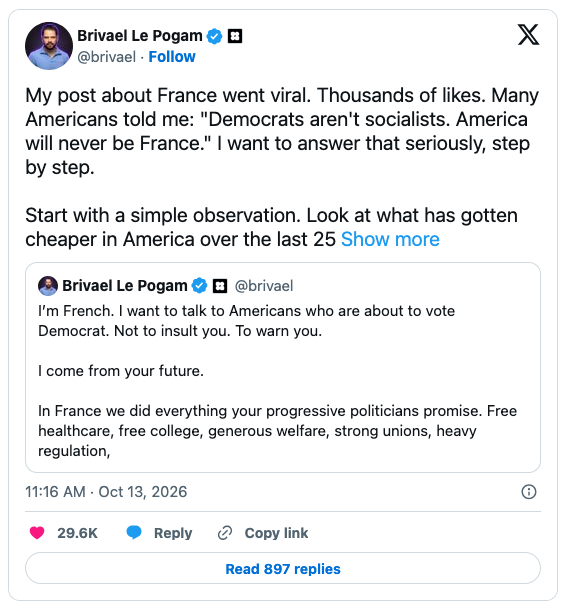
In response to these warnings, many Americans told Le Pogam that America isn’t France and Democrats aren’t socialists (ahem). So in a follow-up tweet, he essentially asked readers to put labels aside and observe patterns, writing:
Start with a simple observation. Look at what has gotten cheaper in America over the last 25 years: TVs, phones, software, clothes, toys. Now look at what has exploded: college tuition, healthcare, childcare, housing.
What separates the two lists? The first lives in competitive markets. The second is exactly where government is most involved: subsidies, mandates, licensing, zoning, regulation.
… So here is the trap. The problems you suffer from are not the failure of free markets. They are the places where the market has already been replaced by the state. And the solution you’re being offered is more of the same.
(Entire tweet below.)
An AI Money Tree?
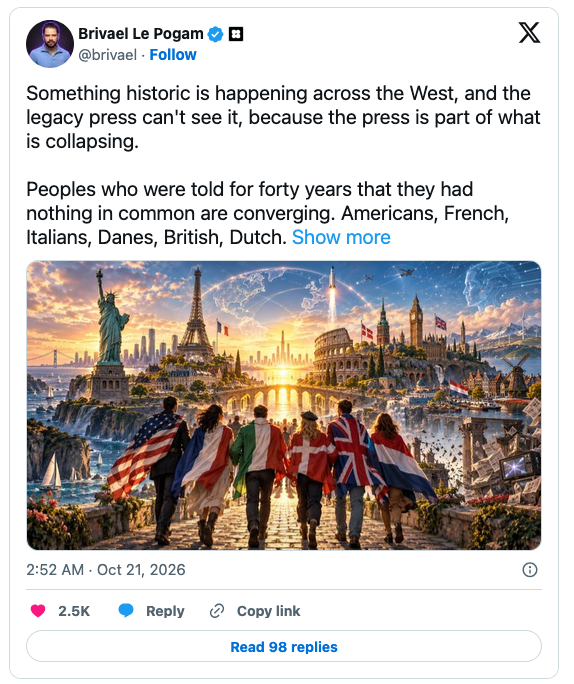
Le Pogam has some good news, too, though. I find it notable because it’s something that has also occurred to me. He states:
Collectivism has always been a politics of scarcity. Its whole logic is that the pie is fixed, so someone’s gain is someone else’s theft, so the state must take and redistribute, ration and control. That’s why its latest form is degrowth. Planners need scarcity the way fire needs oxygen.
What is being built right now makes that logic obsolete. AI is collapsing the cost of intelligence. Robotics is about to collapse the cost of labor. Reusable rockets have already slashed the cost of reaching space. Elon Musk and thousands of builders like him are proving every day that the pie is not fixed.
The idea is essentially something Musk has predicted: AI and robotics will eventually produce all our wealth, making work optional. (That is, if it doesn’t destroy us first.) And when abundance is the norm, who needs socialism? Again, Le Pogam’s entire tweet is below.
In conclusion, Le Pogam is an impressive thinker and essayist, but some other factors should be pondered. First, “If something sounds too good to be true …” — you know the rest.
Yet even if the AI-sugar-daddy promise comes to fruition, something won’t have changed: man’s nature.
People will still need meaning in life, and what will happen when they’re freed from work, which builds character? That an “idle mind is the Devil’s workshop” occurs to me.
Second, there will still be those among us with power lust, with a desire to control others. Through what vehicle will they seek to do this? Government (still)? The AI companies?
Will the AI itself ultimately be organizing — and maybe controlling — civilization?
Third, zealots will still exist; e.g., Muslim jihadists will still want to convert the world by the sword.
Most significantly, though, Le Pogam doesn’t appear to address the most important issue: the morality factor. As Anglo-Irish philosopher Edmund Burke warned, “It is ordained in the eternal constitution of things that men of intemperate minds cannot be free. Their passions forge their fetters.”
I don’t mean to be a wet blanket, only a realistic one. The future that Le Pogam and others enthusiastically predict sounds wholly perfect, prosperous, peaceful, productive, and positive — downright utopian. And that is what’s so profoundly scary about it.