
Trump Threatens $5 Billion Lawsuit Over Study Challenging Guard Deployment: Report
President Donald Trump is reportedly threatening to sue a think-tank for $5 billion over a study that challenged one of his “law-and-order” claims.
The target is the Center for American Progress (CAP), a Washington think-tank led by Neera Tanden, a former advisor to President Joe Biden. Its July 13 report concluded that Trump’s National Guard deployments “failed to reduce urban crime.” CAP says it will not retract the study.
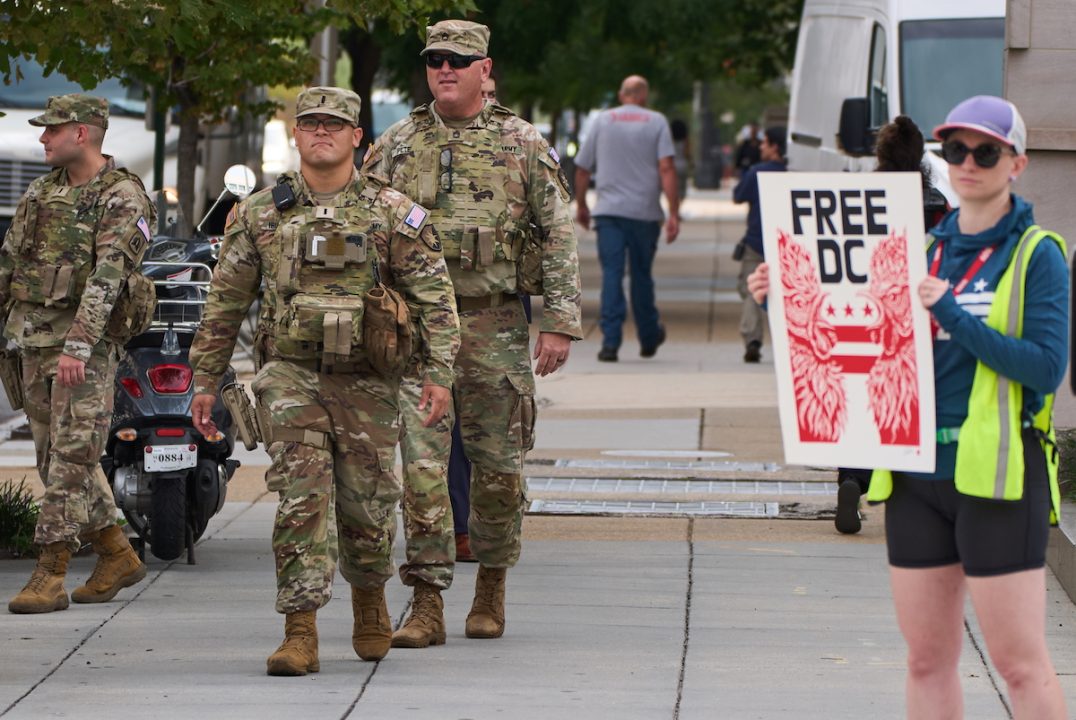
In the meantime, the capital is taking on the trappings of a permanent military garrison.
The Pentagon has extended the Guard deployment through January 20, 2029, or until Trump ends it. The mission is projected to cost another $1.4 billion through the end of his term.
And the government is preparing for a long stay. In June, the National Guard Bureau, partnering with the D.C. National Guard and the U.S. General Services Administration (GSA), awarded a $292 million contract for as many as 2,000 “apartment-style lodging units” for deployed troops. It is the largest interagency lodging acquisition in National Guard history.
Against that backdrop, the president’s reported threat to take the think-tank to court does little to ease growing alarms over the normalization of military deployments for domestic policing.
$5 Billion for a Retraction
The New York Times reported on Friday that Trump’s personal attorney Alejandro Brito sent CAP a letter on August 17. In this letter, says the outlet,
Mr. Brito claimed that the report about the National Guard was full of malicious and false statements. He gave Ms. Tanden and members of her board until 5 p.m. on Friday to retract it and apologize to Mr. Trump.
The report further details,
Mr. Trump referred to the report on social media last week after watching a television segment about the report, which he described as “another Radical Left SCAM.” In the post, he threatened to sue the center and several of its funders, including the liberal financier George Soros….
A week later, Mr. Brito’s letter arrived at the center, saying that the president would sue if Ms. Tanden and her colleagues did not retract the report, issue an apology and give Mr. Trump unspecified financial compensation.
The letter ended: “PLEASE GOVERN YOURSELVES ACCORDINGLY.”
CAP refused.
Tanden called the threat “baseless” and said the organization would “neither cower nor bend.” CAP attorney Kevin Metz was more direct: “Truth is not and cannot be defamation.”
What the Study Found
The report analyzed data from January 2023 through February 2026. It examined Washington, Los Angeles, Memphis, and, in one model, New Orleans.
Researchers used three statistical approaches. They tracked violent crime, homicide, and gun victimization. They also compared deployed cities with cities Trump had threatened with deployments but where troops did not arrive.
The results were not identical in every test. One city-level model found a statistically significant shift in Memphis. But broader models found no statistically significant reduction in homicide or gun victimization attributable to the Guard.
CAP concluded there was “no compelling evidence” that the deployments reduced homicide, violent crime, or gun violence.
And CAP is not alone. A study released weeks earlier by the nonpartisan, libertarian-leaning Niskanen Center reached essentially the same conclusion on violent crime in Washington, D.C. Researchers analyzed Metropolitan Police Department (MPD) crime and arrest data, officer deployment records, and independent data sources. They found no measurable reduction in violent crime attributable to the Guard.
Protecting the Elite?
Reuters added another layer last week.
Its reporters reviewed every publicly available charging document filed in D.C. Superior Court since the deployment began. They found Guard soldiers mentioned in only about 1.3 percent of criminal cases.
There are now roughly 4,500 Guard troops in Washington, according to the outlet. That exceeds the city’s roughly 3,200 police officers.
Yet the troops appear concentrated largely in wealthier, safer parts of the capital. They patrol monuments, transit hubs, and commercial districts, rather than the poorer neighborhoods where most of the city’s murders occur. Reuters reported:
[The reporters] could find no reference … to soldiers doing any kind of law enforcement in the neighborhoods where about 82% of the city’s 859 murders occurred over the past five years.
That raises an obvious question about who and what, exactly, the deployment is protecting.
Whatever the answer, taxpayers are paying heavily for it.
A February Senate committee report estimated that the D.C. deployment was costing taxpayers about $1.65 million per day. Pentagon comptroller nominee Jules Hurst III later said keeping the mission running through January 2029 would cost another $1.4 billion.
CAP estimates that the broader Guard deployments could cost taxpayers more than $1.7 billion through the end of 2026.
A High Legal Bar
As biased as a liberal think-tank may be, that does not strip its research of First Amendment protection. Trump and his administration are free to challenge the studies, question their methodology, and present competing evidence. If the president believes CAP knowingly published false factual claims that damaged him, he can also take the matter to court.
But defamation law sets a high bar for public officials. Under the Supreme Court’s 1964 New York Times v. Sullivan ruling, a public official generally must prove “actual malice,” meaning that a false statement was published with knowledge of its falsity or with reckless disregard for the truth.
The First Amendment also protects opinions that cannot be proven true or false. That distinction matters here. CAP’s conclusion that the deployments produced no measurable reduction in violent crime is an empirical finding based on its analysis. Its description of the policy as a “dangerous power grab” is political judgment.
That is why the dispute reaches beyond one think-tank. A $5 billion threat can exert pressure long before a case reaches a judge. Litigation is expensive. Donors may think twice about supporting an organization that has drawn the president’s wrath. Researchers may begin to wonder whether publishing an unwelcome conclusion is worth the risk.
That is the chilling effect Tanden and other critics warn about.
In a free republic, even plainly partisan research should be answered with better evidence, not a multibillion-dollar threat because its conclusion displeased the president.
Related Articles:
National Guard in D.C.: Little Crime Benefit, Big Constitutional Cost
Pentagon Orders Nationwide Quick Reaction Forces for “Civil Disturbance Operations”
Trump Orders “Specialized Units” for Rapid Deployment in D.C., Other Cities
From Ballroom to Drone Empire: Trump’s Fortress for the Elite