Treasury Readies Trump’s $250 Bill
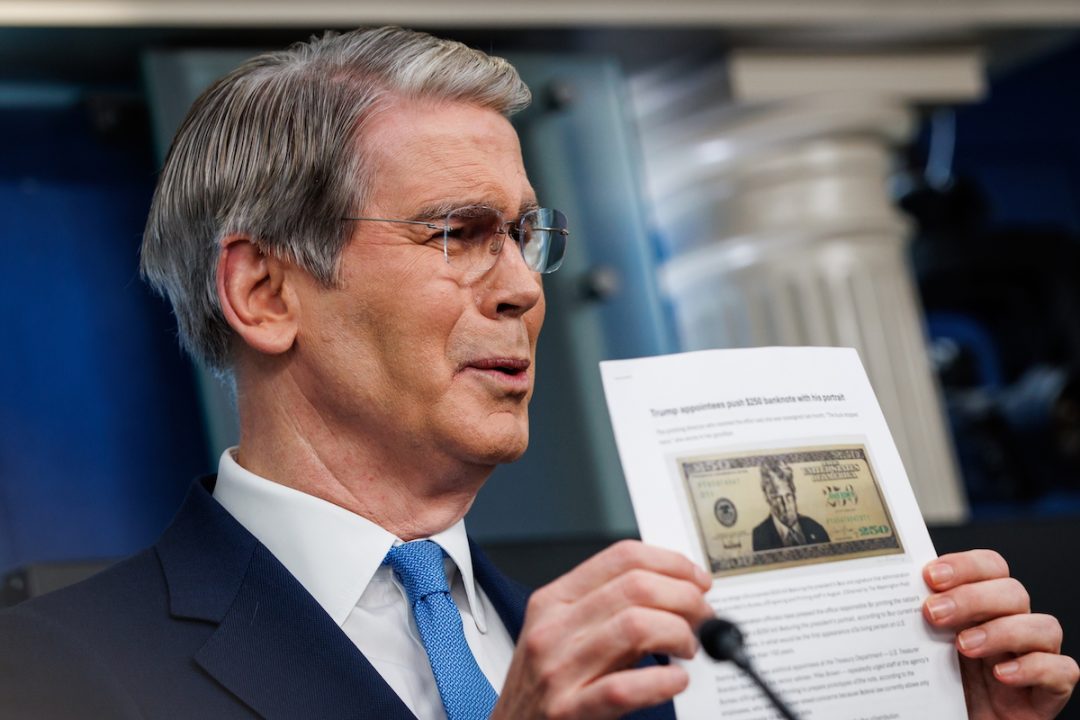
Last Thursday, Treasury Secretary Scott Bessent confirmed a proposed $250 bill bearing President Donald Trump’s face, presenting it as a possible tribute to America’s semiquincentennial.
The main obstacle is the law. For now, it bars living people from appearing on U.S. currency. Existing law also does not authorize a $250 Federal Reserve note. But legislation has already been introduced to solve both problems, at least on paper.
The harder question is what kind of political culture would feel compelled to do so.
Bessent’s Pitch
Bessent presented the proposal as a matter of procedure.
“As Treasury Secretary, I have two mandates for U.S. currency at present,” he said at the White House. “That no living person can be on U.S. currency, and the currency must say, ‘In God We Trust.’”
Then he described the proposed fix.
“So right now there is proposed legislation in front of the House, in front of the Senate, to change the first requirement, so that a living person, Donald J. Trump, could be on the $250 bill,” he said, adding,
At Treasury, we prepare things in advance. So we have prepared in advance [in case] the legislation is passed, but we will stick to the law.
The message was careful. Treasury would obey the law. If Congress changed the law, Treasury would be ready.
But the idea was not merely theoretical. The Washington Post reported that Trump appointees at Treasury had “pressed” the Bureau of Engraving and Printing to prepare designs for the note. According to the paper, “starting last year,” U.S. Treasurer Brandon Beach and senior advisor Mike Brown were involved in the effort. The Post also reported that Patricia Solimene, then director of the bureau, raised legal and procedural objections and was later reassigned.
Treasury denied that Beach had asked staff to print the note before Congress acted. The department said the bureau was conducting “appropriate planning and due diligence” in response to pending legislation.
The president, at the same time, was reportedly not a distant observer:
The artist who said he designed the mock-up told The Post that he had spoken with Trump about it.
British painter Iain Alexander said Trump endorsed changes to his original design, such as adding the colors of the American flag and a logo commemorating the 250th anniversary of the nation’s founding.
So, publicly, officials made the proposal sound conditional. In practice, the administration has already treated it as a live project.
The Bill
On February 27, Representative Joe Wilson, Republican of South Carolina, introduced the Donald J. Trump $250 Bill Act (H.R.1761)
to amend the Federal Reserve Act to require the Secretary of the Treasury to print $250 Federal [R]eserve notes featuring a portrait of Donald J. Trump, and for other purposes.
So far, it has drawn 15 co-sponsors, all Republicans.
Wilson’s office did not hide the symbolism.
“Most valuable bill for most valuable President!” he said in announcing the legislation.
The congressman also offered a practical rationale, arguing that “Bidenflation has destroyed the economy,” forcing American families to carry more cash.
That argument is almost beside the point. The bill is not chiefly about the convenience of a new denomination. Its real function is to convert a legal prohibition into a personal exception. It would not merely add another bill to the wallet. It would change the rule so the current president could appear on it.
The Tradition
The American tradition is not that public money avoids famous leaders. It is that ordinary currency avoids living ones.
That line dates to 1866, after Spencer M. Clark, the superintendent of the National Currency Bureau, appeared on a five-cent fractional currency note. The Bureau of Engraving and Printing says the episode caused a “public uproar.” Congress responded by banning “the portrait or likeness of any living person” on currency notes, bonds, or securities.
The rule came from a small scandal, but it carried a larger lesson. Public money should not become a vanity project for officials who still hold power.
There have been rare exceptions on commemorative coins. Calvin Coolidge appeared with George Washington on the 1926 Sesquicentennial half-dollar. Eunice Kennedy Shriver appeared on the 1995 Special Olympics silver dollar. But those coins were special issues, not ordinary paper money designed for daily circulation.
The older instinct goes back to the founding. In 1792, Congress created a coinage system that required designs “emblematic of liberty.” It did not choose the president’s face. Mount Vernon states that Washington objected to having his image appear on currency.
That was the real boundary. Monarchies put rulers on money because the state and the sovereign are fused. Republics require much more distance. A president may serve the country. But he is not supposed to personify it.
The Trumpification of Public Symbols
The proposed $250 bill also fits a broader pattern.
Treasury has already announced that Trump’s signature will appear on new paper currency, the first time a sitting president’s signature would appear on U.S. bills. The U.S. Mint has also released candidate designs for a 2026 semiquincentennial $1 coin featuring Trump’s portrait.
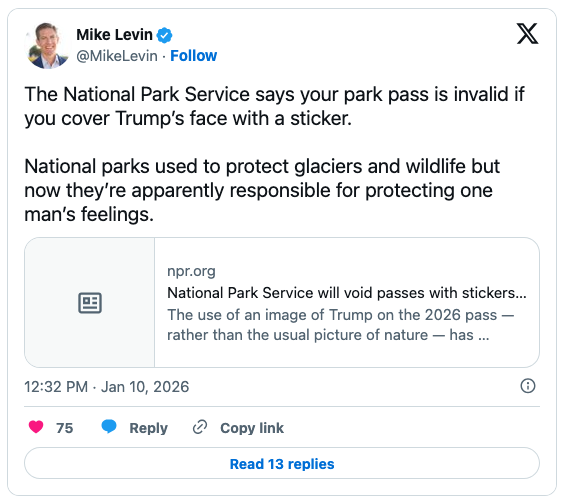
Trump’s image has appeared on the 2026 “America the Beautiful” National Parks pass.
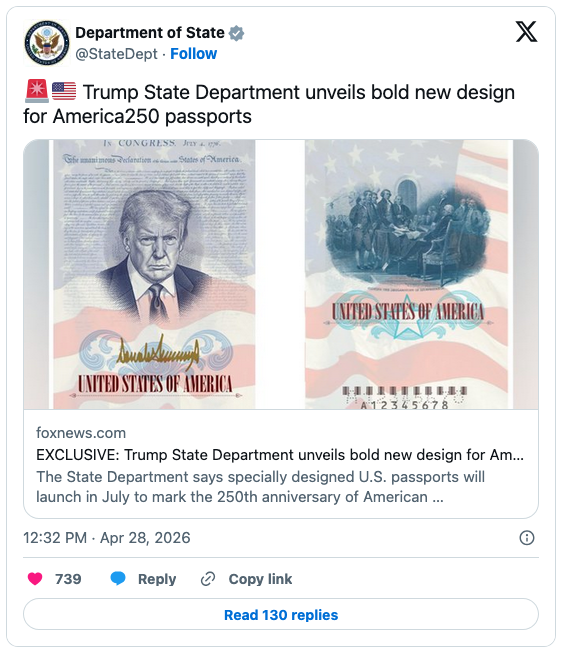
On April 28, the State Department unveiled a limited-edition passport design for the 250th anniversary that includes Trump’s portrait.
A Trump-aligned board at the Kennedy Center decided last December to add his name to the performing arts center, before a federal judge ruled that the move required congressional action, and the name was taken down.
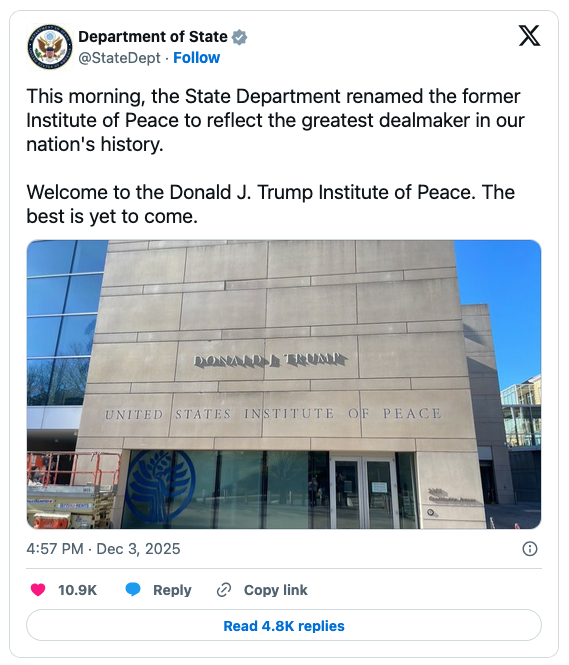
The State Department also renamed the U.S. Institute of Peace, a congressionally created peacebuilding organization, as the Donald J. Trump Institute of Peace, “to reflect the greatest dealmaker in our nation’s history.”
There have also been efforts to rename airports after him. A House Republican introduced legislation to rename Washington Dulles International Airport (IAD) as Donald J. Trump International Airport. In Florida, Governor Ron DeSantis signed legislation to rename Palm Beach International Airport after Trump, subject to required approvals.
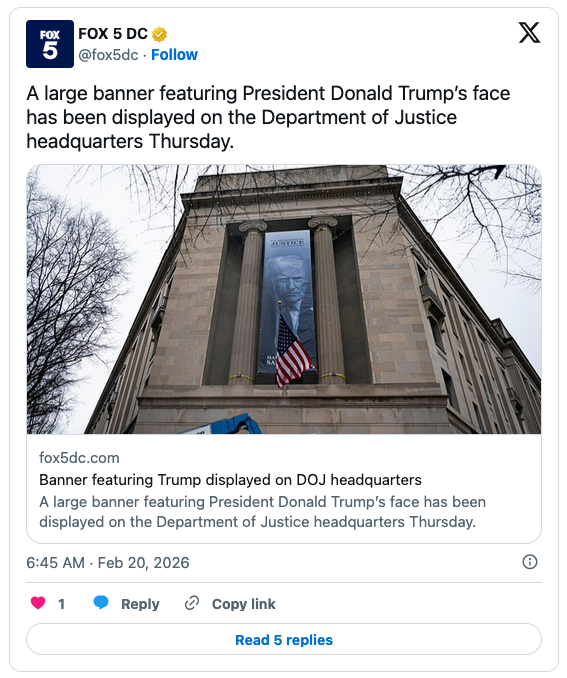
The pattern extends further. Trump’s face has also appeared on large banners at federal buildings, including the Justice, Labor, and Agriculture departments.
The administration has also put his name on federal initiatives such as TrumpRx.gov, “Trump Accounts,” and Trump Gold Card, turning government programs into a kind of official brand architecture that edges toward a cult of personality.