Trump Declares AI Holdouts “THE ENEMY” As Washington Targets Tech Critics
President Donald Trump has declared that anyone who refuses to use his preferred name for artificial intelligence is an enemy of the White House. The warning raises an obvious First Amendment question: Since when does a president get to decide which words Americans may use?
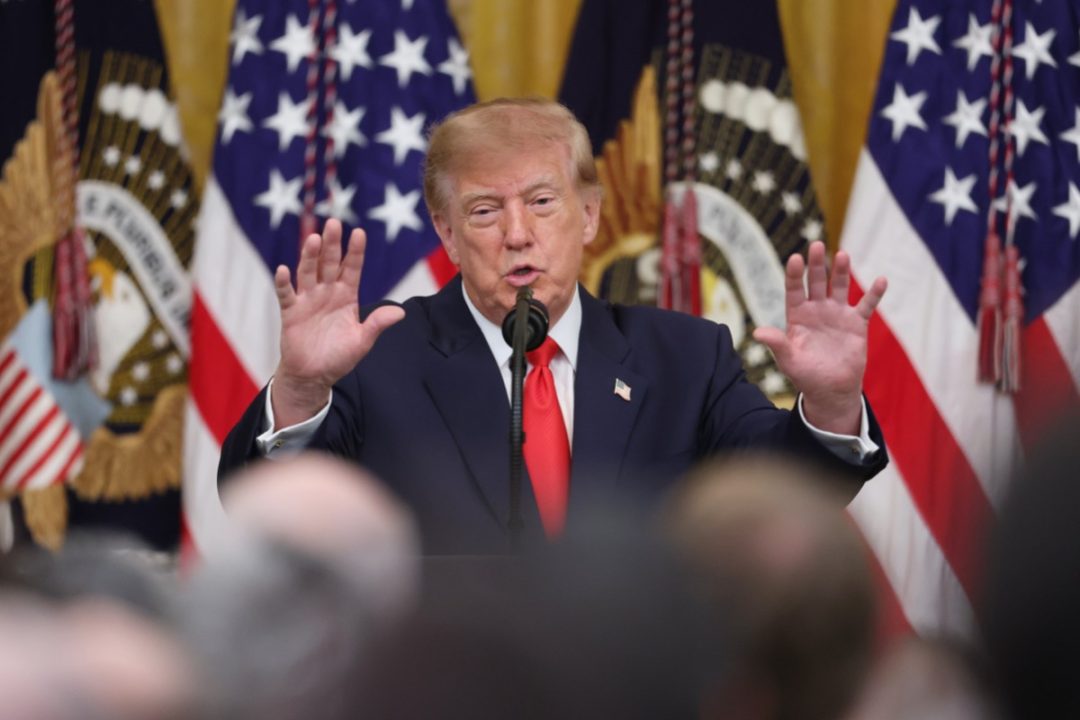
On Thursday, October 8, Trump posted on Truth Social:
The White House considers anyone that uses the term, “Artificial Intelligence,” as opposed to the highly accepted new and more accurate term, “Super Intelligence,” THE ENEMY!
Trump did not explain what being labeled an “enemy” would mean. Nor did he announce penalties for using the familiar term. Yet his declaration comes amid a broader federal campaign to promote AI, portray critics as serving foreign interests, and scrutinize some opposition to the technology as a potential national security threat.
The Executive Order: Renaming AI
Trump’s declaration follows his September 29 executive order, “Inaugurating the Era of Super Intelligence.” It directs federal agencies to replace “Artificial Intelligence” (AI) with “Super Intelligence” (SI) in official communications, websites, and policy documents.
The distinction is more than semantic. Artificial intelligence refers to a broad field of computing, while “super intelligence” generally describes a hypothetical system that surpasses human intelligence across virtually all cognitive tasks. Such systems have not been demonstrated. Trump’s order effectively rebrands existing AI technology with a term traditionally reserved for a far-more advanced capability, as we recently covered.
The order applies to federal agencies, not private citizens or businesses. On October 6, Reuters reported that the Department of Justice (DOJ) had instructed employees to adopt the new terminology, including in most legal proceedings.
The rebranding also reached the government’s AI.gov website. It began displaying “SI.gov,” even as its domain name retained the supposedly outdated “AI.”
Trump’s subsequent declaration went considerably further. He branded “anyone” who continued using the familiar term as “THE ENEMY.”
AI Critics or Chinese Agents?
Trump’s latest warning did not emerge in isolation. Weeks earlier, he had begun portraying calls for AI regulation and opposition to data center expansion as part of a conspiracy benefiting China.
On September 14, Trump posted:
There is a SICK conspiracy going on against AI and Data Centers, and the only one that is happy about it is China… Conspiracy Theorists, Treasonists, Traitors, and Leakers, BEWARE!
In another post that day, he attributed the backlash to America’s technological lead:
The only reason the AI/Data Center outburst is happening is because the United States is leading, by a lot, every other country.
These accusations were not merely presidential rhetoric. Similar allegations had already prompted demands for federal investigations.
On September 23, investigative journalist Ken Klippenstein documented how the administration and congressional Republicans were linking domestic opposition to AI infrastructure with suspected Chinese influence operations.
In June, Senate Intelligence Committee Chairman Tom Cotton (R-Ark.) urged the DOJ to investigate alleged foreign efforts to obstruct American data center construction.
Klippenstein quoted Cotton’s warning:
Alarming reports indicate that a network of foreign actors, led by the Chinese Communist Party (CCP), is attempting to manipulate U.S. policy and public opinion on data centers.
Cotton singled out organizations allegedly connected to Shanghai-based businessman Neville Roy Singham.
Other Republican lawmakers sought similar investigations. They warned that foreign adversaries could exploit domestic opposition to undermine American technological competitiveness.
Suspected Foreign Subversion
Foreign interference is a legitimate national security concern. But suspected foreign influence operations do not make ordinary Americans who oppose the same policies foreign agents.
On September 16, the DOJ issued a warning about federal registration requirements for individuals acting under foreign direction. It specifically mentioned public demonstrations and warned that violations could carry prison sentences of up to five years. Journalist Daniel Boguslaw examined the unusual announcement and its possible implications for political dissent.
The department affirmed First Amendment protections and made no specific accusations. Still, the warning came amid Washington’s growing suspicion of AI critics and broader concerns about the targeting of groups under Trump’s National Security Presidential Memorandum 7 (NSPM-7).
At the same time, public resistance to AI infrastructure is hardly marginal. An August Heatmap Pro poll found that 75 percent of registered voters opposed building a data center near their homes. The backlash crossed party lines, age groups, income levels, and the urban-rural divide.
Their concerns are concrete. They include rising electricity costs, heavy water and land consumption, environmental damage, and risks to surveillance and data privacy. For many communities, the issue is not technological progress itself, but who bears the costs and who reaps the benefits.
That makes the distinction between foreign interference and legitimate public opposition all the more consequential.
The Rise of “Anti-tech Extremism”
The foreign influence allegations fit into a broader pattern of federal scrutiny of technology critics.
In May, WIRED reported that federal agencies and regional intelligence centers had been assessing what they called “anti-technology extremism.”
The investigation examined more than 1,000 pages of documents from the Department of Homeland Security (DHS), FBI, and regional intelligence-sharing centers.
As we reported in June, the documents raised concerns about an increasingly broad definition of domestic security threats.
Some assessments addressed genuine threats of violence or sabotage. Others encompassed peaceful protests, critical commentary, and opposition to technology companies.
One intelligence report flagged a video criticizing the environmental impact of a data center in Georgia.
Another assessment identified activities such as photographing facilities and observing infrastructure as potential indicators of suspicious behavior.
The FBI told WIRED that it investigates criminal activity and national security threats, not merely unpopular opinions.
Nevertheless, the documents illustrate how government threat assessments can extend beyond violence into the monitoring of perfectly lawful political dissent.
The “Enemy” Question
Trump’s administration treats AI development as an economic and national security imperative. It wants faster innovation, more data centers, and fewer obstacles to American technological dominance.
But technological ambitions do not supersede constitutional rights.
Trump’s declaration that anyone using the term “artificial intelligence” is “THE ENEMY” carries no stated legal penalties, at least for now. Yet coupled with allegations of foreign influence and federal scrutiny of “anti-tech extremism,” it raises a troubling question: When does Washington begin treating legitimate dissent as a security threat, with grave legal consequences for those who dare to disagree?
Americans have every right to question AI’s impact on privacy, employment, energy costs, local communities, and the growing power of technology corporations.
The First Amendment does not require citizens to embrace the ambitions of the president and his technocratic circle, adopt their preferred vocabulary, or march toward their dystopian vision of the future.
When Washington begins treating peaceful opposition, or the refusal to use government-approved words, as a potential security threat, Americans have reason to ask: Who is really “THE ENEMY” here?