

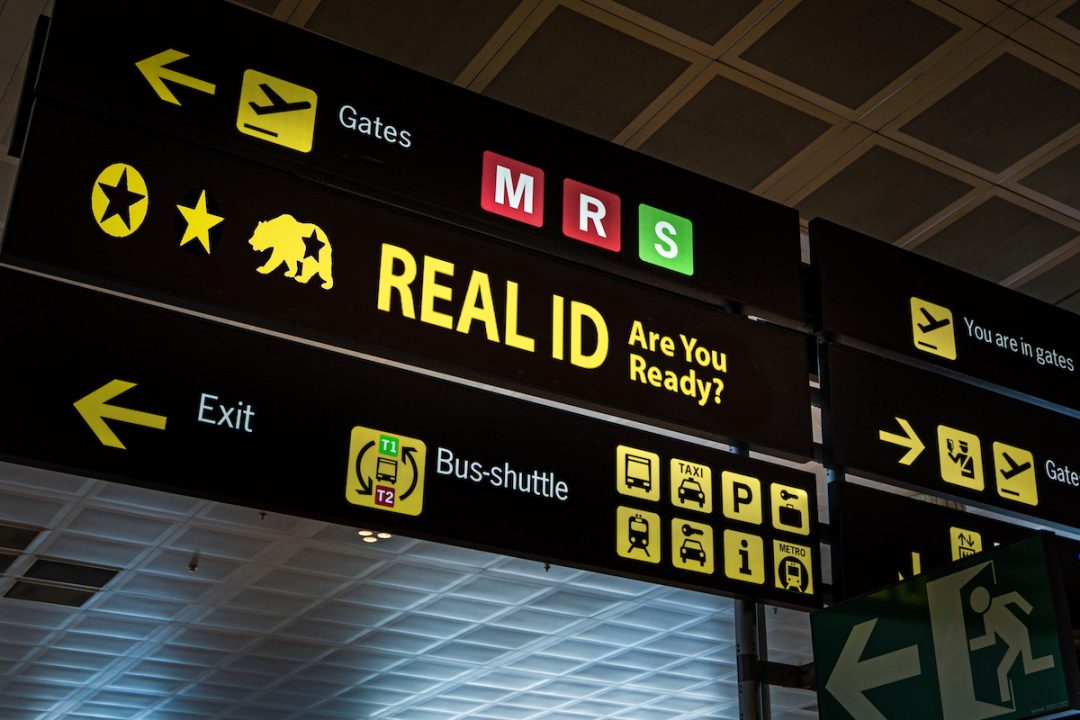
REAL ID Goes Live. Who’s Really Being Tracked?
Twenty years after Congress passed it, the REAL ID Act finally has teeth. The Transportation Security Administration (TSA) is now enforcing compliant identification at every domestic security checkpoint, and travelers without it face a $45 fee and mandatory biometric or biographic verification through a new system called TSA ConfirmID before they’re allowed to fly. TSA frames the rollout in security terms: Identity verification, the agency says, is what “keeps terrorists, criminals, and illegal aliens out of the skies.”
However, for years the agency operated by an entirely different standard for a specific class of traveler.
Double Standard
In January 2018, Judicial Watch reported that foreigners in the country illegally were being quietly flown to cities throughout the United States on commercial flights, escorted by government chaperones in plain clothes specifically to avoid drawing attention. That story built on an earlier 2014 Judicial Watch report describing how TSA at the El Paso airport was letting unaccompanied minors bypass standard security with nothing more than a slip of paper. By January 2022, Joe Biden’s administration had formally admitted that TSA had been accepting arrest warrants as a valid form of ID for illegal immigrants to board commercial aircraft, prompting Senator Josh Hawley (R-Mo.) to point out the obvious absurdity: An arrest warrant exists to catch someone, not clear them for a flight.
The agency now enforcing strict identification on ordinary American travelers spent the better part of two decades running a parallel, far laxer standard for people with no verified identity at all. If REAL ID enforcement is genuinely about closing security gaps, that double standard is the first place reform should have started. Reporting suggests the Department of Homeland Security is now, at least on paper, working to align TSA and Immigration and Customs Enforcement (ICE) more closely to stop that pass-through.
Doorway to the Surveillance State
Regardless, the stated rationale is a ruse. REAL ID is accompanied by a nationwide expansion of license-plate-reader cameras provided by Flock Safety, which operates more than 120,000 cameras under contract with roughly 7,000 law-enforcement agencies, producing more than 20 billion vehicle scans a month. Flock has already been caught sharing data with ICE through informal, one-off local arrangements (despite the company’s public claim that it has no direct federal contract), and reporting has documented officers misusing the network to track more than immigration cases. Several dozen communities have canceled their Flock contracts in the past year alone, and some residents have taken to physically dismantling the cameras themselves.
Put REAL ID and Flock side by side, and immigration enforcement starts to look less like the destination and more like the doorway. A national biometric ID standard at every airport, layered onto a nationwide vehicle-tracking camera grid, layered onto the data-center buildout now underway across the country, isn’t a system that only watches foreign nationals — it’s infrastructure that, once built, watches everyone equally, indefinitely, and without a warrant.
This article is part of The New American’s weekly online newsletter Insider Report, which is emailed to TNA subscribers each week. Click here to subscribe to The New American to receive the Insider Report and access exclusive content.