SCOTUS Backs Trump Order on Mail-in Ballots
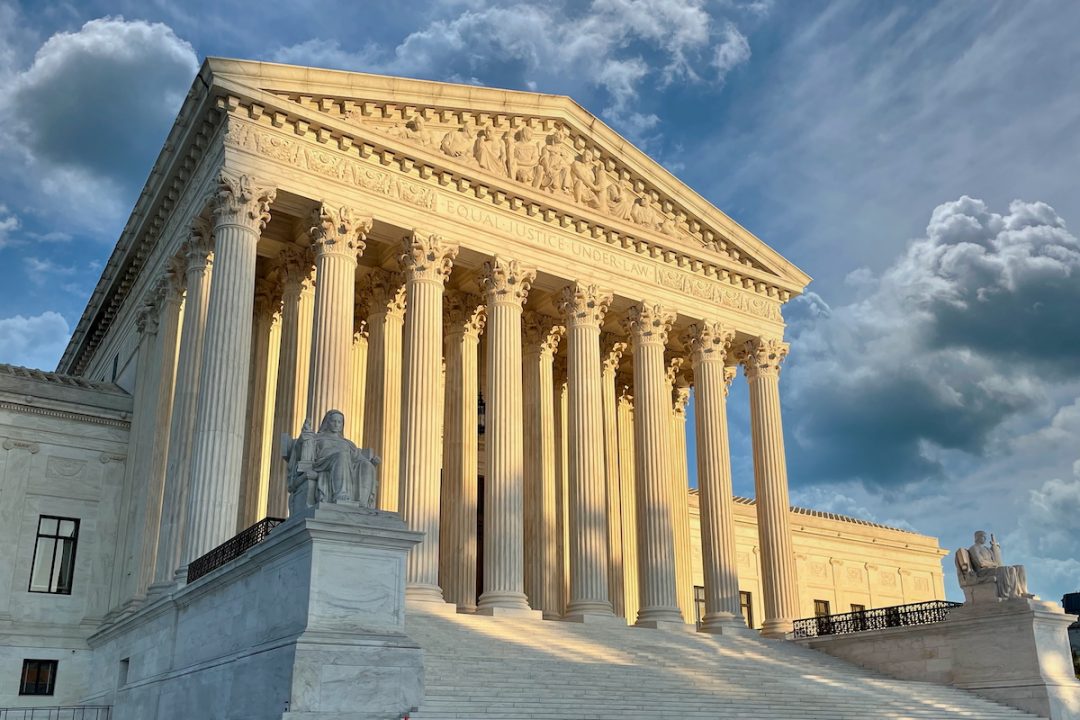
The U.S. Supreme Court has backed President Trump’s executive order to stop voter fraud, which commanded federal officials to compile lists of citizens eligible to vote in federal elections, then transmit those lists to the states to ensure that only citizens vote.
The per curiam 10-page order from the court reversed a lower court stay on the executive order, which also directed postal officials to help ensure the integrity of mail-in ballots.
The fight over Trump’s order, Ensuring Citizenship Verification and Integrity in Federal Elections, isn’t over. But it is a small victory for the administration and a defeat for pro-election-fraud leftists.
The Order
Trump’s order of March 31 followed another on March 25, Preserving and Protecting the Integrity of American Elections.
The first order commands the enforcement of federal election laws that define the date and time of elections, when ballots are to be counted, and notably, requires that only U.S. citizens be permitted to vote in federal elections.
Most notably, the order requires a paper record for votes and forbids voting by barcode only. It also withholds federal funding from states that refuse to comply with federal statutes that regulate voting. Proof of citizenship will be required to vote.
There followed the order of March 31.
It orders the Department of Homeland Security, through U.S. Citizenship and Immigration Services, to coordinate with the Social Security Administration to “compile and transmit to the chief election official of each State a list of individuals confirmed to be United States citizens who will be above the age of 18 at the time of an upcoming Federal election and who maintain a residence in the subject State (State Citizenship List).”
That list will come from federal records, and must be updated and sent to state election officials at their request or 60 days or more before the election.
As well, Trump ordered the attorney general to “prioritize the investigation and, as appropriate, the prosecution of State and local officials or any others involved in the administration of Federal elections who issue Federal ballots to individuals not eligible to vote in a Federal election.”
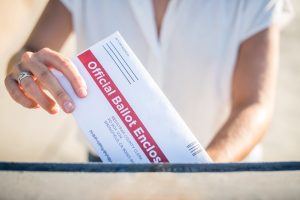
Importantly, however, the order requires the USPS to ensure that all mail-in ballots are “marked as Official Election Mail, including through designated markings provided by USPS for this purpose, such as the Official Election Mail logo.” As well, ballot envelopes must be “automation-compatible and bear a unique Intelligent Mail barcode.”
Plus, “no fewer than 90 days prior to a Federal election, any State may choose to notify the USPS if it intends to allow for mail-in or absentee ballots to be transmitted by the USPS,” the order says:
As part of that notification, any notifying State should further indicate whether it intends to submit to the USPS, no fewer than 60 days before the election, a list of voters eligible to vote in a Federal election in such State to whom the State intends to provide a mail-in or absentee ballot to be transmitted via the USPS.
Ballots from those not on that list will not be transmitted.
After the states provide the list to USPS, it will compile a list of such voters and return it to the states.
SCOTUS Decision
So of course, pro-election-fraud leftists sued, beginning the usual round of crackpot lawfare. A coalition of anti-American open-borders leftist agitators sued but lost in the U.S. District Court for Washington, D.C. But 23 states also sued, while Alabama and other states joined the Trump administration’s fight against them.
The blue states “challenged the government’s implementation of the order in a federal court in Massachusetts,” as the SCOTUS Blog explained:
They argued that the executive order conflicts with provisions in the Constitution that give states the power to determine voter eligibility and to set the “Times, Places, and Manner” of holding congressional elections.
U.S. District Judge Indira Talwani ruled that she could not review the challengers’ claims as they applied to federal elections scheduled after Nov. 3, 2026, because those claims were not yet “ripe” — that is, ready for review. However, she said, she could review the challengers’ claims with regard to the upcoming midterm elections because the order “created a ‘direct and immediate dilemma’” for them, and she prohibited the federal government from implementing the challenged restrictions on or before Nov. 3, 2026, in the District of Columbia and the 23 states.
The U.S. Court of Appeals for the 1st Circuit declined to pause Talwani’s order while the litigation continued. It stressed that neither the federal government nor 12 states, led by Alabama, that had joined the case on the Trump administration’s side had argued that the executive order was legal. That court also rejected the contention that the challengers did not have a right to sue or that the case was not yet ripe. The consequences of the executive order, the court of appeals countered, give states “no practical choice but to respond to the EO now.”
Judge Talwani is, not surprisingly, the daughter of at least one Indian immigrant.
SCOTUS overturned the Indian judge.
It noted that Trump’s order “is an internal directive from the President to his subordinates mandating that certain agencies pursue certain policies. It neither requires nor forbids anything of anyone outside the Executive Branch.”
“This internal directive does not regulate the States’ voter registration processes,” the court ruled:
Nor does it impinge on the States’ authority “‘to create and enforce a legal code’ for elections.”
The section that calls for prosecuting state officials is also unassailable, the court ruled:
This provision directs the Attorney General to “prioritize” the investigation and prosecution of those who violate existing federal laws by issuing ballots to ineligible voters.… Setting prosecutorial priorities lies within the President’s Article II power. And his decision to prioritize the prosecution of certain offenses does not inflict a traditionally recognized harm on the States.
SCOTUS also shot down the challenge to codicil with directions to the Postal Service.
“According to the States, this internal directive demands that they overhaul their existing election procedures,” the court wrote:
It does not. Section 3 orders the Postal Service to initiate the process of proposing a rule that might bind the States in the future. It is not a proposed rule, let alone a final rule. And it imposes no legal requirements on the States (or, for that matter, on anyone outside the Executive Branch).
The Court’s disposition of this application does not mean that any measure taken by the Government to implement the Order will necessarily be lawful. On that score, time will tell. But the Order itself does not harm the States, so the District Court lacked jurisdiction to bar the Government from trying to implement it. And for the reasons discussed, that injunction is likely to irreparably harm the Government if it remains in place while the appellate process runs its course.
Far-left activist Associate Justices Elena Kagan and Justice Sotomayor joined for a four-page dissent. The garrulous and equally far-left Justice Kentanji Jackson, whom President Joe Biden hinted was the greatest legal mind since Sir Edward Coke, blathered on for 23 pages in the apparent belief that a farago of words would make a difference.
During her confirmation hearing, Jackson famously testified that she doesn’t know what a woman is, which raised obvious concerns about her grasp of the law.