White House Gamifies Iran War With Viral Strike Videos
War has always been accompanied by propaganda. Governments frame conflict, control images, and shape public perception. But critics say the Trump administration has pushed this practice into new and unsettling territory.
In recent weeks, the White House has posted a series of videos that splice real military strikes in Iran with clips from Hollywood films, television shows, video games, sports broadcasts, and cartoons. Officials say the goal is to amplify the military campaign online and draw attention to the strikes through viral content, in an apparent attempt to build support for an unpopular and unconstitutional war.
The videos have drawn fierce criticism from journalists, filmmakers, athletes, politicians, and ordinary Americans. They argue that the White House is trivializing lethal force, diminishing the gravity of the office, and attempting to condition the public to cheer real-world strikes with the same dopamine-fueled excitement associated with playing a video game.
“Call of Duty”
The backlash began on March 4, when the White House posted a video that framed real U.S. strikes on Iran through the visual language of the popular first-person shooter video game Call of Duty. The clip was later deleted from official channels, though copies remain widely circulated online.
The video opened with animation taken from the game before cutting to real footage of missiles and other munitions striking targets in Iran.
Set to a hip hop track, the editing resembled gaming highlight reels. Explosions appeared in rapid succession. The pacing mirrored competitive gameplay clips designed to showcase high scoring moments. Editors even inserted the game’s familiar “+100” score notifications each time a bomb struck a target.
Much of the strike footage had appeared previously in administration posts. Similar clips circulated earlier on official military channels, including the U.S. Central Command X account. Those videos already used dramatic editing and cinematic visuals. The March 4 video added an explicit gaming frame.
Washington Post technology reporter Drew Harwell noted that the clip used the game’s “killstreak” animation. He then added that it bore a grave symbolism:
For those wondering, a “killstreak” is when you kill a certain number of people without dying and get a bonus. The one in the White House’s video is for a 30-kill streak: a tactical nuke that kills everyone, including the player.
The video drew sharp condemnation for “gamifying” the war. By that time, six U.S. service members had already been killed in the Iran conflict.
Connor Crehan, an Iraq War veteran, captured the sentiment bluntly:
War isn’t a video game. The consequences of war are final. I wish we didn’t treat it with such a cavalier approach.
“Justice the American Way”
The controversy did not end there. The White House doubled down.
The next day, it posted a 42-second clip celebrating U.S. strikes in Iran.
The clip mixed footage of missile attacks with scenes from action films such as Iron Man 2, Gladiator, Braveheart, and Star Wars, along with clips from the television series Breaking Bad and Better Call Saul.
At one point, the montage briefly shows Defense Secretary Pete Hegseth during a real briefing saying, “F- A-”. This cuts to a robot from Transformers rumbling, “Time to find out.”
The reference appears to echo a phrase Hegseth used in November when describing a wartime posture of his Department: “F-A-F-O,” shorthand for “F*** around and find out.”
The montage ended with a reference to the video game Mortal Kombat. A voice declared “Flawless Victory” as the White House logo flashed on the screen.
The video carried the caption: “JUSTICE THE AMERICAN WAY.”
Some supporters praised the post. “I love this,” reacted actor and producer Kevin Sorbo. “Give whoever did this a raise,” he suggested. “MAGA” influencer David J. Freeman, known on X as Gunther Eagleman, said the same.
“No Coming Back From This”
Many others reacted sharply. Jon Favreau, a former speechwriter for President Barack Obama — a president who bombed seven countries — condemned the video sharply. Despite that record, Favreau still made a point that resonated with many critics of the White House’s messaging:
Hundreds of people are dead. Little girls are dead. Six Americans are dead. Others are risking their lives. Millions across the Middle East are terrified. It’s not a video game. It’s not a meme. It’s not another chance to troll the libs. It’s f***g war.
Senator Tammy Duckworth (D-Ill.), an Army National Guard veteran, echoed the sentiment.
Antiwar.com journalist Dave DeCamp posted, “There’s no coming back from this.”
Journalist Nick Bryant asked whether any “grown up” remained in the White House. “Is there any understanding of the seriousness and horror of war?” he added.
Filmmaker Ben Stiller also objected after discovering that a clip from his 2008 film Tropic Thunder had been used in the video. He asked,
Hey White House, please remove the Tropic Thunder clip. We never gave you permission and have no interest in being a part of your propaganda machine. War is not a movie.
Economist Tuomas Malinen and a former Trump supporter opined that the clip “even beats all the ridiculous rubbish Soviet Union put out.”
Online commenters raised additional concerns. Some accused the administration of trying to distract from the Epstein scandal. Others pointed to Israel’s role in drawing the United States into the conflict. Others referenced America’s apparent responsibility for bombing a girls’ school in Minab on the first day of the war, stressing the “dystopian” gap between the action-movie mashup and deadly reality on ground.
Gaming the War
The backlash did not slow the White House. The administration continued posting similar videos.
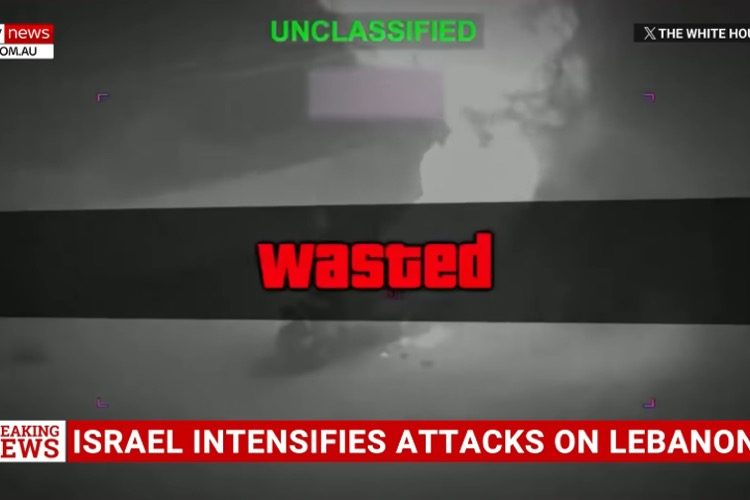
Last Friday, the White House released a clip built around imagery from the video game series Grand Theft Auto. The series centers on criminal characters navigating a violent world of gang warfare and shootouts.
The video combined real footage of U.S. strikes in Iran with a famous line from the game. It opened with a character saying, “Ah s***, here we go again,” a phrase widely used online as a meme. The editing again framed real explosions through gaming references.
In another post, the White House used clips from Nintendo’s Wii Sports. Animated characters appeared playing tennis, golf, and archery. Each time a target was hit, the video cut to footage of Iranian targets being bombed, accompanied by exclamations such as “Hole in one!” and “Out of the park!”
Another animated clip began with ESPN footage of U.S. bowling star Pete Weber hitting a strike. The scene then shifted to an animation showing bowling pins labeled “Iranian regime officials,” one holding a sign reading “We won’t stop making nuclear weapons.” A bowling ball painted with the American flag slammed into the pins and destroyed them.
One of the earliest examples of the administration’s “gamified” war messaging featured NFL footage spliced with videos of strikes on Iran and set to AC/DC’s “Thunderstruck.”
Several former and current NFL players strongly criticized the video. Among them was former University of Nebraska receiver Kenny Bell. Speaking to The Washington Post, Bell said,
For that play to be associated with bombing human beings makes me sick…. I don’t want anything to do with images like that.
The newspaper noted that the montage used footage of NFL hits by players such as Ray Lewis, Ed Reed, and Kam Chancellor. Both Reed and Lewis publicly disapproved. Reed wrote on X, “I do not approve this message.”
Viral Slop as “Communication Strategy”
The administration shows no sign of retreating from this messaging strategy despite growing criticism.
When contacted by reporters, White House spokesperson Anna Kelly defended the posts.
“Under the decisive leadership of President Trump, America’s heroic warfighters are meeting or surpassing all of their goals under Operation Epic Fury,” Kelly said. She dismissed the backlash as media criticism of the “incredible [military] success.”
According to reporting cited by several outlets, the administration sees the videos as part of a deliberate digital-communication strategy. The administration has increasingly used social media to tie presidential policy goals to trending memes and viral online formats. White House press secretary Karoline Leavitt praised the approach:
This is another example of our non-traditional and traditional media strategy, which has proven highly successful…. Over the past few days, the White House videos have generated more than 2 billion impressions. People are talking about the tremendous success of the war and the U.S. Military’s obliteration of Iranian terrorists — and that’s exactly the point.
A former White House official told NBC News that the accounts have been given “creative authority to attract new attention and make political figures uncomfortable.”
Critics, however, argue the result resembles what internet culture increasingly calls “slop”: highly shareable content engineered for engagement rather than substance, now applied to the messaging of war.
As effective as it may be in terms of digital reach, a strategy that turns war into shareable content carries a deeper cost. As Karen Crompton opined in The Deseret News, “When the line between entertainment and slaughter is permanently erased, we aren’t just losing our sense of decorum. We are losing our humanity.”