

GOPers on Armed Services Vote to Entwine U.S.-Israel Militaries, Put U.S. Secrets in Danger
Israel-first Republicans on the House Armed Services Committee have voted to integrate the U.S. and Israeli militaries, a move that will enable the Israelis to steal American military secrets and sell them to China, Russia, and other hostile nations.
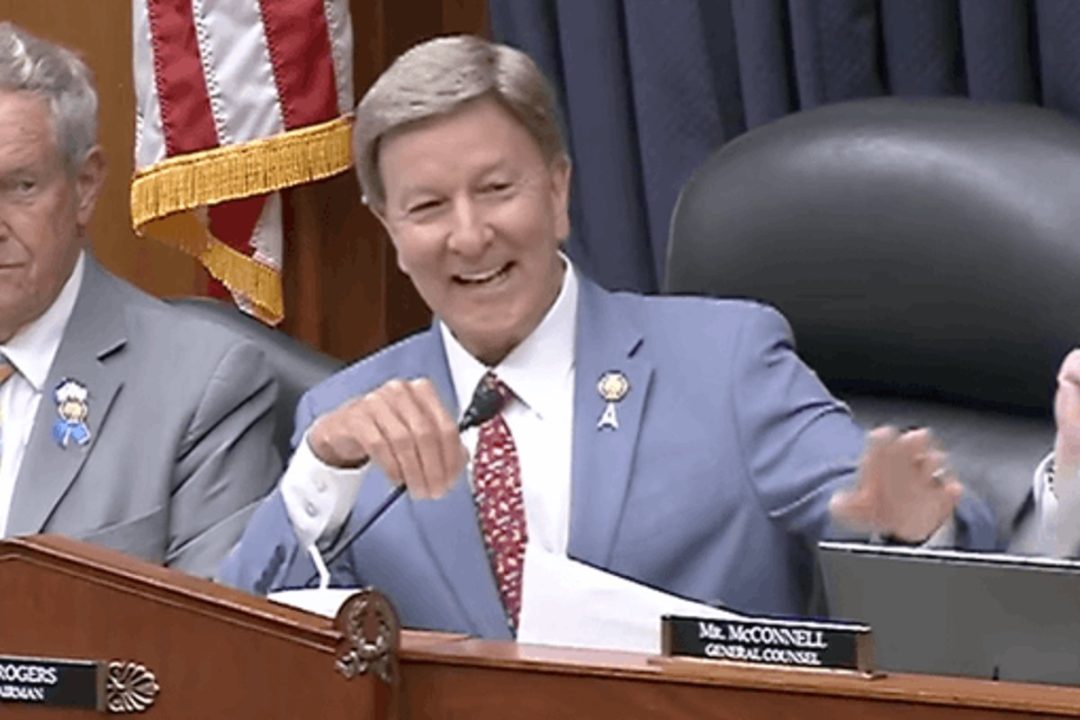
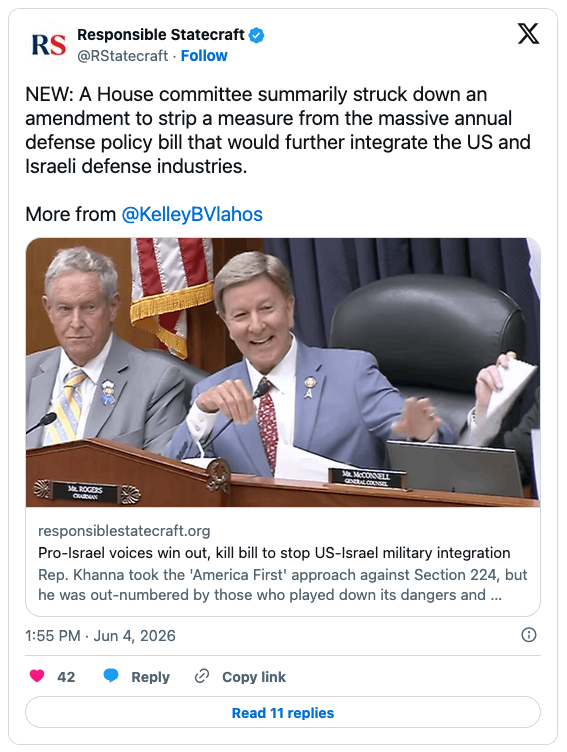
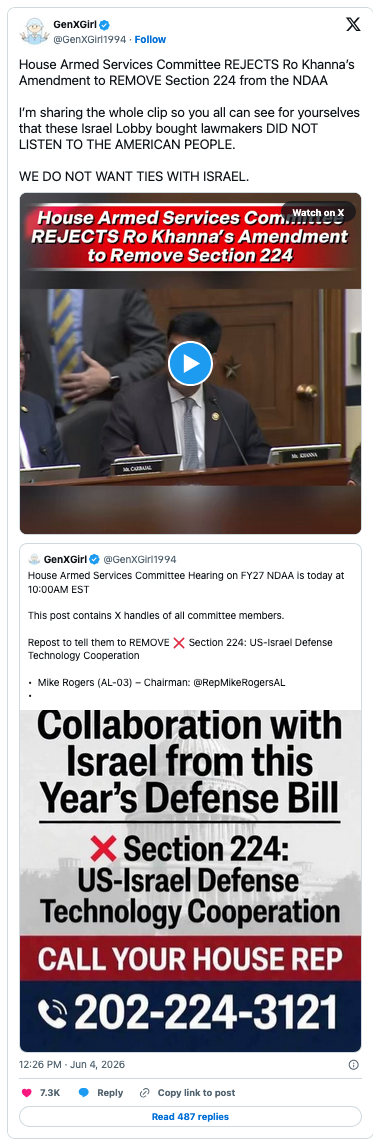
In approving the 2027 National Defense Authorization Act, committee Republicans shot down an amendment from Democratic Representative Ro Khanna of California that would have stripped Section 224, which will give Israel access to secret U.S. military, intelligence, and technology information.
Now that the bill has passed committee, however, outgoing GOP Representative Thomas Massie — the America-first Kentuckian whom President Donald Trump stabbed in the back — will offer an amendment on the floor of the House to strip the dangerous measure.
Section 224
As The New American reported yesterday, the measure will “expand and accelerate bilateral defense technology research, development, testing, evaluation, integration, and industrial cooperation” by a number of means, including:
• identifying jointly developed or Israeli-origin technologies with operational utility for potential integration into United States systems and programs … ;
• ensuring collaborative research initiatives involving government, private sector, and academic institutions in the United States and Israel, … in a manner that protects sensitive technology and information and the national security interests of the United States and Israel; …
• establishing frameworks for joint ventures, licensing agreements, and United States-based co-production or manufacturing partnerships with Israeli industry. …
The two militaries will cooperate on “missile and air defense technologies” as well as cyber-defense, electronic warfare, and artificial intelligence.
The measure “lays the groundwork for bilateral research and development, co-production of weapons, joint ventures, licensing agreements, and seemingly every manner of U.S.-Israeli military-industrial complex cooperation,” Ben Freeman explained for Responsible Statecraft:
The U.S. and Israel already work together heavily on missile defense, but this provision would greatly expand coordination to seemingly every area of defense tech, including AI, quantum, autonomous systems, directed energy, cyber, biotech, and many more. It also proposes “network integration” and “data fusion.” In other words, the U.S. military’s data could soon be the Israeli military’s data.
Beyond that, he continued, it would give the Israel Lobby even more power than it has now. That power already includes marshaling the tens of millions of dollars that bought Massie’s seat in the House for a largely unknown Israel-firster.
Section 224 will “give the Israeli government the opportunity to greatly expand one of the most powerful levers of influence in U.S. politics: jobs in the U.S,” Freeman continued:
By expanding or starting new co-production facilities like it already has in Mississippi and Arkansas, the Israeli government could boast of providing jobs on U.S. soil, thereby securing allies among members of Congress who represent the districts where those jobs lie.
The result could well be a U.S. political system even more susceptible to the whims of an Israeli government that seemingly has no qualms about drawing the U.S. into military conflicts in the Middle East.
“We are creating access and control mechanisms for a nation that has drastically different goals than America does,” former U.S. counterterrorism director Joe Kent wrote for Responsible Statecraft:
We should instead keep the development of key technologies restricted to Americans only. The dangers of allowing any other nation to access our sensitive military technologies are obvious, including the fact that back doors and spyware can be installed that will most certainly be used by the Israelis to influence U.S. policy.
Kent also agreed with Freeman. Giving Israel the power to create jobs in America, he wrote, will further empower the Israel Lobby.
But those aren’t the only dangers of Section 224. Another, apropos of American traitor and Israeli spy Jonathan Pollard, the Navy intelligence analyst convicted of passing secrets to Israel, is that Israel might pass American military, intelligence, and technology secrets to foreign powers. Israel is believed to have given Pollard’s cache of stolen secrets to the Soviet Union. Some of those secrets might have revealed the identity of American spies who were later murdered.
America-first Democrat Khanna?
Thus did Massie and Khanna oppose it. The latter cited President Trump’s America First platform as his reason for opposing the merger, which Israeli Prime Minister Benjamin Netanyahu heartily endorsed.
Khanna furiously opposed the measure before yesterday’s vote.
“The American people are tired of the arrogance and insolence of Prime Minister Netanyahu telling America what we should do,” he began, noting that Israel’s gross domestic product is smaller than that of a “single town in my district. Yet somehow Netanyahu thinks he can tell the American people what we should do?” The person most upset with Netanyahu now, Khanna continued, is Trump, who called Netanyahu “f**king crazy” for Israel’s continuing campaign in Lebanon.
Party affiliation regardless, Americans want Congress “to tell Netanyahu that America calls the shots, not the prime minister of any other country,” Khanna fumed:
They want less cooperation and blank checks to Israel, not more. Only the United States Congress would dream up at this moment, let’s actually do more Israel, not less. …
Now let me just be clear. Mr. Netanyahu actually wrote to a member of Congress to put this Section 224 into the bill. He says I know that aid is unpopular in America. I know that even Republicans don’t want aid. So here’s what you got to do: “Let’s create a new framework,” — this is Netanyahu, telling us what we should do — “a new framework of joint defense cooperation, co-development, co-production, and mutual investment in areas including advanced missile defense, artificial intelligence, cybersecurity, and next-generation military platforms.” Why? Because he doesn’t want Congress to vote on the aid. He just wants it fused in the bill. Last I checked, Netanyahu doesn’t have a seat on this committee. … We need to reject an amendment which [contains language] coming directly from the Israeli Prime Minister. And we ought to have any aid have a vote of the American people. I am for Team America. I am for the interests of this country. And I believe that when Donald Trump ran, he ran on America First. That includes American interests against any foreign country. We should have American sovereignty and make it clear that we strike 224. If we want to give aid to Israel and want to sell them weapons, that should be a vote for the entire Congress.
On May 30, Massie explained on X that the committee vote on Section 224 would not be the last word.
“If the provision in the NDAA to integrate/synchronize the U.S. and Israeli militaries (section 224) makes it out of committee, I’ll offer an amendment to strip it from the bill on the floor,” he wrote on X. “We are a sovereign country.”
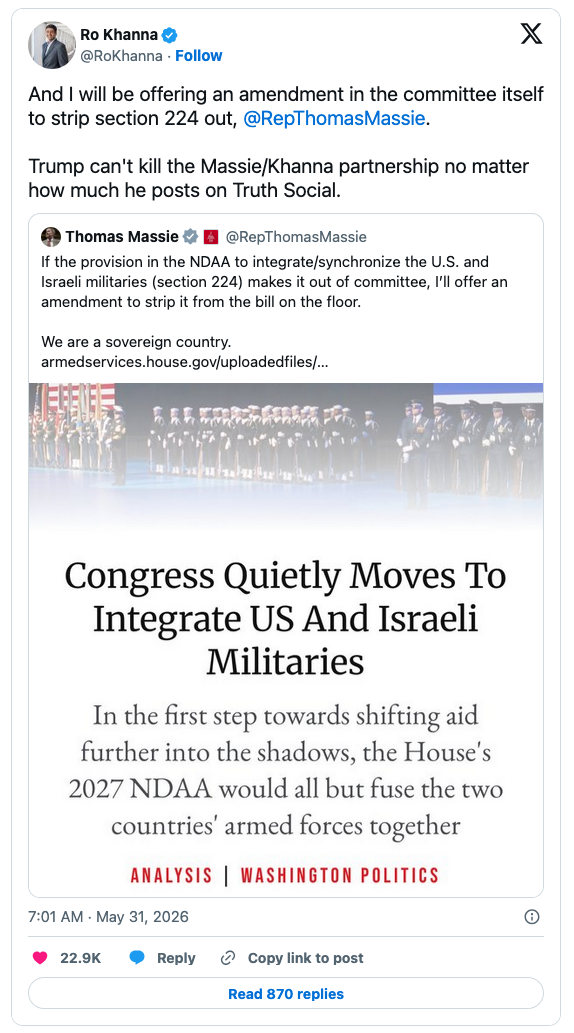
After that post, Khanna replied that he would offer the amendment to kill the measure.
“Trump can’t kill the Massie/Khanna partnership no matter how much he posts on Truth Social,” Khanna wrote.
The Israel-first Republicans who killed Khanna’s amendment claimed that the bill merely codified “existing initiatives.”
“Section 224 actually improves oversight and accountability of these programs by designating a single official responsible for them,” said GOP committee chief Mike Rogers of Alabama.
If true, Rogers must explain which official will keep an eye on Israel to ensure it doesn’t retail American secrets to other countries.